QUESTION IMAGE
Question
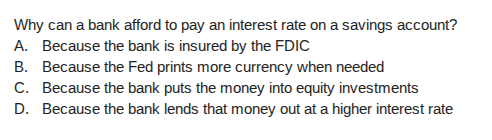
why can a bank afford to pay an interest rate on a savings account? a. because the bank is insured by the fdic b. because the fed prints more currency when needed c. because the bank puts the money into equity investments d. because the bank lends that money out at a higher interest rate
, which pay a low interest rate) and lending that same money to borrowers at a higher interest rate. The difference between the rate paid to depositors and the rate charged to borrowers (net interest margin) allows banks to cover costs and profit, enabling them to pay interest on savings accounts. The FDIC only insures deposits, not fund interest payments; the Fed's currency printing is unrelated to savings account interest; and equity investments are not the primary way banks fund savings account interest.

Snap & solve any problem in the app
Get step-by-step solutions on Sovi AI
Photo-based solutions with guided steps
Explore more problems and detailed explanations
, which pay a low interest rate) and lending that same money to borrowers at a higher interest rate. The difference between the rate paid to depositors and the rate charged to borrowers (net interest margin) allows banks to cover costs and profit, enabling them to pay interest on savings accounts. The FDIC only insures deposits, not fund interest payments; the Fed's currency printing is unrelated to savings account interest; and equity investments are not the primary way banks fund savings account interest.