QUESTION IMAGE
Question
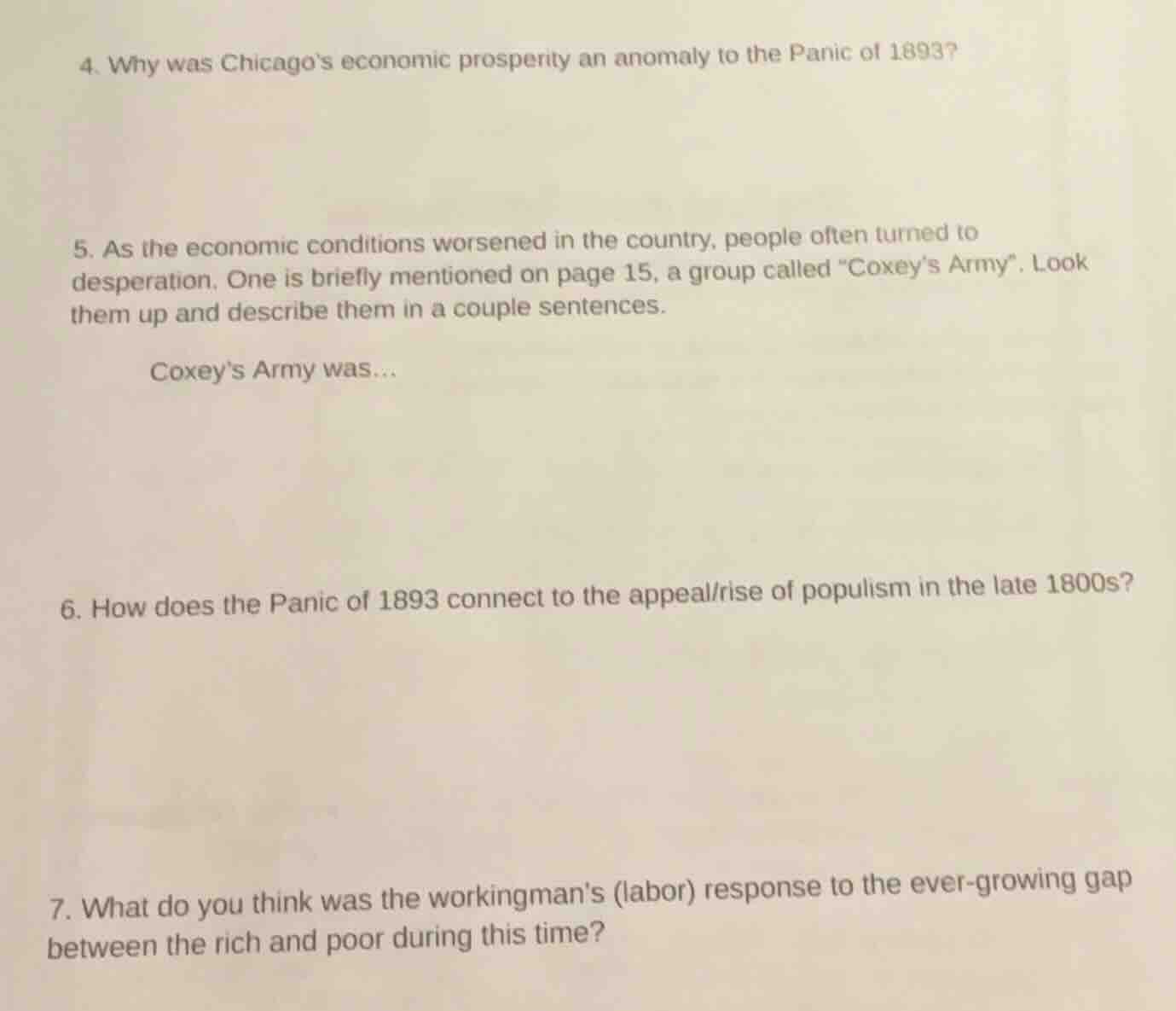
- why was chicago’s economic prosperity an anomaly to the panic of 1893?
- as the economic conditions worsened in the country, people often turned to desperation. one is briefly mentioned on page 15, a group called \coxey’s army\. look them up and describe them in a couple sentences.
coxey’s army was…
- how does the panic of 1893 connect to the appeal/rise of populism in the late 1800s?
- what do you think was the workingmans (labor) response to the ever - growing gap between the rich and poor during this time?
Question 4
The Panic of 1893 caused a severe economic depression with widespread business failures, unemployment, and financial collapse across the US. Chicago, however, was an anomaly because it was undergoing rapid industrialization, had major transportation hubs (like railroads and the Great Lakes), was a center for meatpacking, manufacturing, and had ongoing construction (e.g., for the 1893 World's Columbian Exposition), which sustained economic activity and growth while most of the country struggled.
Coxey’s Army was a protest group led by Jacob Coxey in 1894, during the economic depression following the Panic of 1893. Composed of unemployed workers, they marched to Washington, D.C., to demand government-funded public works programs to create jobs and stimulate the economy, becoming a notable example of labor unrest and calls for economic reform during the crisis.
The Panic of 1893 deepened economic inequality and hardship, especially for farmers and laborers. Populism (the Populist Party) appealed to these groups by advocating for economic reforms like free silver (to inflate currency, helping debtors), government regulation of railroads, and direct democracy. The crisis made populist ideas about addressing corporate power, economic exploitation, and supporting the “common people” more attractive, fueling the movement’s rise.

Snap & solve any problem in the app
Get step-by-step solutions on Sovi AI
Photo-based solutions with guided steps
Explore more problems and detailed explanations
Chicago’s economic prosperity was an anomaly during the Panic of 1893 because, while most of the U.S. faced severe depression with business failures and unemployment, Chicago benefited from ongoing industrial growth (e.g., meatpacking, manufacturing), its role as a transportation hub (rail, Great Lakes), and projects like the 1893 World’s Columbian Exposition, which sustained economic activity.