QUESTION IMAGE
Question
why it pays to save early and often
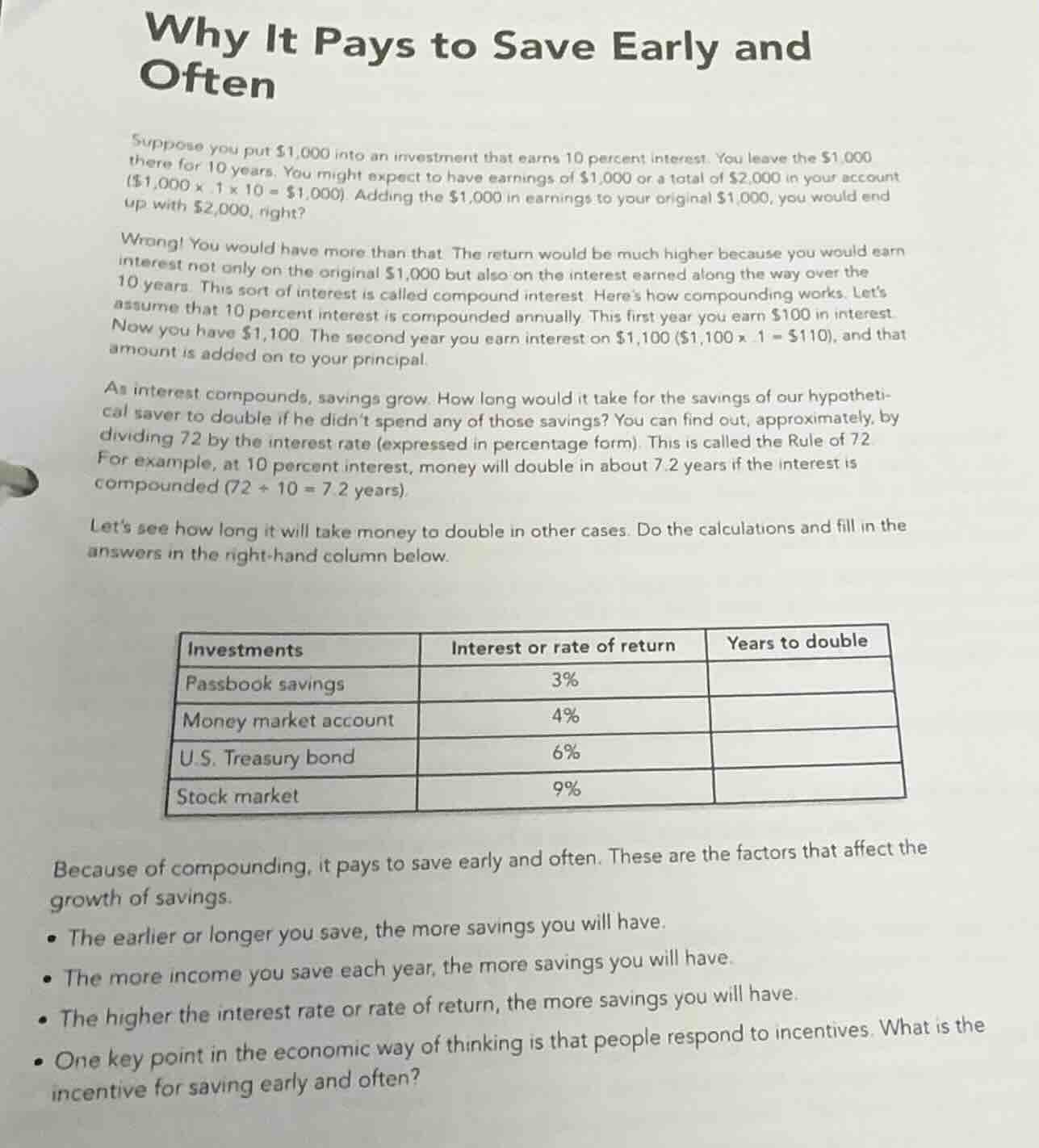
suppose you put $1,000 into an investment that earns 10 percent interest. you leave the $1,000 there for 10 years. you might expect to have earnings of $1,000 or a total of $2,000 in your account ($1,000 ×.1 × 10 = $1,000). adding the $1,000 in earnings to your original $1,000, you would end up with $2,000, right?
wrong! you would have more than that. the return would be much higher because you would earn interest not only on the original $1,000 but also on the interest earned along the way over the 10 years. this sort of interest is called compound interest. here’s how compounding works. let’s assume that 10 percent interest is compounded annually. this first year you earn $100 in interest. now you have $1,100. the second year you earn interest on $1,100 ($1,100 ×.1 = $110), and that amount is added on to your principal.
as interest compounds, savings grow. how long would it take for the savings of our hypothetical saver to double if he didn’t spend any of those savings? you can find out, approximately, by dividing 72 by the interest rate (expressed in percentage form). this is called the rule of 72. for example, at 10 percent interest, money will double in about 7.2 years if the interest is compounded (72 ÷ 10 = 7.2 years).
let’s see how long it will take money to double in other cases. do the calculations and fill in the answers in the right - hand column below.
| investments | interest or rate of return | years to double |
|---|---|---|
| money market account | 4% | |
| u.s. treasury bond | 6% | |
| stock market | 9% |
because of compounding, it pays to save early and often. these are the factors that affect the growth of savings.
- the earlier or longer you save, the more savings you will have.
- the more income you save each year, the more savings you will have.
- the higher the interest rate or rate of return, the more savings you will have.
- one key point in the economic way of thinking is that people respond to incentives. what is the incentive for saving early and often?
For the "Years to double" calculations (using the Rule of 72):
Passbook savings (3% interest rate):
Step1: Apply Rule of 72
Use the formula $\text{Years to double} = \frac{72}{\text{Interest Rate (in \%)}}$. For 3% interest, substitute the rate.
$\text{Years to double} = \frac{72}{3}$
Step2: Calculate the result
$\frac{72}{3} = 24$
Step1: Apply Rule of 72
Use the formula $\text{Years to double} = \frac{72}{\text{Interest Rate (in \%)}}$. For 4% interest, substitute the rate.
$\text{Years to double} = \frac{72}{4}$
Step2: Calculate the result
$\frac{72}{4} = 18$
Step1: Apply Rule of 72
Use the formula $\text{Years to double} = \frac{72}{\text{Interest Rate (in \%)}}$. For 6% interest, substitute the rate.
$\text{Years to double} = \frac{72}{6}$
Step2: Calculate the result
$\frac{72}{6} = 12$

Snap & solve any problem in the app
Get step-by-step solutions on Sovi AI
Photo-based solutions with guided steps
Explore more problems and detailed explanations
24 years