QUESTION IMAGE
Question
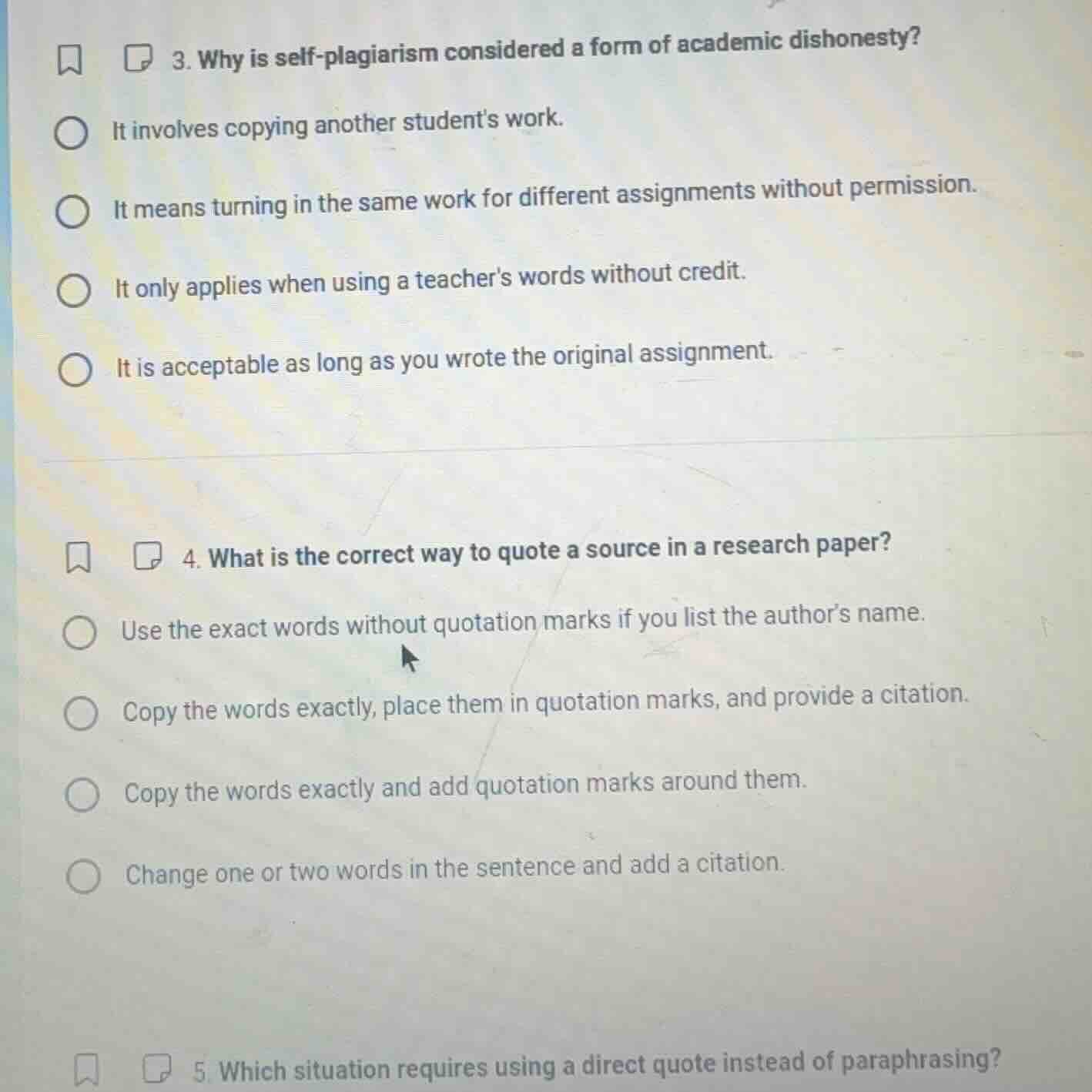
- why is self - plagiarism considered a form of academic dishonesty?
it involves copying another student’s work.
it means turning in the same work for different assignments without permission.
it only applies when using a teacher’s words without credit.
it is acceptable as long as you wrote the original assignment.
- what is the correct way to quote a source in a research paper?
use the exact words without quotation marks if you list the author’s name.
copy the words exactly, place them in quotation marks, and provide a citation.
copy the words exactly and add quotation marks around them.
change one or two words in the sentence and add a citation.
- which situation requires using a direct quote instead of paraphrasing?
Question 3
- Option 1: Copying another student’s work is regular plagiarism, not self - plagiarism.
- Option 2: Self - plagiarism is re - using one's own work for different assignments without proper permission (like from instructors), as it misrepresents the work as new for each assignment.
- Option 3: Using a teacher’s words without credit is plagiarism of the teacher’s work, not self - plagiarism.
- Option 4: Self - plagiarism is not acceptable just because you wrote the original work; you need permission to reuse it for different assignments.
- Option 1: Even if you list the author’s name, exact words need quotation marks to indicate direct quotation.
- Option 2: To correctly quote a source, you must use the exact words, put them in quotation marks, and provide a citation (to give credit to the original author and show the source).
- Option 3: Just adding quotation marks is not enough; a citation is also required to show where the quote came from.
- Option 4: Changing one or two words and adding a citation is paraphrasing (with citation), not direct quoting.

Snap & solve any problem in the app
Get step-by-step solutions on Sovi AI
Photo-based solutions with guided steps
Explore more problems and detailed explanations
B. It means turning in the same work for different assignments without permission.