QUESTION IMAGE
Question
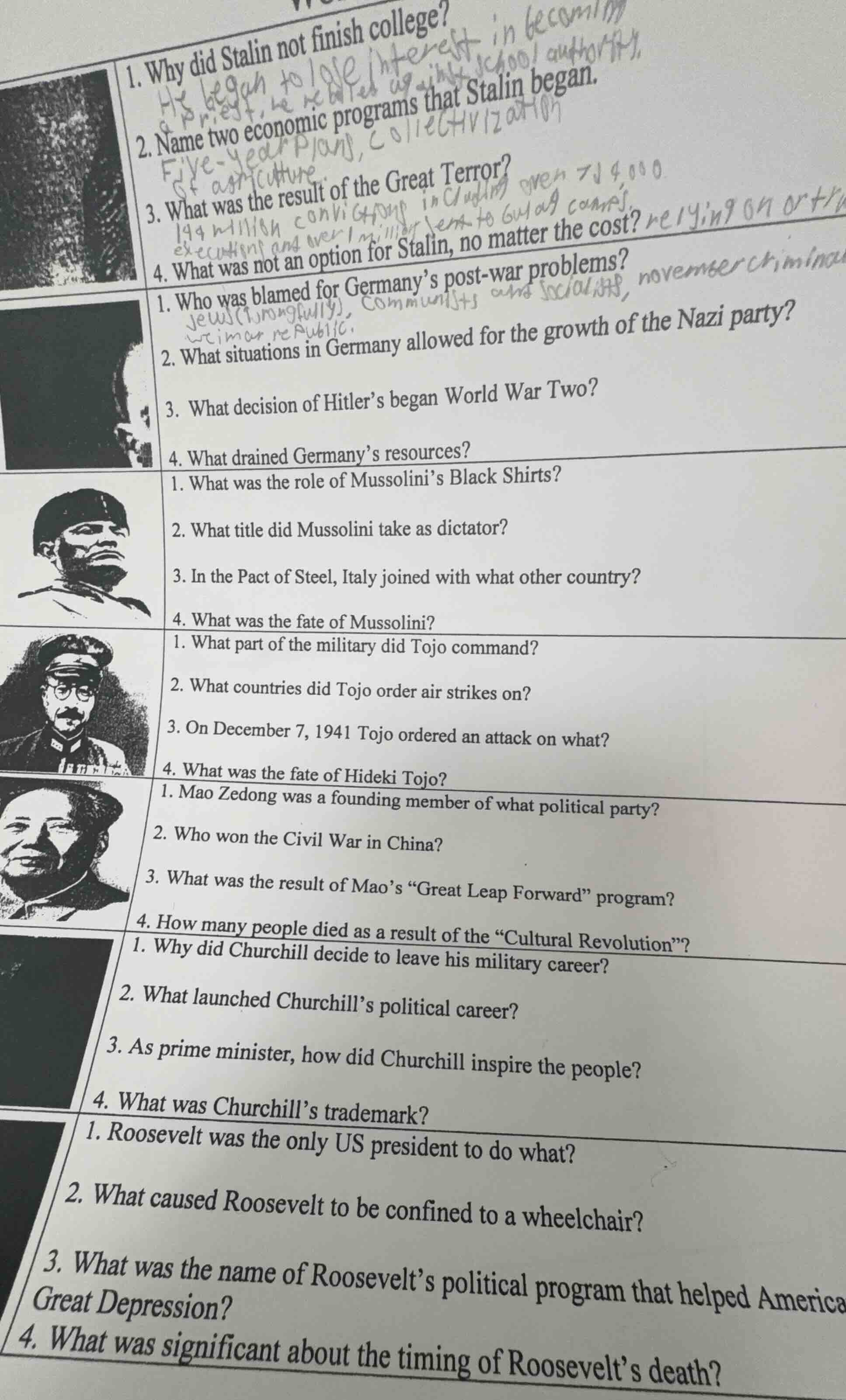
- why did stalin not finish college?
- name two economic programs that stalin began.
- what was the result of the great terror?
- what was not an option for stalin, no matter the cost?
- who was blamed for germany’s post - war problems?
- what situations in germany allowed for the growth of the nazi party?
- what decision of hitler’s began world war two?
- what drained germany’s resources?
- what was the role of mussolini’s black shirts?
- what title did mussolini take as dictator?
- in the pact of steel, italy joined with what other country?
- what was the fate of mussolini?
- what part of the military did tojo command?
- what countries did tojo order air strikes on?
- on december 7, 1941 tojo ordered an attack on what?
- what was the fate of hideki tojo?
- mao zedong was a founding member of what political party?
- who won the civil war in china?
- what was the result of mao’s “great leap forward” program?
- how many people died as a result of the “cultural revolution”?
- why did churchill decide to leave his military career?
- what launched churchill’s political career?
- as prime minister, how did churchill inspire the people?
- what was churchill’s trademark?
- roosevelt was the only us president to do what?
- what caused roosevelt to be confined to a wheelchair?
- what was the name of roosevelt’s political program that helped america great depression?
- what was significant about the timing of roosevelt’s death?

Snap & solve any problem in the app
Get step-by-step solutions on Sovi AI
Photo-based solutions with guided steps
Explore more problems and detailed explanations
- He was expelled for missing exams or failing to pay tuition (often attributed to his revolutionary activities).
- Five-Year Plans and Collectivization.
- Widespread purges, executions (approx. 700,000 to 1.2 million), and imprisonment in Gulag labor camps.
- Failure or surrender.
- Jews, Communists, and the "November Criminals" (leaders of the Weimar Republic).
- Economic instability (Great Depression), high unemployment, and resentment over the Treaty of Versailles.
- The invasion of Poland on September 1, 1939.
- The costs of World War II and the Allied strategic bombing campaign.
- To use violence and intimidation against political opponents (primarily socialists and communists).
- Il Duce.
- Germany.
- He was captured and executed by Italian partisans in April 1945.
- The Imperial Japanese Army.
- The United States, China, and various Southeast Asian nations/territories.
- Pearl Harbor.
- He was executed by hanging for war crimes in 1948.
- The Chinese Communist Party (CCP).
- The Chinese Communist Party (Mao Zedong).
- Widespread famine resulting in tens of millions of deaths and economic collapse.
- Estimates vary widely, typically ranging from hundreds of thousands to several million.
- To pursue a career in politics.
- His election to Parliament as the MP for Oldham in 1900.
- Through his powerful oratory and radio broadcasts.
- His "V for Victory" hand gesture and his cigar.
- Serve more than two terms (he was elected to four).
- Polio (paralytic illness).
- The New Deal.
- He died just weeks before the end of WWII in Europe (V-E Day).