QUESTION IMAGE
Question
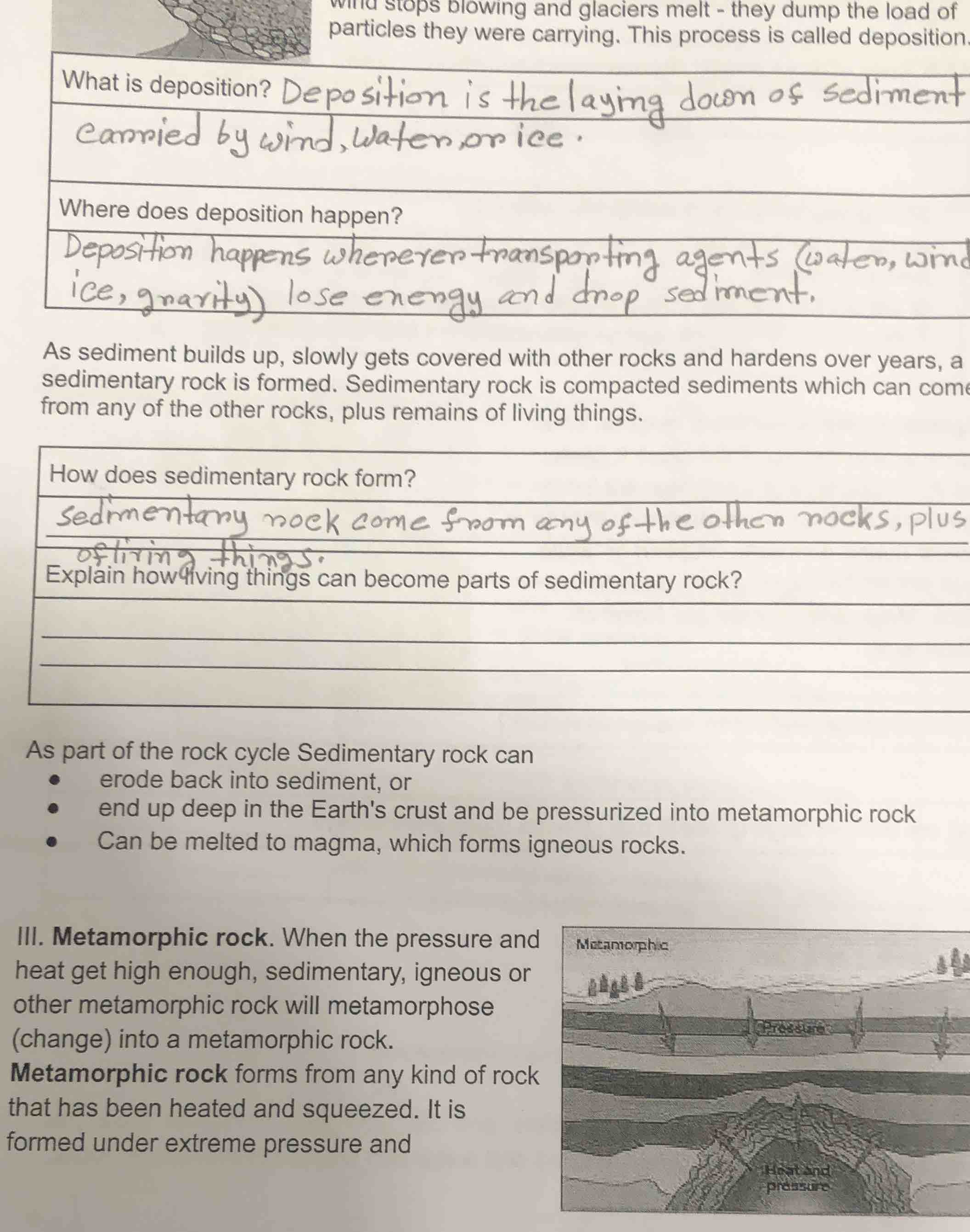
wind stops blowing and glaciers melt - they dump the load of particles they were carrying. this process is called deposition. what is deposition? deposition is the laying down of sediment carried by wind, water, or ice. where does deposition happen? deposition happens whenever transporting agents (water, wind, ice, gravity) lose energy and drop sediment. as sediment builds up, slowly gets covered with other rocks and hardens over years, a sedimentary rock is formed. sedimentary rock is compacted sediments which can come from any of the other rocks, plus remains of living things. how does sedimentary rock form? sedimentary rock come from any of the other rocks, plus of living things. explain how living things can become parts of sedimentary rock? as part of the rock cycle sedimentary rock can - erode back into sediment, or - end up deep in the earths crust and be pressurized into metamorphic rock - can be melted to magma, which forms igneous rocks. iii. metamorphic rock. when the pressure and heat get high enough, sedimentary, igneous or other metamorphic rock will metamorphose (change) into a metamorphic rock. metamorphic rock forms from any kind of rock that has been heated and squeezed. it is formed under extreme pressure and
To answer the question "Explain how living things can become parts of sedimentary rock?":
- Death and Deposition: Living organisms (like plants, animals, or microorganisms) die. Their remains (such as shells, bones, plant matter) can be deposited along with sediment (carried by wind, water, or ice) in environments like oceans, lakes, or riverbeds.
- Burial and Sediment Accumulation: Over time, more sediment accumulates on top of these organic remains, burying them deeper. The weight of the overlying sediment creates pressure.
- Compaction and Cementation: The pressure from the sediment compacts the organic material and the surrounding sediment. Minerals dissolved in water (like calcite or silica) can act as a cement, binding the sediment and organic remains together. Over millions of years, this process forms sedimentary rock, with the organic material becoming a part of it (e.g., fossils in limestone, coal from plant matter).

Snap & solve any problem in the app
Get step-by-step solutions on Sovi AI
Photo-based solutions with guided steps
Explore more problems and detailed explanations
Living things can become part of sedimentary rock through these steps: 1) When organisms die, their remains (e.g., shells, bones, plant matter) are deposited with sediment (by wind, water, or ice) in environments like oceans or riverbeds. 2) Over time, more sediment buries these remains, creating pressure. 3) The pressure compacts the sediment and remains, while dissolved minerals (cement) bind them. Over millions of years, this forms sedimentary rock, preserving the organic material (e.g., fossils, coal).