QUESTION IMAGE
Question
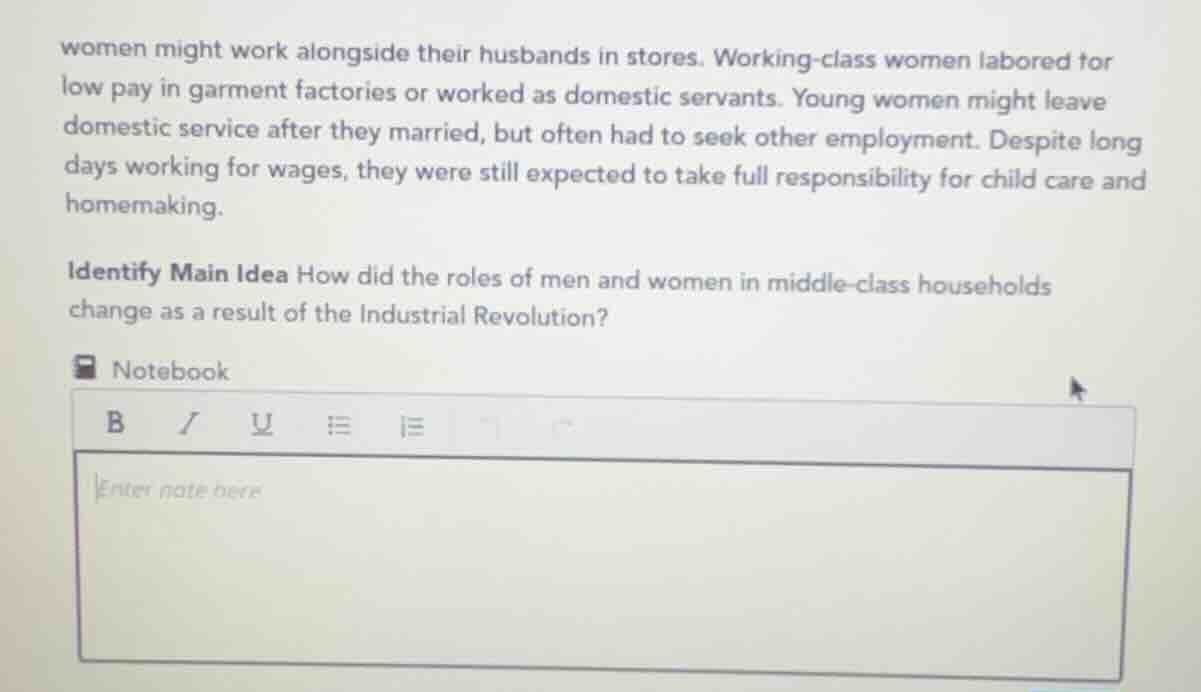
women might work alongside their husbands in stores. working-class women labored for low pay in garment factories or worked as domestic servants. young women might leave domestic service after they married, but often had to seek other employment. despite long days working for wages, they were still expected to take full responsibility for child care and homemaking.
identify main idea how did the roles of men and women in middle-class households change as a result of the industrial revolution?
The provided text focuses on working-class women's labor, but the question asks about middle-class households in the Industrial Revolution. For middle-class families, the Industrial Revolution created a clear "separate spheres" divide: men became the primary wage earners, working outside the home in factories or professional roles. Middle-class women were increasingly expected to stay home, taking on exclusive responsibility for child care, homemaking, and managing the household, rather than contributing to family income through work outside the home. This was a shift from pre-industrial times where middle-class men and women often worked together in home-based enterprises.

Snap & solve any problem in the app
Get step-by-step solutions on Sovi AI
Photo-based solutions with guided steps
Explore more problems and detailed explanations
In middle-class households during the Industrial Revolution, a clear "separate spheres" model emerged: men became the primary wage earners, working outside the home in factories or professional positions, while women were increasingly confined to the domestic sphere, taking on exclusive responsibility for child care, homemaking, and household management, rather than contributing to formal, outside-the-home work for income.