QUESTION IMAGE
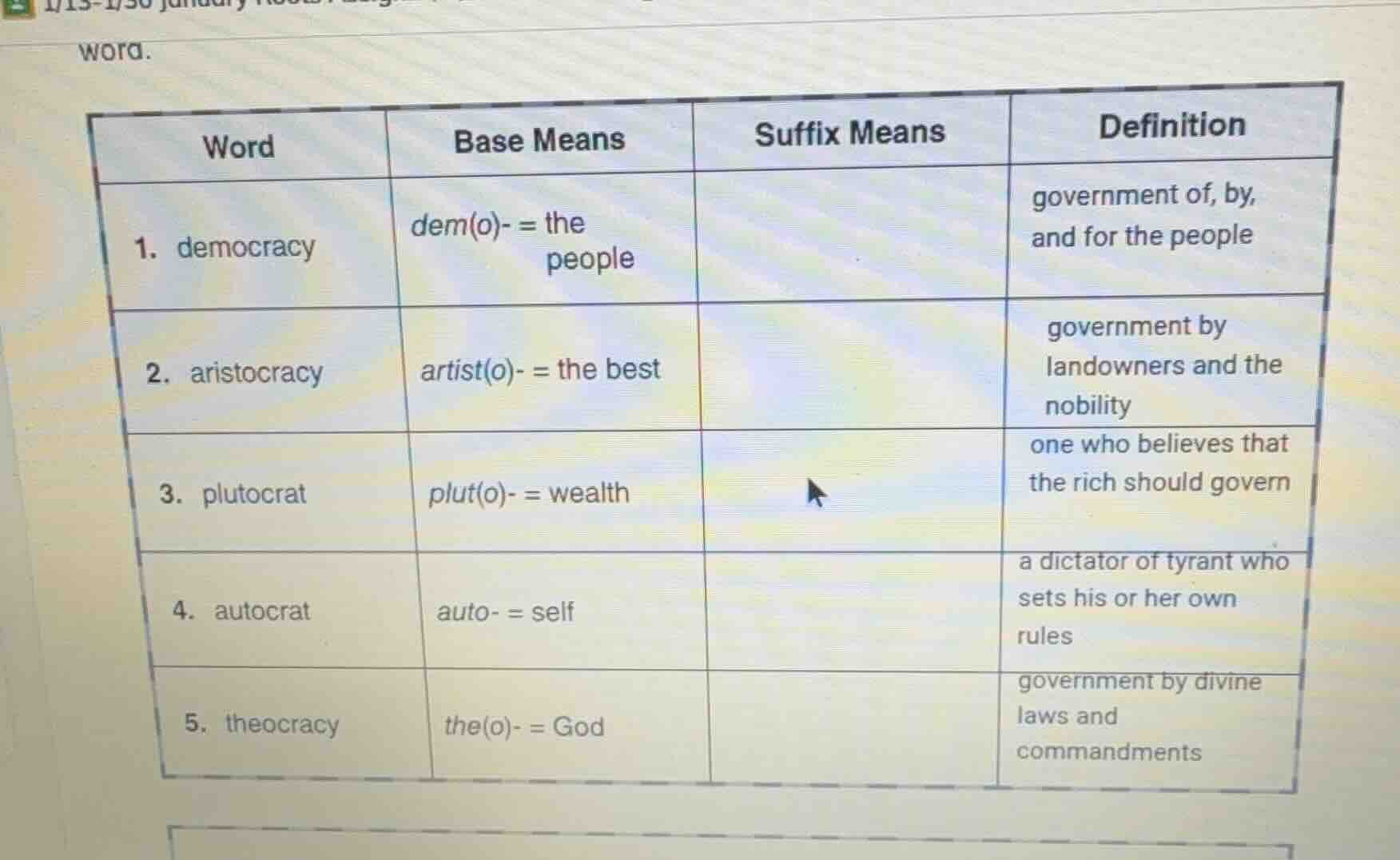
Question
word
- democracy
- aristocracy
- plutocrat
- autocrat
- theocracy
base means
dem(o)- = the people
artist(o)- = the best
plut(o)- = wealth
auto- = self
the(o)- = god
suffix means
definition
government of, by, and for the people
government by landowners and the nobility
one who believes that the rich should govern
a dictator of tyrant who sets his or her own rules
government by divine laws and commandments
To determine the meaning of the suffixes, we analyze the pattern of the words:
For "democracy" (word 1):
The base is \( \text{dem(o)- = the people} \), and the definition is "government of, by, and for the people". The suffix here is \( \text{-cracy} \) (since "democracy" is \( \text{dem(o)- + -cracy} \)).
For "aristocracy" (word 2):
Base: \( \text{artist(o)- = the best} \), definition: "government by landowners and the nobility". The suffix is also \( \text{-cracy} \) ( \( \text{artist(o)- + -cracy} \) ).
For "plutocrat" (word 3):
Base: \( \text{plut(o)- = wealth} \), definition: "one who believes that the rich should govern". The suffix here is \( \text{-crat} \) ( \( \text{plut(o)- + -crat} \) ).
For "autocrat" (word 4):
Base: \( \text{auto- = self} \), definition: "a dictator or tyrant who sets his or her own rules". The suffix is \( \text{-crat} \) ( \( \text{auto- + -crat} \) ).
For "theocracy" (word 5):
Base: \( \text{the(o)- = God} \), definition: "government by divine laws and commandments". The suffix is \( \text{-cracy} \) ( \( \text{the(o)- + -cracy} \) ).
Pattern Summary:
- \( \boldsymbol{\text{-cracy}} \): means "government by" (seen in democracy, aristocracy, theocracy).
- \( \boldsymbol{\text{-crat}} \): means "one who rules" or "a person who governs" (seen in plutocrat, autocrat).
Filling the Table:
| Word | Base Means | Suffix Means | Definition |
|---|---|---|---|
| 2. aristocracy | \( \text{artist(o)- = the best} \) | \( \text{-cracy = government by} \) | government by landowners and the nobility |
| 3. plutocrat | \( \text{plut(o)- = wealth} \) | \( \text{-crat = one who rules/governs} \) | one who believes that the rich should govern |
| 4. autocrat | \( \text{auto- = self} \) | \( \text{-crat = one who rules/governs} \) | a dictator or tyrant who sets his or her own rules |
| 5. theocracy | \( \text{the(o)- = God} \) | \( \text{-cracy = government by} \) | government by divine laws and commandments |
Final Answer (Suffix Meanings):
- For -cracy: \( \boldsymbol{\text{government by}} \)
- For -crat: \( \boldsymbol{\text{one who rules/governs}} \)

Snap & solve any problem in the app
Get step-by-step solutions on Sovi AI
Photo-based solutions with guided steps
Explore more problems and detailed explanations
To determine the meaning of the suffixes, we analyze the pattern of the words:
For "democracy" (word 1):
The base is \( \text{dem(o)- = the people} \), and the definition is "government of, by, and for the people". The suffix here is \( \text{-cracy} \) (since "democracy" is \( \text{dem(o)- + -cracy} \)).
For "aristocracy" (word 2):
Base: \( \text{artist(o)- = the best} \), definition: "government by landowners and the nobility". The suffix is also \( \text{-cracy} \) ( \( \text{artist(o)- + -cracy} \) ).
For "plutocrat" (word 3):
Base: \( \text{plut(o)- = wealth} \), definition: "one who believes that the rich should govern". The suffix here is \( \text{-crat} \) ( \( \text{plut(o)- + -crat} \) ).
For "autocrat" (word 4):
Base: \( \text{auto- = self} \), definition: "a dictator or tyrant who sets his or her own rules". The suffix is \( \text{-crat} \) ( \( \text{auto- + -crat} \) ).
For "theocracy" (word 5):
Base: \( \text{the(o)- = God} \), definition: "government by divine laws and commandments". The suffix is \( \text{-cracy} \) ( \( \text{the(o)- + -cracy} \) ).
Pattern Summary:
- \( \boldsymbol{\text{-cracy}} \): means "government by" (seen in democracy, aristocracy, theocracy).
- \( \boldsymbol{\text{-crat}} \): means "one who rules" or "a person who governs" (seen in plutocrat, autocrat).
Filling the Table:
| Word | Base Means | Suffix Means | Definition |
|---|---|---|---|
| 2. aristocracy | \( \text{artist(o)- = the best} \) | \( \text{-cracy = government by} \) | government by landowners and the nobility |
| 3. plutocrat | \( \text{plut(o)- = wealth} \) | \( \text{-crat = one who rules/governs} \) | one who believes that the rich should govern |
| 4. autocrat | \( \text{auto- = self} \) | \( \text{-crat = one who rules/governs} \) | a dictator or tyrant who sets his or her own rules |
| 5. theocracy | \( \text{the(o)- = God} \) | \( \text{-cracy = government by} \) | government by divine laws and commandments |
Final Answer (Suffix Meanings):
- For -cracy: \( \boldsymbol{\text{government by}} \)
- For -crat: \( \boldsymbol{\text{one who rules/governs}} \)