QUESTION IMAGE
Question
world dc activities
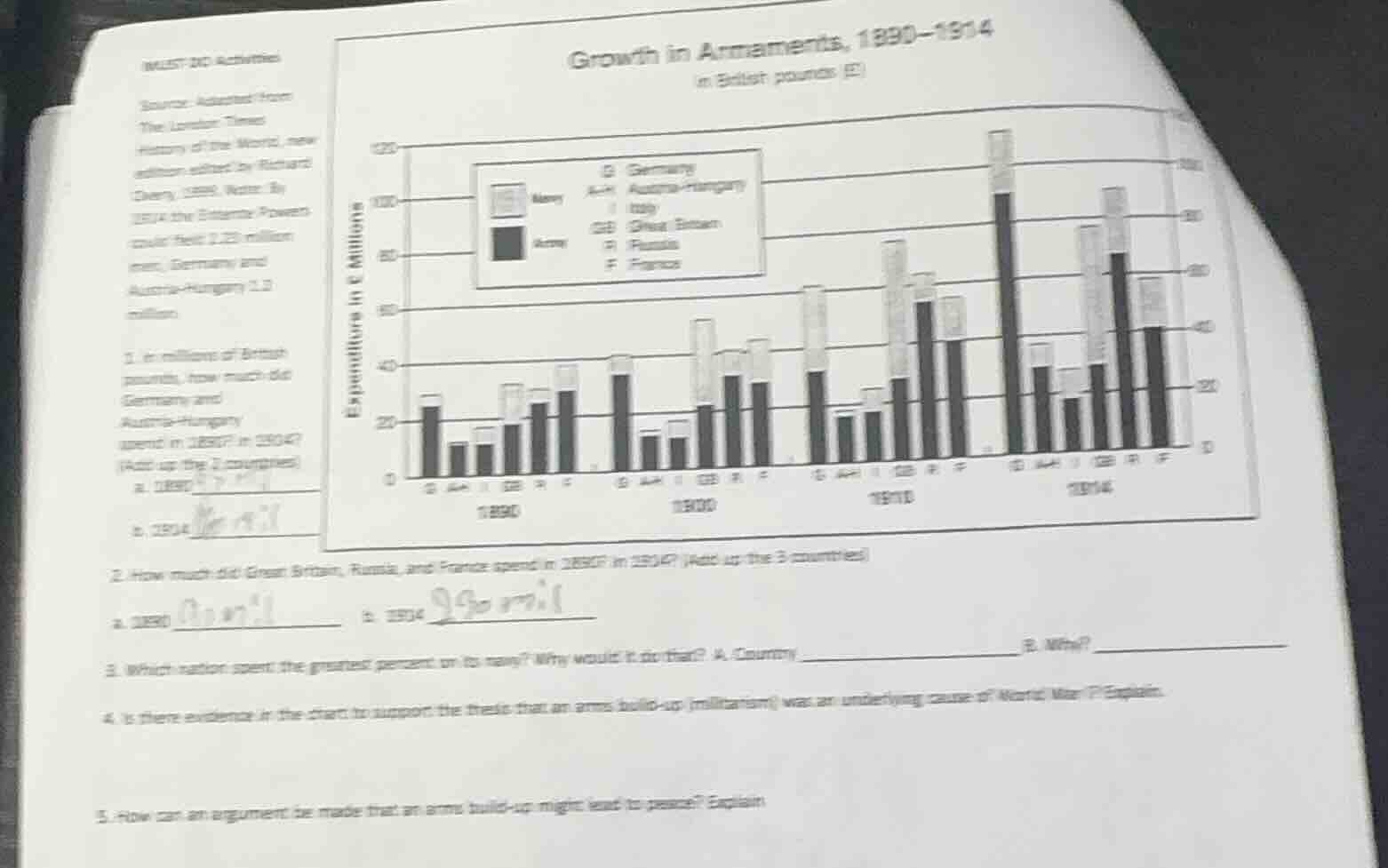
source: adapted from
the london times
history of the world, new
edition edited by richard
overy, 1999. note: by
1914 the entente powers
could field 2.25 million
men; germany and
austria - hungary 2.3
million.
- in millions of british
pounds, how much did
germany and
austria - hungary
spend in 1890? in 1904?
(add up the 2 countries)
a. 1890
b. 1904
- how much did great britain, russia, and france spend in 1890? in 1914? (add up the 3 countries)
a. 1890
b. 1914
- which nation spent the greatest percent on its navy? why would it do that? a. country
b. why?
- is there evidence in the chart to support the thesis that an arms build - up (militarism) was an underlying cause of world war i? explain.
- how can an argument be made that an arms build - up might lead to peace? explain
Brief Explanations
- Question 1:
- 1890: Germany (25m) + Austria-Hungary (15m) = $25 + 15 = 40$ million £
- 1914: Germany (120m) + Austria-Hungary (78m) = $120 + 78 = 198$ million £
- Question 2:
- 1890: Great Britain (30m) + Russia (10m) + France (10m) = $30 + 10 + 10 = 50$ million £
- 1914: Great Britain (102m) + Russia (90m) + France (98m) = $102 + 90 + 98 = 290$ million £
- Question 3: Great Britain’s navy expenditure is visibly the largest share of its total arms spending. As a global imperial power with overseas colonies, it relied on a dominant navy to protect trade routes, supply lines, and territorial holdings.
- Question 4: All major powers show a steep, consistent rise in arms spending from 1890 to 1914. This widespread, rapid militarization created a climate of distrust and rivalry, directly aligning with the thesis that arms build-up was an underlying cause of World War I.
- Question 5: The argument relies on mutual deterrence: if all major powers build up equivalent military strength, no single nation will risk starting a war, as the potential cost and destruction would be catastrophic for all sides. This balance of power can discourage aggressive actions.

Snap & solve any problem in the app
Get step-by-step solutions on Sovi AI
Photo-based solutions with guided steps
Explore more problems and detailed explanations
- a. 40 million £, b. 198 million £
- a. 50 million £, b. 290 million £
- A. Great Britain; B. Maritime defense/imperial needs
- Yes
- Through mutual deterrence theory