QUESTION IMAGE
Question
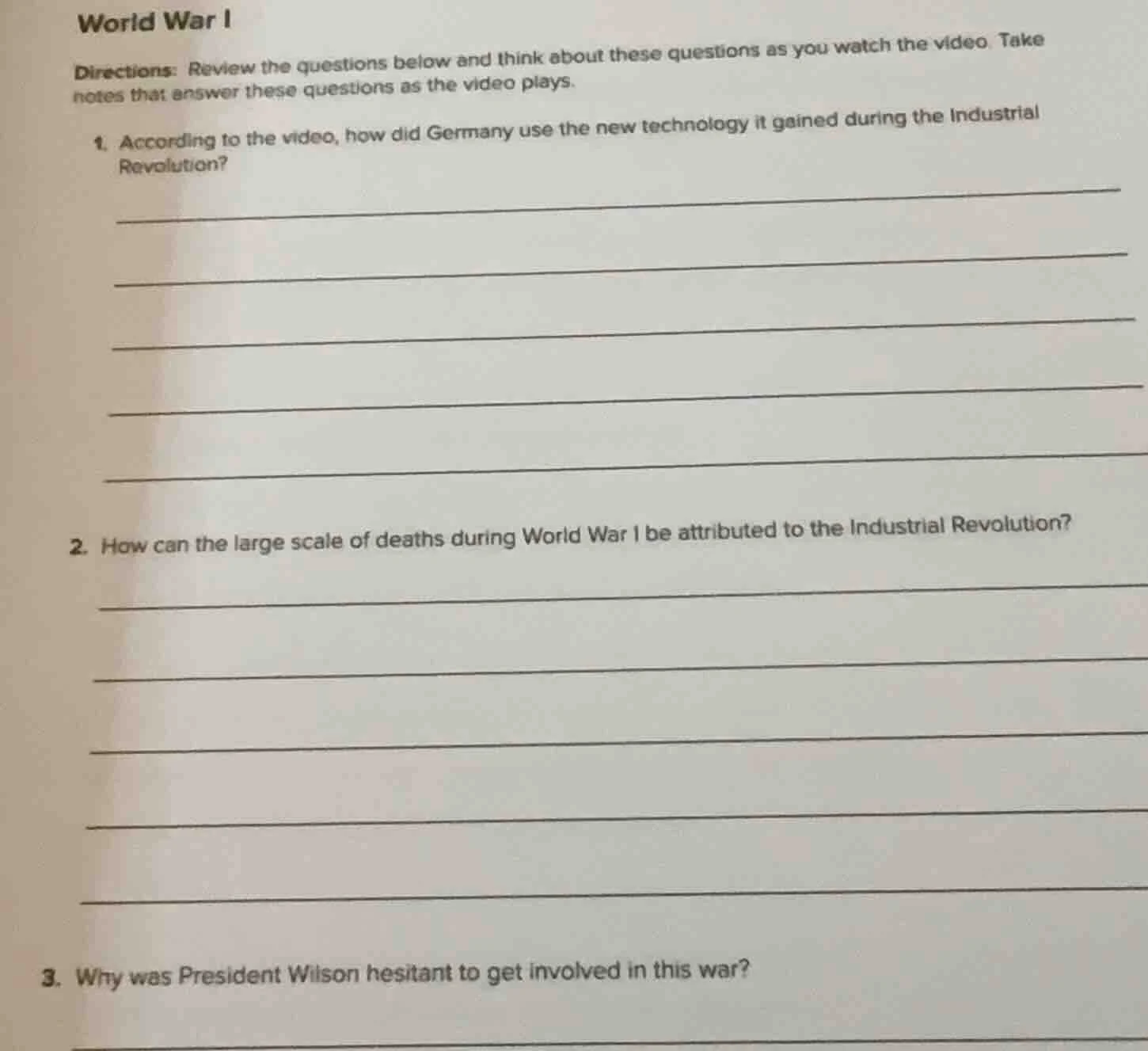
world war i
directions: review the questions below and think about these questions as you watch the video. take notes that answer these questions as the video plays.
- according to the video, how did germany use the new technology it gained during the industrial revolution?
- how can the large scale of deaths during world war i be attributed to the industrial revolution?
- why was president wilson hesitant to get involved in this war?
To answer these questions, we analyze each one based on historical context (World War I and the Industrial Revolution) and relevant historical knowledge:
Question 1
During the Industrial Revolution, Germany advanced in technologies like chemistry (for explosives), engineering (for machinery), and manufacturing. It used these to develop modern weapons (e.g., machine guns, artillery, U - boats) and industrialize its military production, strengthening its war capabilities for World War I.
The Industrial Revolution enabled mass production of weapons (e.g., machine guns, artillery, poison gas) with greater lethality. It also improved transportation (railways) to deploy troops/weapons faster, and communication (telegraph) for better coordination. These advancements made warfare more destructive, leading to higher casualties in World War I.
President Wilson wanted the U.S. to remain neutral, focusing on domestic issues and avoiding European conflicts. He also believed the war was a European matter, and U.S. involvement could disrupt domestic peace and economic stability (though later events forced U.S. entry).

Snap & solve any problem in the app
Get step-by-step solutions on Sovi AI
Photo-based solutions with guided steps
Explore more problems and detailed explanations
Germany used Industrial Revolution - era technologies (e.g., in chemistry, engineering, and manufacturing) to develop advanced military weapons (like machine guns, artillery, U - boats) and industrialize military production, enhancing its warfare capabilities for World War I.