QUESTION IMAGE
Question
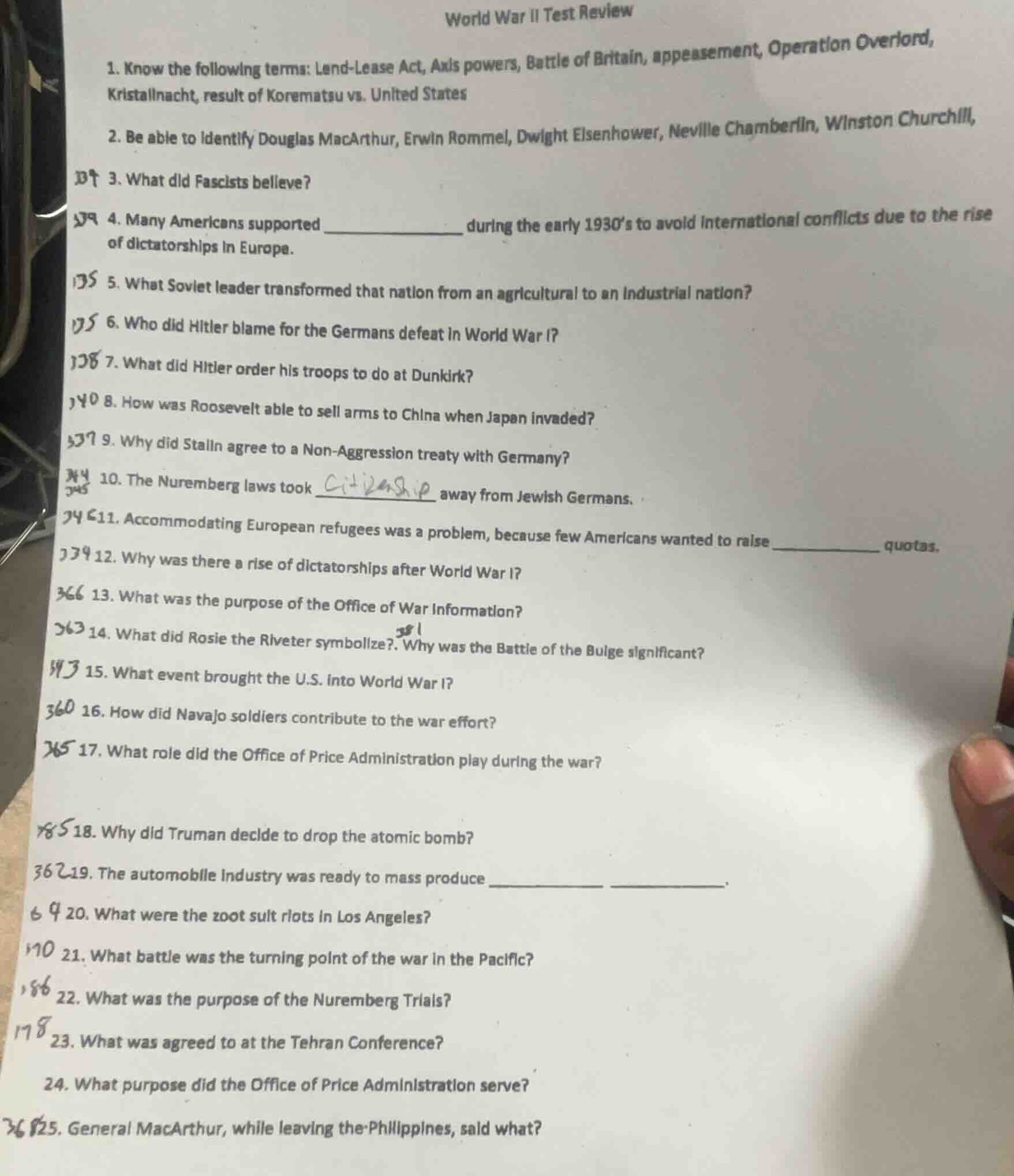
world war ii test review1. know the following terms: lend-lease act, axis powers, battle of britain, appeasement, operation overlord, kristallnacht, result of korematsu vs. united states2. be able to identify douglas macarthur, erwin rommel, dwight eisenhower, neville chamberlin, winston churchill,3. what did fascists believe?4. many americans supported __________ during the early 1930s to avoid international conflicts due to the rise of dictatorships in europe.5. what soviet leader transformed that nation from an agricultural to an industrial nation?6. who did hitler blame for the germans defeat in world war i?7. what did hitler order his troops to do at dunkirk?8. how was roosevelt able to sell arms to china when japan invaded?9. why did stalin agree to a non-aggression treaty with germany?10. the nuremberg laws took ____ away from jewish germans.11. accommodating european refugees was a problem, because few americans wanted to raise _____ quotas.12. why was there a rise of dictatorships after world war i?13. what was the purpose of the office of war information?14. what did rosie the riveter symbolize?. why was the battle of the bulge significant?15. what event brought the u.s. into world war ii?16. how did navajo soldiers contribute to the war effort?17. what role did the office of price administration play during the war?18. why did truman decide to drop the atomic bomb?19. the automobile industry was ready to mass produce _____ ________.20. what were the zoot suit riots in los angeles?21. what battle was the turning point of the war in the pacific?22. what was the purpose of the nuremberg trials?23. what was agreed to at the tehran conference?24. what purpose did the office of price administration serve?25. general macarthur, while leaving the philippines, said what?
- Term Definitions:
- Lend-Lease Act: U.S. program supplying Allied nations with war materials (1941-1945) in exchange for repayment or leases.
- Axis powers: WWII alliance of Germany, Italy, Japan, and their allies.
- Battle of Britain: 1940 air campaign where the Royal Air Force defeated Germany's Luftwaffe, preventing a German invasion of Britain.
- Appeasement: Policy of conceding to aggressive nations (e.g., Britain/France giving Czechoslovakia to Hitler) to avoid war.
- Operation Overlord: 1944 Allied D-Day invasion of Normandy, France, opening a Western front against Germany.
- Kristallnacht: 1938 Nazi-led pogrom against Jewish people in Germany/Austria, destroying synagogues, businesses, and arresting thousands.
- Korematsu vs. United States: 1944 Supreme Court case upholding the internment of Japanese Americans during WWII; later overturned in principle.
- Figure Identifications:
- Douglas MacArthur: U.S. general who led forces in the Pacific theater, oversaw Japan's post-WWII occupation.
- Erwin Rommel: German field marshal ("Desert Fox") known for North African campaign tactics.
- Dwight Eisenhower: U.S. general who commanded Allied forces in Europe (Operation Overlord), later U.S. president.
- Neville Chamberlain: British prime minister associated with the appeasement policy toward Hitler.
- Winston Churchill: British prime minister during WWII, known for his defiant leadership against Nazi Germany.
- Fascists believed in authoritarian one-party rule, extreme nationalism, suppression of opposition, and the supremacy of the state over individual rights.
- Isolationism was a U.S. policy avoiding foreign entanglements to prevent repeating WWI's costs.
- Joseph Stalin implemented forced industrialization and collective farming to transform the Soviet Union.
- Hitler used antisemitic conspiracy theories to scapegoat Jewish people and political opponents for Germany's WWI defeat.
- Hitler halted his advancing troops, allowing British and French forces to evacuate Dunkirk in 1940.
- Roosevelt used the "cash-and-carry" policy, allowing nations to buy U.S. arms for cash and transport them on their own ships.
- Stalin sought time to strengthen the Soviet military and gain control of Eastern European territory.
- The Nuremberg Laws (1935) stripped Jewish Germans of citizenship and legal rights.
- U.S. immigration quotas limited entry for European refugees, driven by nativism and fear of economic competition.
- WWI left economic ruin, political instability, and resentment, creating conditions for authoritarian leaders to rise.
- The Office of War Information coordinated U.S. propaganda to boost public support for the war effort.
- Rosie the Riveter symbolized women entering the industrial workforce to replace men serving in the military.
- Battle of the Bulge: 1944 German counteroffensive that was the last major German attack on the Western Front; its defeat exhausted German military resources.
- The Japanese surprise attack on Pearl Harbor (December 7, 1941) led the U.S. to declare war on Japan and enter WWII.
- Navajo soldiers created and used an unbreakable code based on their native language to transmit secure military messages.
- The Office of Price Administration controlled inflation by setting price ceilings on goods and rationing scarce resources (e.g., gasoline, food) during the war.
- Truman argued the bomb would end the war quickly, avoid a costly U.S. invasion of Japan, and demonstrate U.S. power to…

Snap & solve any problem in the app
Get step-by-step solutions on Sovi AI
Photo-based solutions with guided steps
Explore more problems and detailed explanations
- (Term definitions provided in explanations)
- (Figure identifications provided in explanations)
- Authoritarian nationalism, state supremacy, anti-liberalism
- isolationism
- Joseph Stalin
- Jewish people and German political opponents
- Halt their advance, allowing Allied evacuation
- Through the "cash-and-carry" policy
- To buy time to strengthen Soviet defenses
- citizenship
- immigration
- Economic collapse and political instability post-WWI
- Coordinate U.S. war propaganda
- Rosie the Riveter: Women's wartime industrial labor; Battle of the Bulge: Last major German Western Front offensive
- The Japanese attack on Pearl Harbor
- They created an unbreakable code using the Navajo language
- Controlled prices and rationed scarce goods
- To end WWII quickly and avoid a U.S. invasion of Japan
- military vehicles (tanks, trucks, jeeps)
- Racial conflicts between white servicemen and Mexican American youth over zoot suit fashion
- The Battle of Midway
- Prosecute Nazi leaders for war crimes and genocide
- Open a second European front (D-Day) and post-war planning
- Prevent inflation and ration scarce wartime resources
- "I shall return"