QUESTION IMAGE
Question
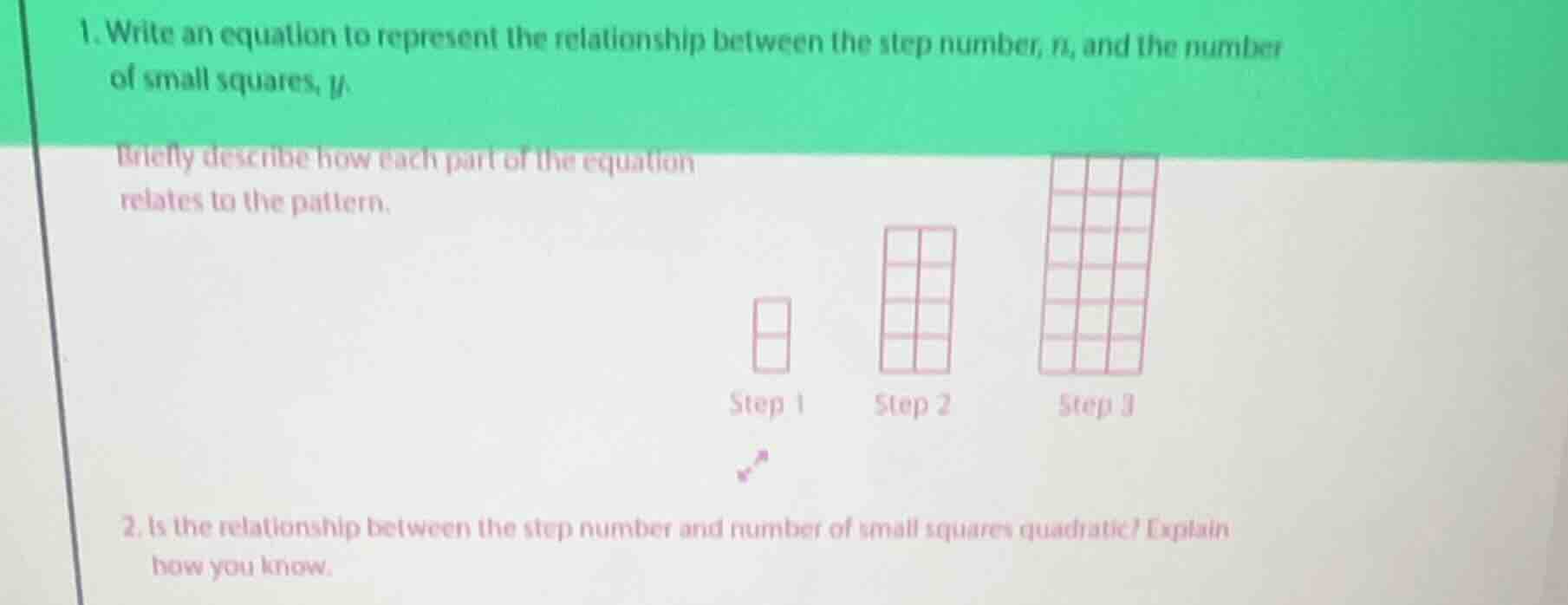
- write an equation to represent the relationship between the step number, n, and the number of small squares, y.
briefly describe how each part of the equation relates to the pattern.
step 1 step 2 step 3
- is the relationship between the step number and number of small squares quadratic? explain how you know.
Question 1
Step 1: Analyze the pattern for each step
For Step 1 (\(n = 1\)): The number of small squares \(y=2=1\times2\)
For Step 2 (\(n = 2\)): The number of small squares \(y = 8=2\times4\)? Wait, no, looking at the figures: Step 1 has 2 squares (1 column, 2 rows), Step 2 has 8? Wait, no, maybe I misread. Wait, Step 1: 2 squares (1×2), Step 2: 2×4? No, wait the second figure: Step 2, how many squares? Let's count: 2 columns, 4 rows? Wait, no, maybe it's \(n(n + 1)\)? Wait, Step 1: \(n=1\), \(y = 2=1\times2\); Step 2: \(n = 2\), \(y=8\)? No, that doesn't fit. Wait, maybe the number of rows and columns: Step 1: 1 column, 2 rows: \(1\times2 = 2\); Step 2: 2 columns, 4 rows: \(2\times4=8\); Step 3: 3 columns, 6 rows: \(3\times6 = 18\). Wait, no, that's not. Wait, maybe the number of squares is \(n\times2n\)? For \(n = 1\): \(1\times2\times1=2\); \(n = 2\): \(2\times2\times2 = 8\); \(n=3\): \(3\times2\times3=18\). Wait, but let's check the figures again. Wait, the first figure (Step 1) has 2 squares (vertical, 2 in a column). Step 2: 2 columns, each with 4 squares? No, maybe it's a rectangle where the number of columns is \(n\) and the number of rows is \(2n\). So the area (number of squares) is \(n\times2n=2n^{2}\)? Wait, for \(n = 1\): \(2(1)^{2}=2\), correct. \(n = 2\): \(2(2)^{2}=8\), correct. \(n = 3\): \(2(3)^{2}=18\), which matches if Step 3 has 3 columns and 6 rows (3×6=18). So the equation is \(y = 2n^{2}\).
Step 2: Explain the equation
The variable \(n\) represents the step number. The coefficient 2 and the exponent 2 in \(2n^{2}\) relate to the pattern: for each step \(n\), the number of columns is \(n\) and the number of rows is \(2n\) (since in Step 1, rows = 2×1=2; Step 2, rows=2×2=4; Step 3, rows=2×3=6). So the total number of squares (area of the rectangle) is columns × rows = \(n\times2n=2n^{2}\).
A quadratic relationship is one where the dependent variable (\(y\)) is related to the independent variable (\(n\)) by a polynomial of degree 2 (i.e., the highest power of \(n\) is 2). In the equation \(y = 2n^{2}\), the highest power of \(n\) is 2 (since \(n\) is squared). Quadratic functions have the general form \(y=ax^{2}+bx + c\) (here \(b = 0\), \(c = 0\), \(a = 2\)). The pattern of the number of squares follows \(y = 2n^{2}\), which is a quadratic function because the exponent of the independent variable \(n\) is 2.

Snap & solve any problem in the app
Get step-by-step solutions on Sovi AI
Photo-based solutions with guided steps
Explore more problems and detailed explanations
The equation is \(y = 2n^{2}\), where \(n\) is the step number and \(y\) is the number of small squares. The \(n^{2}\) term comes from the product of the number of columns (\(n\)) and a factor related to rows, and the coefficient 2 accounts for the doubling of rows relative to the step number (rows = \(2n\)), so total squares \(=n\times2n = 2n^{2}\).