QUESTION IMAGE
Question
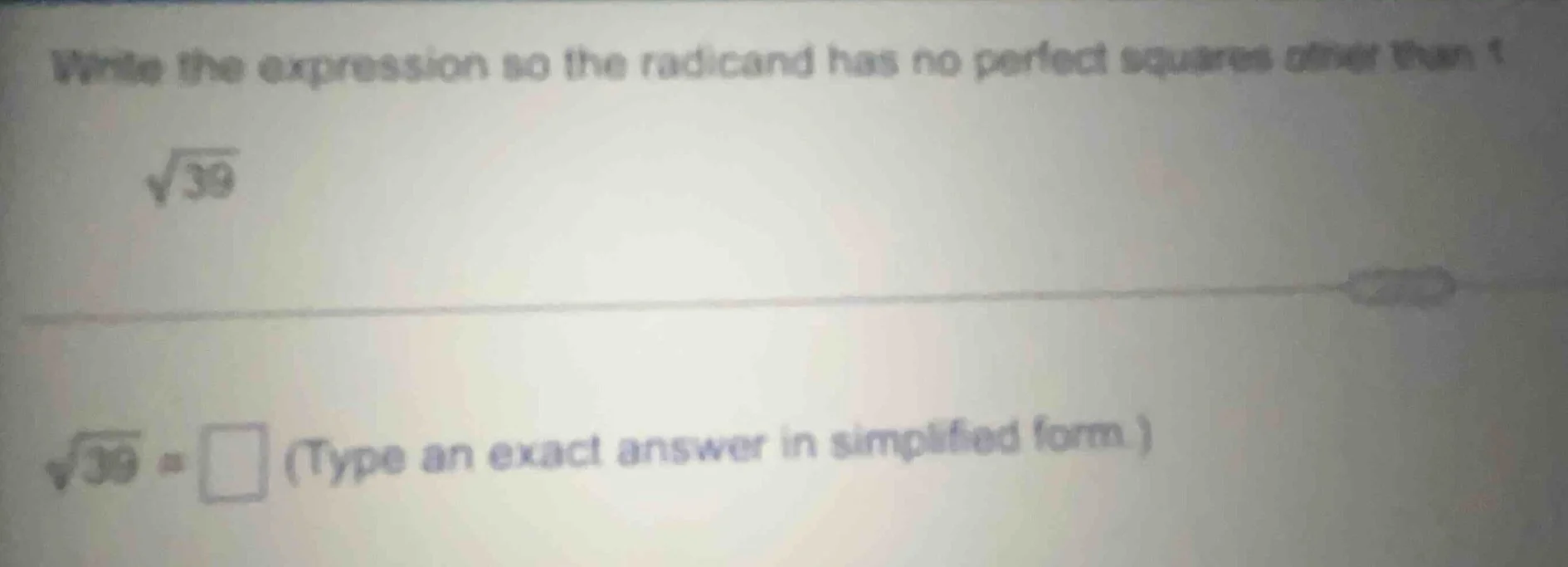
write the expression so the radicand has no perfect squares other than 1
\\(\sqrt{39}\\)
\\(\sqrt{39} = \square\\) (type an exact answer in simplified form.)
Step1: Factorize 39
First, we factorize the radicand (the number inside the square root) 39. We find the prime factors of 39.
We know that \(39 = 3\times13\). Both 3 and 13 are prime numbers, and neither of them is a perfect square (since the perfect squares are \(1, 4, 9, 16, 25, 36, 49, \dots\) and neither 3 nor 13 is in this list).
Step2: Check for simplification
To simplify a square root \(\sqrt{a}\), we look for factors of \(a\) that are perfect squares. If we can write \(a = b\times c\) where \(b\) is a perfect square, then \(\sqrt{a}=\sqrt{b\times c}=\sqrt{b}\times\sqrt{c}\) (by the property \(\sqrt{xy}=\sqrt{x}\times\sqrt{y}\) for \(x\geq0,y\geq0\)). But in the case of 39, since its prime factors (3 and 13) are not perfect squares, we cannot simplify the square root further. So \(\sqrt{39}\) is already in a form where the radicand has no perfect square factors other than 1.

Snap & solve any problem in the app
Get step-by-step solutions on Sovi AI
Photo-based solutions with guided steps
Explore more problems and detailed explanations
\(\sqrt{39}\)