QUESTION IMAGE
Question
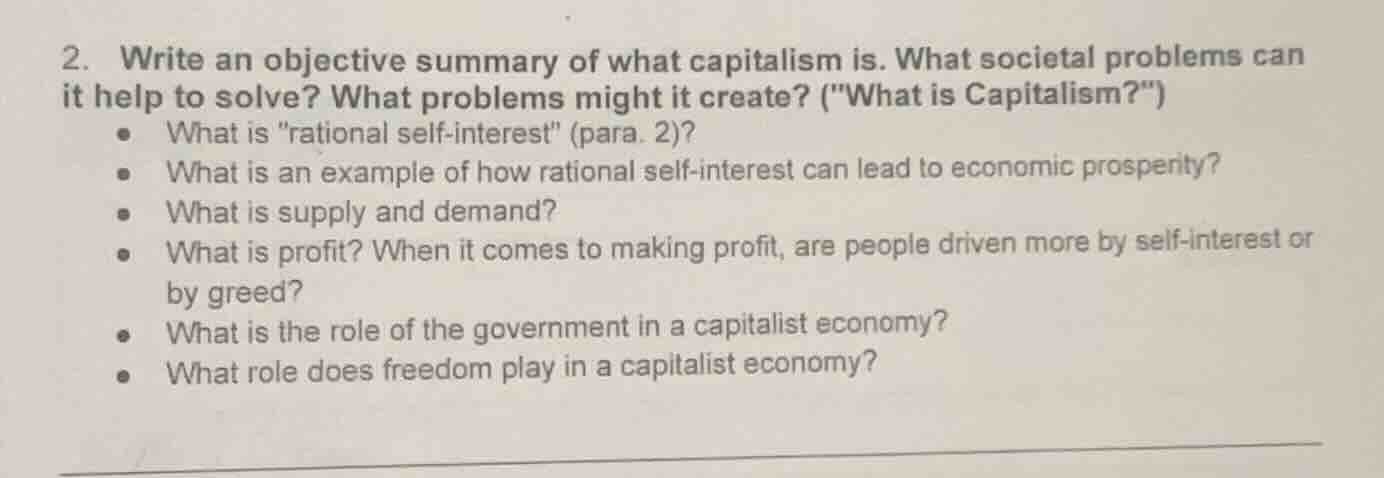
- write an objective summary of what capitalism is. what societal problems can it help to solve? what problems might it create? (\what is capitalism?\)
- what is
ational self - interest\ (para. 2)?
- what is an example of how rational self - interest can lead to economic prosperity?
- what is supply and demand?
- what is profit? when it comes to making profit, are people driven more by self - interest or by greed?
- what is the role of the government in a capitalist economy?
- what role does freedom play in a capitalist economy?
Brief Explanations
- Capitalism Summary: Capitalism is an economic system centered on private ownership of the means of production, where goods/services are produced for profit, and market forces (supply and demand) drive resource allocation, with minimal government intervention as a core default principle.
- Problems it solves: Can reduce shortages by letting supply/demand adjust prices to match production to consumer wants; drives innovation via profit incentives; can lift living standards through economic growth from competitive production.
- Problems it creates: May lead to wealth inequality as successful entities accumulate more resources; can cause market failures (e.g., unregulated overproduction leading to recessions); may prioritize profit over public good (e.g., neglecting affordable healthcare or environmental protection).
- Rational self-interest: The idea that individuals make calculated choices to maximize their own well-being, weighing costs and benefits of actions.
- Rational self-interest example: A café owner invests in better coffee beans and efficient equipment to attract more customers. This self-interested choice increases their revenue, and also creates local jobs and provides a higher-quality product for the community, boosting local economic activity.
- Supply and demand: Supply is the quantity of a good/service producers are willing to sell at various prices; demand is the quantity consumers are willing to buy at various prices. The interaction of the two sets the market price for a good/service.
- Profit: Profit is the financial gain when revenue from selling goods/services exceeds the total costs of producing or providing them. In most cases, profit-seeking is driven more by rational self-interest (calculated pursuit of sustainable, reasonable gains) than greed (unrestrained, excessive pursuit of wealth that often harms others), though greed can occur in unregulated contexts.
- Government role in capitalism: Typically limited to enforcing property rights, regulating to prevent monopolies and unfair business practices, providing public goods (e.g., roads, education) that markets underproduce, and stabilizing the economy during crises.
- Freedom in capitalism: Includes economic freedom (individuals can choose their jobs, start businesses, and buy/sell goods freely) and freedom of choice for consumers to select products. This freedom encourages competition, innovation, and individual initiative, which are core drivers of the system.

Snap & solve any problem in the app
Get step-by-step solutions on Sovi AI
Photo-based solutions with guided steps
Explore more problems and detailed explanations
- Capitalism Summary & Impacts:
- Capitalism is an economic system defined by private ownership of production, profit-driven production, and market-based resource allocation.
- Solves: Shortages via supply/demand, drives innovation, boosts living standards through growth.
- Creates: Wealth inequality, market failures, neglect of public good for profit.
- Rational self-interest: Calculated choice to maximize personal well-being.
- Rational self-interest example: A café owner invests in better supplies to grow their business, creating local jobs and better products for the community.
- Supply and demand: Supply = producer willingness to sell at various prices; demand = consumer willingness to buy at various prices; their interaction sets market prices.
- Profit: Revenue minus production costs. Mostly driven by rational self-interest, not greed.
- Government role: Enforces property rights, regulates unfair practices, provides public goods, stabilizes the economy.
- Freedom's role: Economic and consumer freedom fuels competition, innovation, and individual initiative.