QUESTION IMAGE
Question
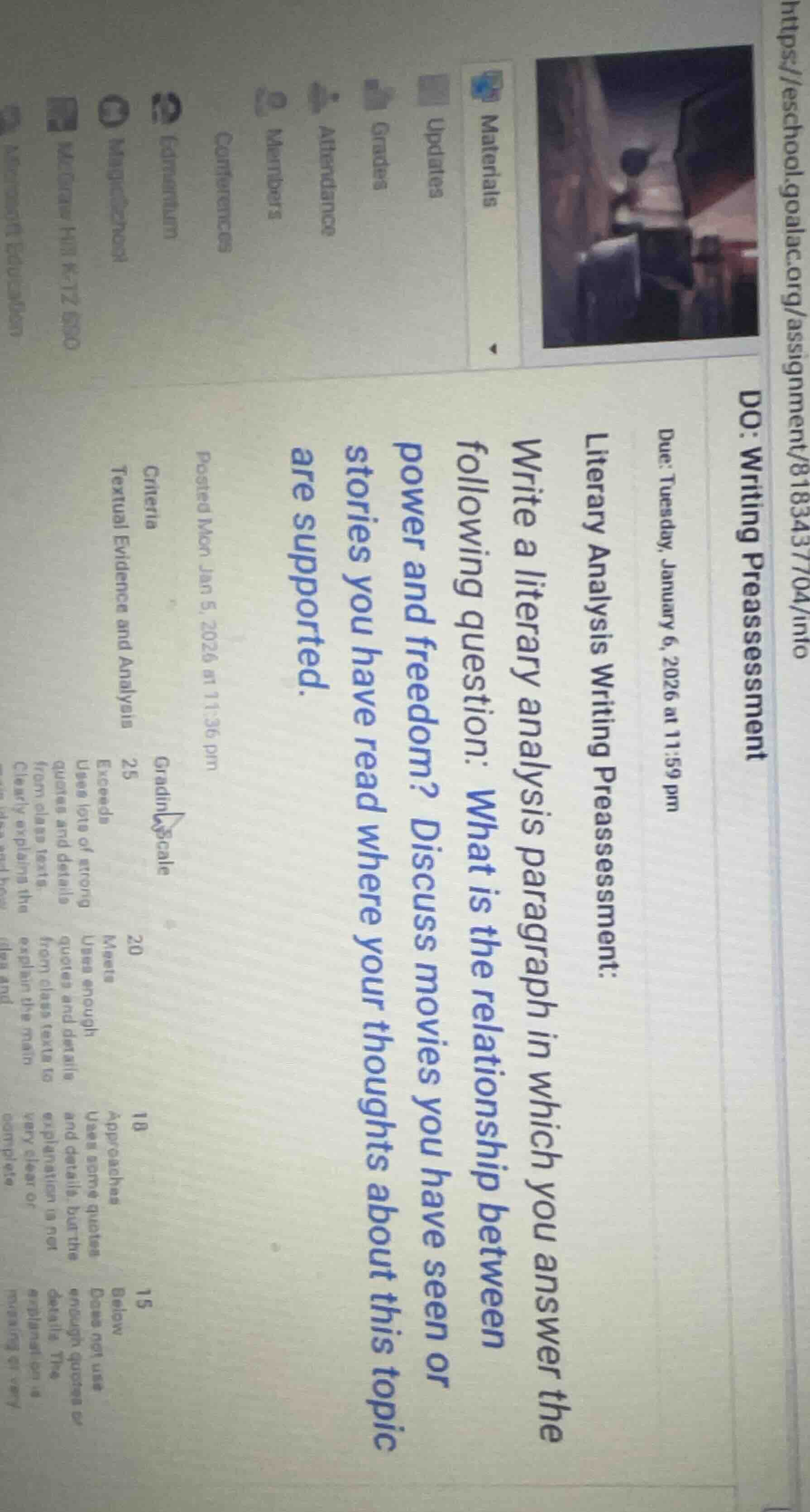
do: writing preassessment
due: tuesday, january 6, 2026 at 11:59 pm
literary analysis writing preassessment:
write a literary analysis paragraph in which you answer the following question: what is the relationship between power and freedom? discuss movies you have seen or stories you have read where your thoughts about this topic are supported.
posted mon jan 5, 2026 at 11:36 pm
criteria
textual evidence and analysis
gradin scale
25 exceeds
uses lots of strong quotes and details from class texts. clearly explains the idea and how
20 meets
uses enough quotes and details from class texts to explain the main
18 approaches
uses some quotes and details but the explanation is not very clear or complete
15 below
does not use enough quotes or details. the explanation is a mixing or very
This literary analysis explores the inverse, often coercive relationship between power and freedom, using 1984 and The Hunger Games as evidence. Orwell's totalitarian regime uses surveillance and thought control to strip citizens of bodily and ideological freedom, while Snowpanes' Capitol weaponizes scarcity and violence to suppress Panem's districts. Textual examples show how concentrated power systematically erodes individual and collective freedom, with resistance framing freedom as the rejection of dominant power structures.

Snap & solve any problem in the app
Get step-by-step solutions on Sovi AI
Photo-based solutions with guided steps
Explore more problems and detailed explanations
In George Orwell’s 1984, the Party’s absolute power directly extinguishes individual freedom: Winston Smith’s desire to think independently or love freely is crushed by surveillance, thoughtcrime laws, and psychological torture, as seen when O’Brien declares, “If you want a picture of the future, imagine a boot stamping on a human face—forever.” This quote encapsulates how unaccountable power does not merely restrict freedom but seeks to erase the very possibility of it. In contrast, Suzanne Collins’ The Hunger Games frames power and freedom as a zero-sum struggle: the Capitol’s control over Panem’s districts, enforced by annual ritualized violence, is only challenged when Katniss Everdeen defies the Games’ rules, turning her individual act of rebellion into a collective fight for freedom. Her choice to threaten a double suicide with Peeta Mellark strips the Capitol of its power to dictate the narrative, proving that freedom often emerges as a rejection of oppressive power. Across both texts, power and freedom exist in an inverse relationship: the more concentrated and unchallenged power becomes, the more freedom is diminished, while acts of resistance redefine freedom as the ability to push back against dominant power structures.