QUESTION IMAGE
Question
writing prompt
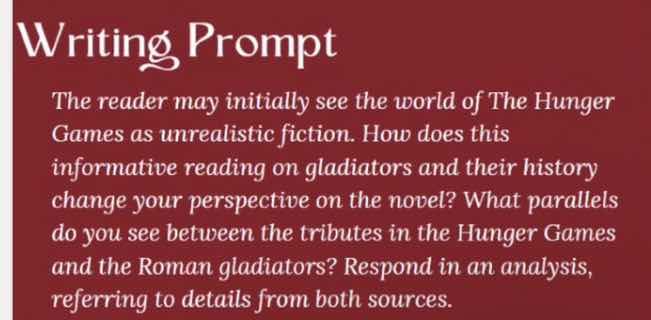
the reader may initially see the world of the hunger games as unrealistic fiction. how does this informative reading on gladiators and their history change your perspective on the novel? what parallels do you see between the tributes in the hunger games and the roman gladiators? respond in an analysis, referring to details from both sources.
- Perspective Shift: Learning about Roman gladiators frames The Hunger Games not as pure fantasy, but as a modern reimagining of a real, historical system of state-sanctioned violence used to control populations and distract the masses. The Capitol's use of the Games mirrors Rome's use of gladiatorial combat to pacify the lower classes and reinforce its power.
- Key Parallels:
- Forced Participation: Both gladiators (many enslaved, prisoners of war, or condemned people) and tributes (abducted from oppressed districts) are forced into life-or-death combat against their will, as punishment or a tool of political control.
- Spectacle for the Elite: The Games in both contexts are staged as grand, popular entertainments for the ruling class (Capitol citizens, Roman nobles and crowds). The audience's enjoyment of the violence normalizes the oppression of the participants' groups.
- Symbol of Oppression: Both systems serve as a constant reminder of the ruling power's absolute authority: the districts/Roman subjugated groups cannot resist the demand to sacrifice their people for the entertainment of the powerful.
- Potential for Cult Status: Some gladiators and tributes (like Katniss Everdeen) gain fame or a following, which can be both a survival tool and a subtle threat to the ruling power's narrative.

Snap & solve any problem in the app
Get step-by-step solutions on Sovi AI
Photo-based solutions with guided steps
Explore more problems and detailed explanations
Analyzing The Hunger Games alongside Roman gladiator history reframes the novel from a purely dystopian fantasy to a deliberate echo of real historical systems of state violence and control.
Core parallels between tributes and Roman gladiators include:
- Forced, non-consensual participation: Tributes are taken by the Capitol's Peacekeepers; many gladiators were enslaved, prisoners of war, or criminals condemned to the arena, with no choice but to fight.
- Violence as state spectacle: Both the Hunger Games and gladiatorial combat are staged, highly public entertainments designed to distract and pacify the privileged majority (Capitol citizens, Roman crowds) while reinforcing the ruling power's dominance over marginalized groups (the districts, Rome's conquered peoples and lower classes).
- Oppression through ritualized sacrifice: Both systems function as a brutal, recurring reminder of the ruling authority's absolute power, ensuring subjugated groups remain compliant through fear and the forced loss of their own people.
- Complex participant identities: Just as some gladiators gained limited fame or leverage from their role, tributes like Katniss Everdeen turn the spectacle against the Capitol, using the audience's attention to challenge the status quo—mirroring how rare gladiators became symbols of resistance or popular dissent in Rome.
This historical context deepens the novel's meaning, positioning it as a critique of authoritarian power structures that have existed beyond fictional dystopias.