QUESTION IMAGE
Question
writing in slope-intercept form from graphs
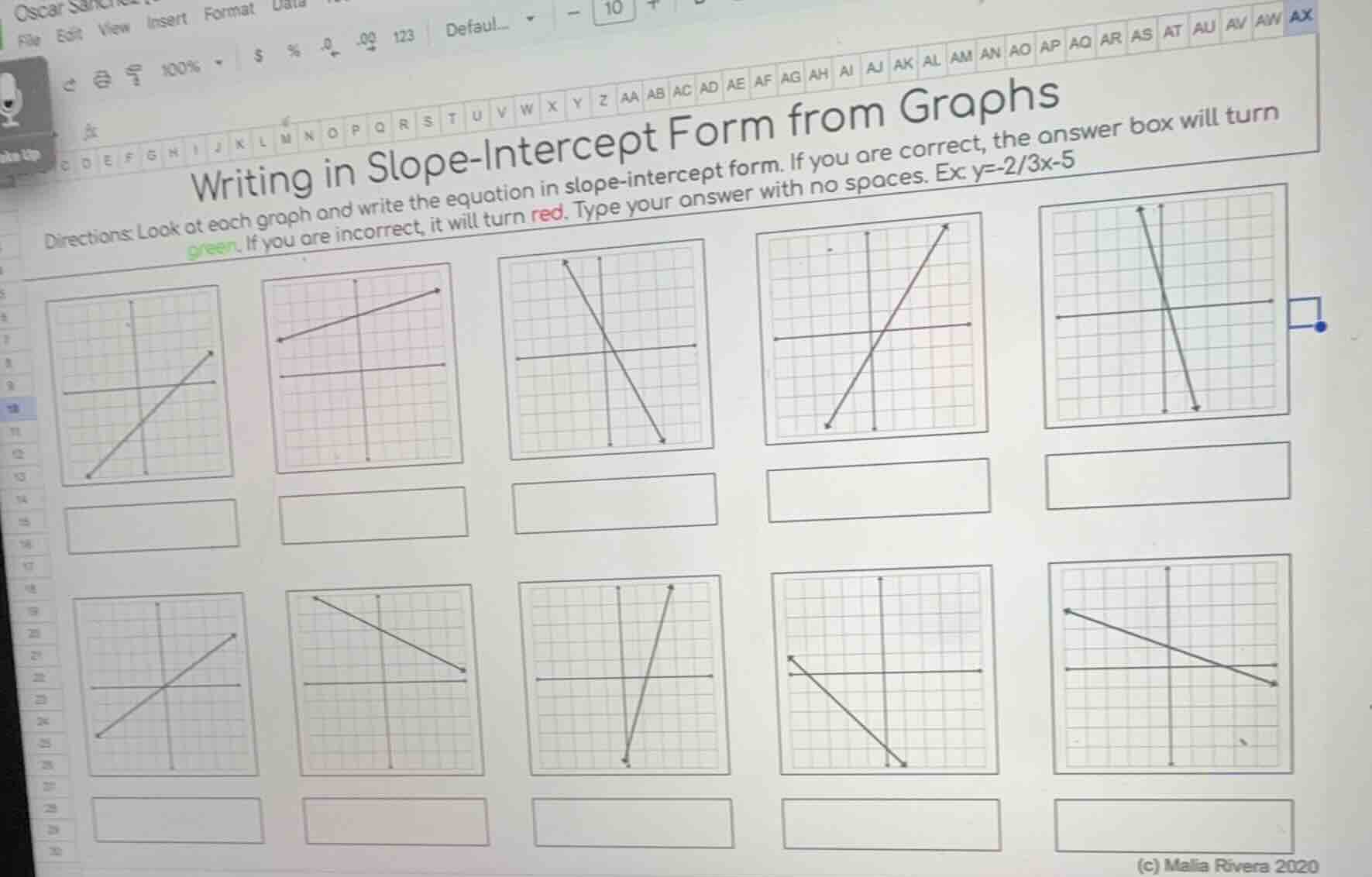
directions: look at each graph and write the equation in slope - intercept form. if you are correct, the answer box will turn green. if you are incorrect, it will turn red. type your answer with no spaces. ex: y=-2/3x - 5
To solve these problems, we use the slope - intercept form of a linear equation, which is \(y = mx + b\), where \(m\) is the slope and \(b\) is the y - intercept.
First Graph (Top - Left)
Step 1: Find the slope (\(m\))
We can use two points on the line. Let's assume the line passes through \((0,0)\) and \((3,3)\) (by looking at the grid). The slope formula is \(m=\frac{y_2 - y_1}{x_2 - x_1}\). So, \(m=\frac{3 - 0}{3 - 0}=1\).
Step 2: Find the y - intercept (\(b\))
The line passes through the origin \((0,0)\), so \(b = 0\).
Step 3: Write the equation
Using \(y=mx + b\), we substitute \(m = 1\) and \(b = 0\). So the equation is \(y=x\).
Second Graph (Top - Second from Left)
Step 1: Find the slope (\(m\))
Let's take two points, say \((- 6, - 1)\) and \((6,1)\). Then \(m=\frac{1-(-1)}{6 - (-6)}=\frac{2}{12}=\frac{1}{6}\).
Step 2: Find the y - intercept (\(b\))
Looking at the graph, when \(x = 0\), \(y = 0\)? Wait, no, maybe better to use the slope - intercept form. Wait, if we look at the line, when \(x = 0\), \(y = 0\)? Wait, maybe I made a mistake. Let's re - examine. If the line is a shallow line, let's take two points: \((- 12,-2)\) and \((12,2)\). Then \(m=\frac{2-(-2)}{12-(-12)}=\frac{4}{24}=\frac{1}{6}\). And when \(x = 0\), \(y = 0\)? Wait, no, maybe the y - intercept is \(0\). So the equation is \(y=\frac{1}{6}x\).
Third Graph (Top - Middle)
Step 1: Find the slope (\(m\))
Let's take two points, say \((0,0)\) and \((3,-3)\). Then \(m=\frac{-3 - 0}{3 - 0}=- 1\).
Step 2: Find the y - intercept (\(b\))
The line passes through the origin, so \(b = 0\).
Step 3: Write the equation
Using \(y=mx + b\), we get \(y=-x\).
Fourth Graph (Top - Second from Right)
Step 1: Find the slope (\(m\))
Take two points, say \((0,0)\) and \((3,3)\). Then \(m=\frac{3 - 0}{3 - 0}=1\).
Step 2: Find the y - intercept (\(b\))
The line passes through the origin, so \(b = 0\).
Step 3: Write the equation
The equation is \(y=x\).
Fifth Graph (Top - Right)
Step 1: Find the slope (\(m\))
Take two points, say \((0,0)\) and \((-3,3)\). Then \(m=\frac{3-0}{-3 - 0}=-1\).
Step 2: Find the y - intercept (\(b\))
The line passes through the origin, so \(b = 0\).
Step 3: Write the equation
The equation is \(y=-x\).
Sixth Graph (Bottom - Left)
Step 1: Find the slope (\(m\))
Take two points, say \((0,0)\) and \((3,3)\). Then \(m=\frac{3 - 0}{3 - 0}=1\).
Step 2: Find the y - intercept (\(b\))
The line passes through the origin, so \(b = 0\).
Step 3: Write the equation
The equation is \(y=x\).
Seventh Graph (Bottom - Second from Left)
Step 1: Find the slope (\(m\))
Take two points, say \((-6,2)\) and \((6,0)\). Then \(m=\frac{0 - 2}{6-(-6)}=\frac{-2}{12}=-\frac{1}{6}\).
Step 2: Find the y - intercept (\(b\))
When \(x = 0\), let's find \(y\). Using the slope - intercept form \(y=mx + b\). We know \(m=-\frac{1}{6}\), and if we take the point \((6,0)\), then \(0=-\frac{1}{6}(6)+b\), \(0=- 1 + b\), so \(b = 1\). So the equation is \(y=-\frac{1}{6}x + 1\).
Eighth Graph (Bottom - Middle)
Step 1: Find the slope (\(m\))
Let's take two points, say \((0,-3)\) and \((3,0)\). Then \(m=\frac{0-(-3)}{3 - 0}=1\). Wait, no, if the line goes from \((0,-3)\) to \((3,0)\), \(m=\frac{0 + 3}{3-0}=1\). Wait, but the line is a V - shape? No, wait, maybe it's two lines? Wait, no, the graph is a V - shaped graph? Wait, maybe it's an absolute - value graph, but the problem says "writing in slope - intercept form", so maybe it's two linear lines. For the right - hand line, let's take two points \((0,-3)\)…

Snap & solve any problem in the app
Get step-by-step solutions on Sovi AI
Photo-based solutions with guided steps
Explore more problems and detailed explanations
s for each graph (in order from top - left to bottom - right):
- \(y = x\)
- \(y=\frac{1}{6}x\)
- \(y=-x\)
- \(y = x\)
- \(y=-x\)
- \(y = x\)
- \(y=-\frac{1}{6}x + 1\)
- \(y=x - 3\) (for the right - hand line)
- \(y=-x\)
- \(y=-\frac{1}{6}x + 1\)