QUESTION IMAGE
Question
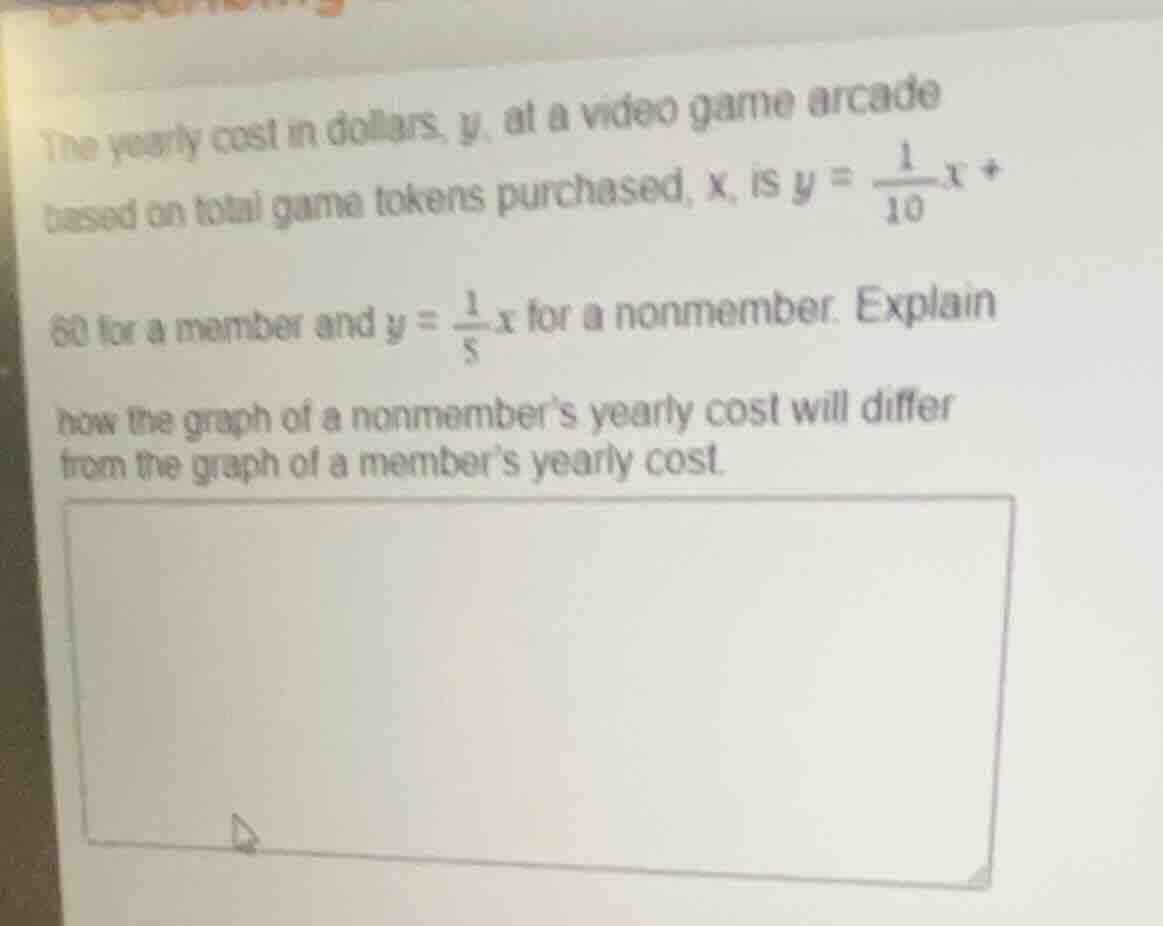
the yearly cost in dollars, y, at a video game arcade based on total game tokens purchased, x, is $y = \frac{1}{10}x + 60$ for a member and $y = \frac{1}{5}x$ for a nonmember. explain how the graph of a nonmember’s yearly cost will differ from the graph of a member’s yearly cost.
Both equations are in slope-intercept form $y=mx+b$, where $m$ is the slope and $b$ is the y-intercept.
- Member equation: $y=\frac{1}{10}x + 60$ has a y-intercept of $60$ and slope of $\frac{1}{10}$.
- Nonmember equation: $y=\frac{1}{5}x$ has a y-intercept of $0$ and slope of $\frac{1}{10}$.
- Compare the two: The nonmember's graph starts at the origin (no fixed cost), while the member's graph starts at $(0,60)$ (fixed annual fee). The nonmember's graph has a steeper slope, meaning their cost per token is higher.

Snap & solve any problem in the app
Get step-by-step solutions on Sovi AI
Photo-based solutions with guided steps
Explore more problems and detailed explanations
The nonmember's yearly cost graph has a y-intercept of 0 (no upfront cost) instead of the member's y-intercept of 60 (fixed annual fee). Additionally, the nonmember's graph has a steeper slope ($\frac{1}{5}$ vs. $\frac{1}{10}$), representing a higher cost per game token compared to the member.