QUESTION IMAGE
Question
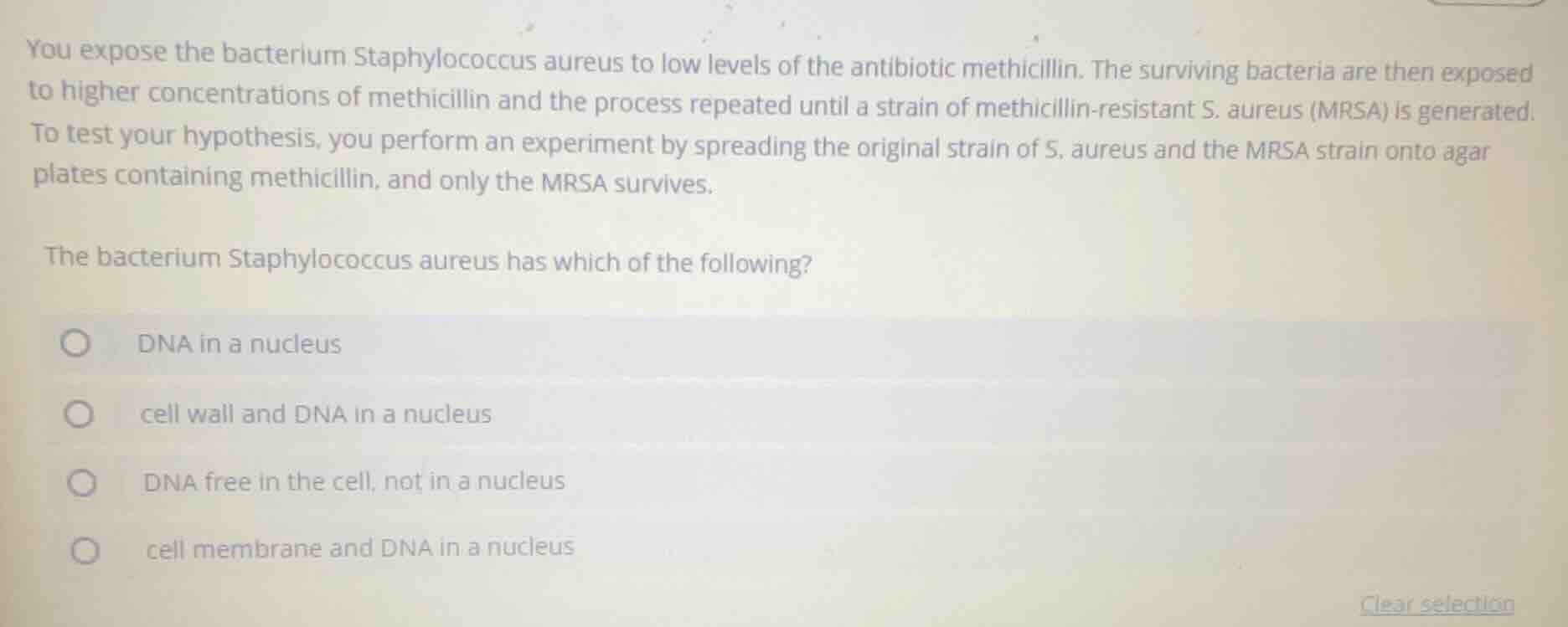
you expose the bacterium staphylococcus aureus to low levels of the antibiotic methicillin. the surviving bacteria are then exposed to higher concentrations of methicillin and the process repeated until a strain of methicillin - resistant s. aureus (mrsa) is generated. to test your hypothesis, you perform an experiment by spreading the original strain of s. aureus and the mrsa strain onto agar plates containing methicillin, and only the mrsa survives. the bacterium staphylococcus aureus has which of the following? options: dna in a nucleus; cell wall and dna in a nucleus; dna free in the cell, not in a nucleus; cell membrane and dna in a nucleus
Staphylococcus aureus is a bacterium, which is a prokaryotic organism. Prokaryotes lack a membrane-bound nucleus; their genetic material (DNA) is free in the cytoplasm (nucleoid region). They also have a cell wall and cell membrane, but the key distinction here related to the options is the location of DNA.

Snap & solve any problem in the app
Get step-by-step solutions on Sovi AI
Photo-based solutions with guided steps
Explore more problems and detailed explanations
DNA free in the cell, not in a nucleus