QUESTION IMAGE
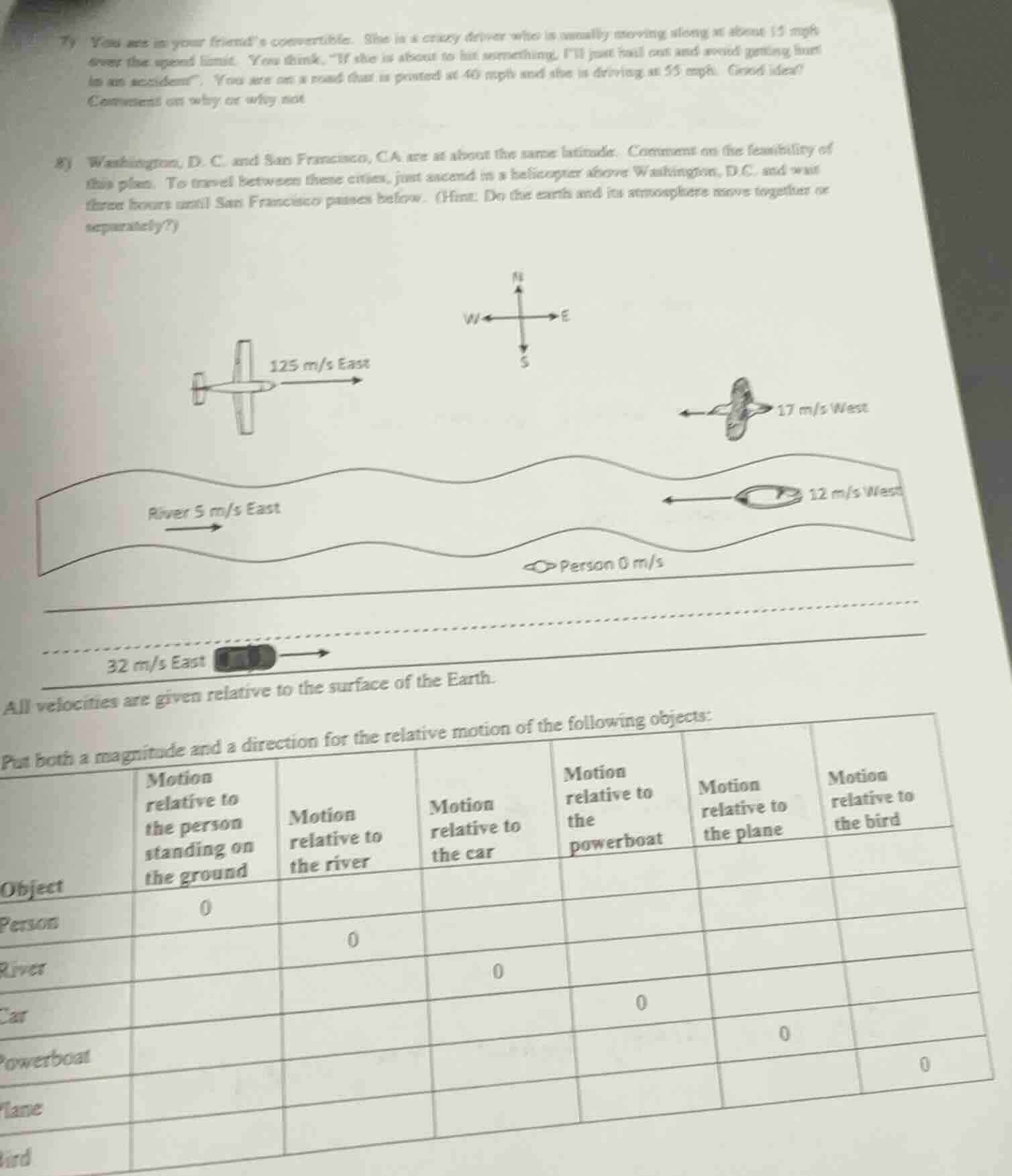
Question
- you are in your friends convertible. she is a crazy driver who is usually moving along at about 15 mph over the speed limit. you think, \if she is about to hit something, ill just bail out and avoid getting hurt in an accident\. you are on a road that is posted at 40 mph and she is driving at 55 mph. good idea? comment on why or why not
- washington, d. c. and san francisco, ca are at about the same latitude. comment on the feasibility of this plan. to travel between these cities, just ascend in a helicopter above washington, d. c. and wait three hours until san francisco passes below. (hint: do the earth and its atmosphere move together or separately?)
all velocities are given relative to the surface of the earth.
put both a magnitude and a direction for the relative motion of the following objects:
| object | motion relative to the person standing on the ground | motion relative to the river | motion relative to the car | motion relative to the powerboat | motion relative to the plane | motion relative to the bird | ---- | ---- | ---- | ---- | ---- | ---- | ---- | person | 0 | river | 0 | car | 0 | powerboat | 0 | plane | 0 | bird | 0 |
---
Question 7 Explanation:
When you jump out of the moving convertible, you are already moving at 55 mph relative to the ground. You will continue moving at that horizontal speed (due to inertia) when you exit, so you will still collide with objects ahead or hit the ground at high speed, resulting in injury.
---
Question 8 Explanation:
Earth's atmosphere rotates along with the planet. When you ascend in a helicopter, you remain moving with the Earth's rotation (and the atmosphere) at the same speed as Washington, D.C. San Francisco will not pass below you; you will stay above the same relative spot on the Earth's surface.
---
Relative Motion Calculations (Step-by-Step for selected examples, using sign convention: East = positive, West = negative)
Step1: Define reference values
Let:
- $v_{person/ground} = 0$ m/s
- $v_{river/ground} = +5$ m/s
- $v_{car/ground} = +32$ m/s
- $v_{boat/ground} = -17$ m/s
- $v_{plane/ground} = +125$ m/s
- $v_{bird/ground} = -17$ m/s
Relative velocity formula: $v_{A/B} = v_{A/ground} - v_{B/ground}$
Step2: Person relative to river
$v_{person/river} = v_{person/ground} - v_{river/ground}$
$v_{person/river} = 0 - 5 = -5$ m/s = 5 m/s West
Step3: River relative to car
$v_{river/car} = v_{river/ground} - v_{car/ground}$
$v_{river/car} = 5 - 32 = -27$ m/s = 27 m/s West
Step4: Car relative to powerboat
$v_{car/boat} = v_{car/ground} - v_{boat/ground}$
$v_{car/boat} = 32 - (-17) = 49$ m/s = 49 m/s East
Step5: Plane relative to bird
$v_{plane/bird} = v_{plane/ground} - v_{bird/ground}$
$v_{plane/bird} = 125 - (-17) = 142$ m/s = 142 m/s East
All other table values use the same relative velocity formula with the defined reference speeds.

Snap & solve any problem in the app
Get step-by-step solutions on Sovi AI
Photo-based solutions with guided steps
Explore more problems and detailed explanations
Question 7:
No, this is not a good idea.
Question 8:
This plan is not feasible.
Relative Motion Table:
| Object | Motion relative to the person standing on the ground | Motion relative to the river | Motion relative to the car | Motion relative to the powerboat | Motion relative to the plane | Motion relative to the bird |
|---|---|---|---|---|---|---|
| River | 5 m/s East | 0 m/s | 27 m/s West | 17 m/s East | 120 m/s West | 17 m/s East |
| Car | 32 m/s East | 27 m/s East | 0 m/s | 44 m/s East | 93 m/s West | 49 m/s East |
| Powerboat | 17 m/s West | 22 m/s West | 49 m/s West | 0 m/s | 142 m/s West | 0 m/s |
| Plane | 125 m/s East | 120 m/s East | 93 m/s East | 142 m/s East | 0 m/s | 142 m/s East |
| Bird | 17 m/s West | 22 m/s West | 49 m/s West | 0 m/s | 142 m/s West | 0 m/s |