QUESTION IMAGE
Question
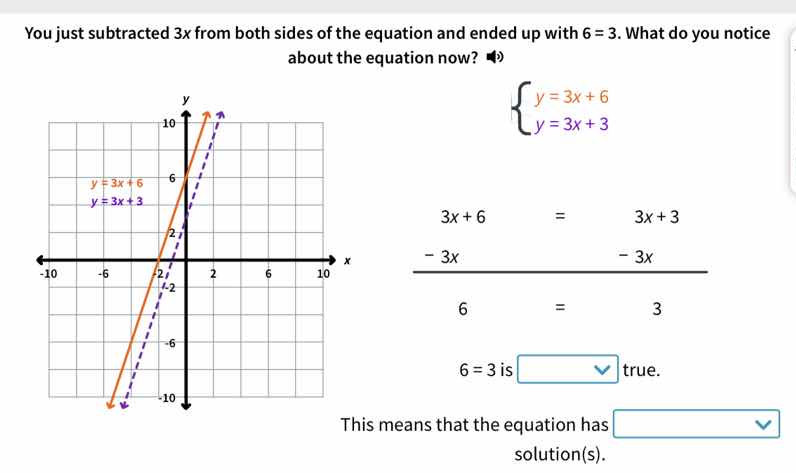
you just subtracted 3x from both sides of the equation and ended up with 6 = 3. what do you notice about the equation now?
\\(\
\\)
\\(\
\\)
6 = 3 is \\(\boldsymbol{\text{true}}\\).
this means that the equation has \\(\boldsymbol{\text{solution(s)}}\\).
Step1: Analyze the result \(6 = 3\)
We know that in mathematics, an equation is a statement that two expressions are equal. Here, after subtracting \(3x\) from both sides of the equation \(3x + 6=3x + 3\), we get \(6 = 3\). But \(6\) and \(3\) are two different numbers, and \(6
eq3\). So the statement \(6 = 3\) is false.
Step2: Relate to the number of solutions
For a system of linear equations (in this case, the two equations \(y = 3x+6\) and \(y = 3x + 3\) are linear equations in two variables), if after performing algebraic operations we end up with a false statement (like \(6 = 3\)), this means that the system of equations has no solution. This is because there are no values of \(x\) and \(y\) that can satisfy both equations simultaneously. If we think about the graphs of these two lines, they are parallel (since they have the same slope, \(m = 3\), but different y - intercepts, \(6\) and \(3\)) and parallel lines never intersect, so there are no solutions.

Snap & solve any problem in the app
Get step-by-step solutions on Sovi AI
Photo-based solutions with guided steps
Explore more problems and detailed explanations
The first box: false; The second box: no