QUESTION IMAGE
Question
if you know the area and are looking for a missing side, use the area formulas backwards.
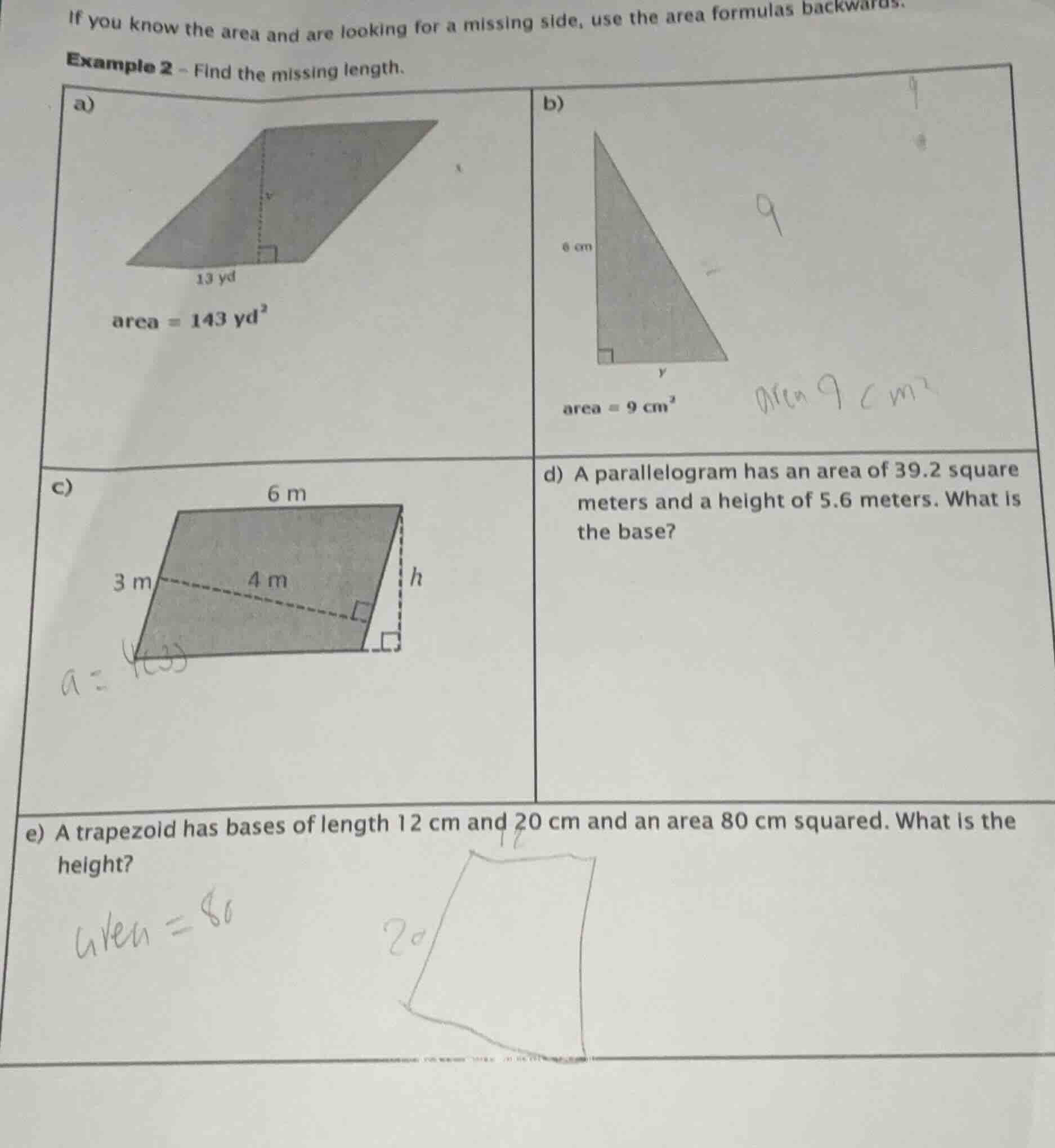
example 2 - find the missing length.
a)
13 yd
area = 143 $yd^{2}$
b)
6 cm
area = 9 $cm^{2}$
c)
6 m
3 m
4 m
d) a parallelogram has an area of 39.2 square meters and a height of 5.6 meters. what is the base?
e) a trapezoid has bases of length 12 cm and 20 cm and an area 80 cm squared. what is the height?
Step1: Use parallelogram area formula
The area of a parallelogram is $A = b \times h$. Rearrange to solve for height $x$:
$x = \frac{A}{b}$
Substitute $A=143$, $b=13$:
$x = \frac{143}{13}$
Step2: Calculate the value of x
$x = 11$
Step3: Use triangle area formula
The area of a triangle is $A = \frac{1}{2} \times b \times h$. Rearrange to solve for base $y$:
$y = \frac{2A}{h}$
Substitute $A=9$, $h=6$:
$y = \frac{2 \times 9}{6}$
Step4: Calculate the value of y
$y = 3$
Step5: Find area first, then solve for h
First, calculate the area of the parallelogram using side $3$ m and height $4$ m:
$A = 3 \times 4 = 12$ $m^2$
Rearrange $A = b \times h$ to solve for $h$:
$h = \frac{A}{b}$
Substitute $A=12$, $b=6$:
$h = \frac{12}{6}$
Step6: Calculate the value of h
$h = 2$
Step7: Solve for parallelogram base
Rearrange $A = b \times h$ to solve for base $b$:
$b = \frac{A}{h}$
Substitute $A=39.2$, $h=5.6$:
$b = \frac{39.2}{5.6}$
Step8: Calculate the base value
$b = 7$
Step9: Use trapezoid area formula
The area of a trapezoid is $A = \frac{1}{2} \times (b_1 + b_2) \times h$. Rearrange to solve for $h$:
$h = \frac{2A}{b_1 + b_2}$
Substitute $A=80$, $b_1=12$, $b_2=20$:
$h = \frac{2 \times 80}{12 + 20}$
Step10: Calculate the height value
$h = \frac{160}{32} = 5$

Snap & solve any problem in the app
Get step-by-step solutions on Sovi AI
Photo-based solutions with guided steps
Explore more problems and detailed explanations
a) $11$ yd
b) $3$ cm
c) $2$ m
d) $7$ meters
e) $5$ cm