QUESTION IMAGE
Question
as you like it
by william shakespeare
act iii, scene 2
this scene from shakespeare’s play tells the story of rosalind as
she flees persecution from her uncle’s court. accompanying her is
her cousin celia. the two journey to the forest of arden. to
further disguise herself, rosalind wears the clothing of a boy
shepherd and takes the name ganymede. in this scene, rosalind
learns that her love, orlando, has been hanging poems on the
trees throughout the forest, proclaiming his love for her. posing
as ganymede, rosalind starts a conversation with orlando to
learn more and offer “his” advice.
rosalind: there is a man haunts the forest, that
abuses our young plants with carving “rosalind” on
their barks, hangs odes upon hawthorns and elegies
on brambles, all, forsooth, deifying the name of
rosalind: if i could meet that fancy - monger i would
give him some good counsel, for he seems to have the
quotidian of love upon him.
orlando: i am he that is so love - shaked: i pray you tell
me
your remedy.
(10) rosalind: there is none of my uncle’s marks upon you:
he
taught me how to know a man in love; in which cage
of rushes i am sure you are not prisoner.
orlando: what were his marks?
rosalind: a lean cheek, which you have not, a blue eye
and
(15) sunken, which you have not, an unquestionable
aunt, which you have not, a beard neglected,
which you have not, but i pardon you for that,
for
simply your having in beard is a younger brother’s
reverence then your hose should be ungartered, your
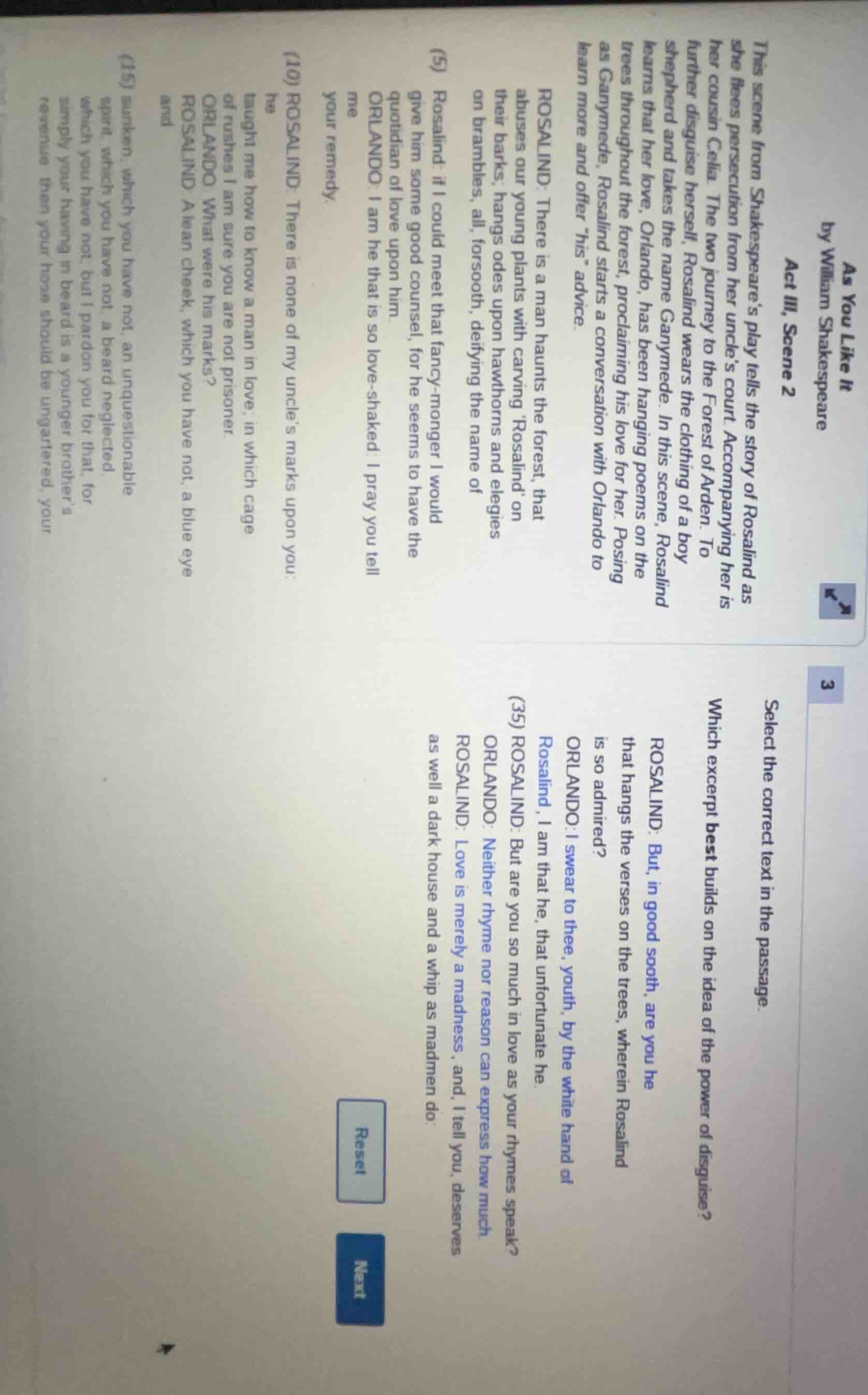
select the correct text in the passage.
which excerpt best builds on the idea of the power of disguise?
rosalind: but, in good sooth, are you he
that hangs the verses on the trees, wherein rosalind
is so admired?
orlando: i swear to thee, youth, by the white hand of
rosalind, i am that he, that unfortunate he.
(35) rosalind: but are you so much in love as your rhymes speak?
orlando: neither rhyme nor reason can express how much
rosalind: love is merely a madness, and, i tell you, deserves
as well a dark house and a whip as madmen do.
To determine which excerpt builds on the idea of the power of disguise, we analyze each option:
- The first part of the passage (before the questions) describes Rosalind disguising as Ganymede. The relevant excerpt for disguise's power would involve elements of her disguise affecting interactions. The line "ORLANDO: I am that he, that unfortunate he." comes after Rosalind (as Ganymede) interacts with Orlando. Orlando's recognition (or lack thereof, but here he refers to himself in a way tied to Rosalind's disguise - related interaction) and the context of Rosalind's disguise (as Ganymede) influencing their conversation. Wait, actually, let's re - evaluate. The question is about the power of disguise. The excerpt "ORLANDO: I swear to thee, youth, by the white hand of Rosalind, I am that he, that unfortunate he." Here, Orlando is speaking to Rosalind (disguised as Ganymede) and refers to himself in the context of his love for Rosalind. But the key is which excerpt shows the power of disguise. Wait, maybe the first part of the passage's description: "she flees persecution... disguises herself... Rosalind wears the clothing of a boy shepherd...". But the options are the excerpts given. Wait, the user's question is "Which excerpt best builds on the idea of the power of disguise?". Let's look at the options (the excerpts provided):
- "ROSALIND: But, in good sooth, are you he that hangs the verses on the trees, wherein Rosalind is so admired?" - This is about the verses, not disguise.
- "ORLANDO: I swear to thee, youth, by the white hand of Rosalind, I am that he, that unfortunate he." - Orlando is speaking to Rosalind (disguised as Ganymede). His interaction with the disguised Rosalind (as a youth) shows the power of her disguise - she is able to engage with him in a way that he doesn't recognize her fully (or in the way she is normally), and this interaction is driven by her disguise.
- "ROSALIND: But are you so much in love as your rhymes speak?" - This is about love and rhymes, not disguise.
- "ORLANDO: Neither rhyme nor reason can express how much" - About expressing love, not disguise.
- "ROSALIND: Love is merely a madness... deserves as well a dark house and a whip as madmen do." - About love as madness, not disguise.
Wait, maybe I misread. The correct excerpt should be related to how disguise affects the interaction. The excerpt where Orlando interacts with Rosalind (disguised as Ganymede) - "ORLANDO: I swear to thee, youth, by the white hand of Rosalind, I am that he, that unfortunate he." Because Rosalind's disguise (as a youth) allows her to be in a position where Orlando confides in her (the youth) about his feelings for Rosalind, showing the power of her disguise to facilitate this interaction.

Snap & solve any problem in the app
Get step-by-step solutions on Sovi AI
Photo-based solutions with guided steps
Explore more problems and detailed explanations
ORLANDO: I swear to thee, youth, by the white hand of Rosalind, I am that he, that unfortunate he.