QUESTION IMAGE
Question
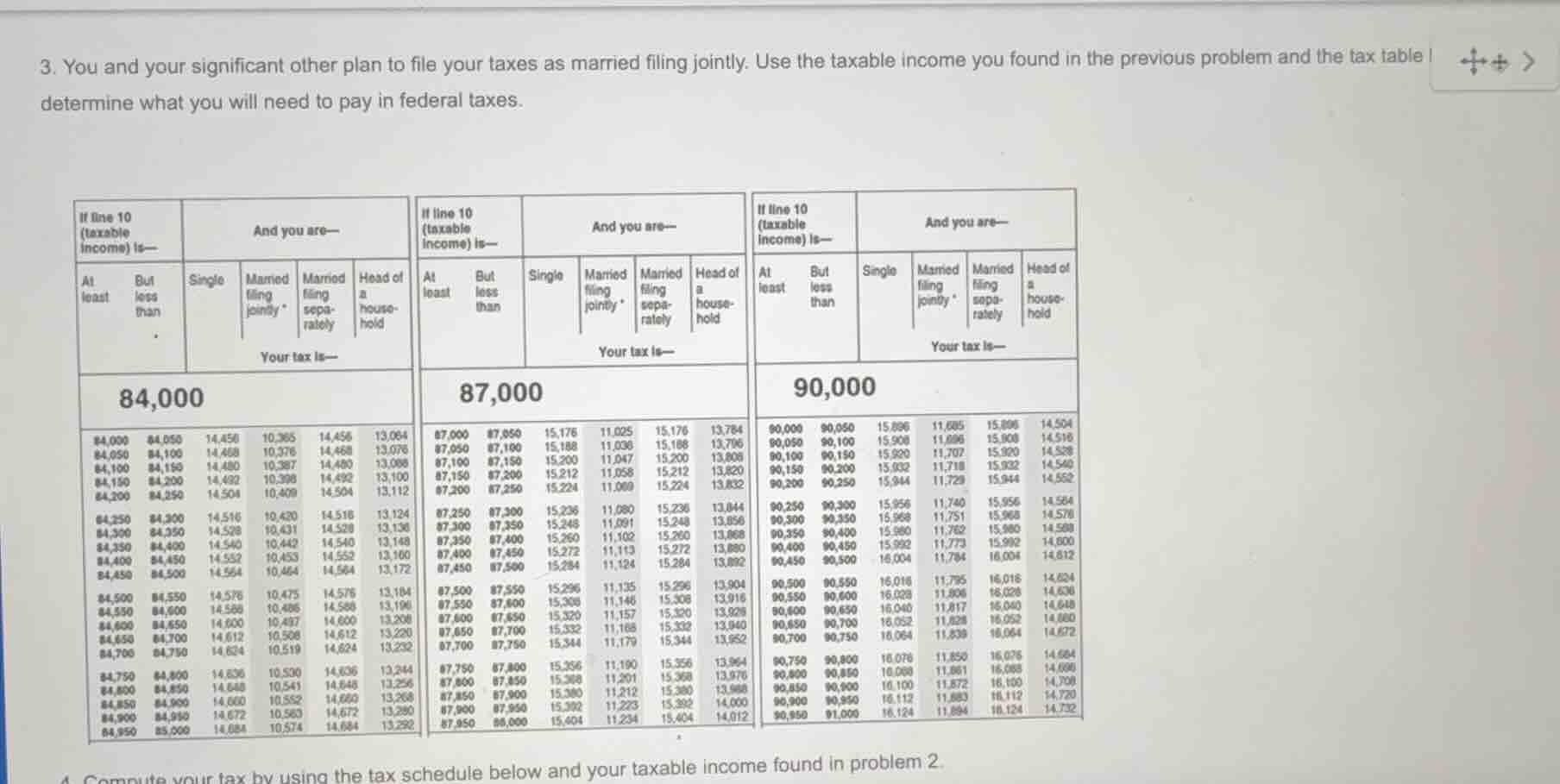
- you and your significant other plan to file your taxes as married filing jointly. use the taxable income you found in the previous problem and the tax table determine what you will need to pay in federal taxes.
tax table with columns for taxable income ranges and rows for different filing statuses (single, married filing jointly, married filing separately, head of household) and corresponding tax amounts for income ranges starting at 84,000, 87,000, 90,000
- compute your tax by using the tax schedule below and your taxable income found in problem 2.
To solve this, we need the taxable income from the previous problem (Problem 2). Since it's not provided here, we can't proceed with the calculation. However, here's the general approach:
Step 1: Identify Taxable Income
Let’s assume the taxable income from Problem 2 is, for example, $85,000 (to demonstrate). Locate the row in the tax table where “At least” ≤ taxable income < “But less than.”
Step 2: Select “Married Filing Jointly” Column
In the tax table, find the column labeled “Married filing jointly.” For a taxable income of $85,000, look at the row where “At least” is 84,950 and “But less than” is 85,000. The tax for “Married filing jointly” in that row is $10,574 (from the table provided).
Since the actual taxable income from Problem 2 is missing, substitute it into the table to find the corresponding tax.
If you provide the taxable income from Problem 2, we can calculate the exact federal tax. For example, if the taxable income is $86,000, locate the row for 86,000 (or the appropriate range) and use the “Married filing jointly” column to find the tax.

Snap & solve any problem in the app
Get step-by-step solutions on Sovi AI
Photo-based solutions with guided steps
Explore more problems and detailed explanations
To solve this, we need the taxable income from the previous problem (Problem 2). Since it's not provided here, we can't proceed with the calculation. However, here's the general approach:
Step 1: Identify Taxable Income
Let’s assume the taxable income from Problem 2 is, for example, $85,000 (to demonstrate). Locate the row in the tax table where “At least” ≤ taxable income < “But less than.”
Step 2: Select “Married Filing Jointly” Column
In the tax table, find the column labeled “Married filing jointly.” For a taxable income of $85,000, look at the row where “At least” is 84,950 and “But less than” is 85,000. The tax for “Married filing jointly” in that row is $10,574 (from the table provided).
Since the actual taxable income from Problem 2 is missing, substitute it into the table to find the corresponding tax.
If you provide the taxable income from Problem 2, we can calculate the exact federal tax. For example, if the taxable income is $86,000, locate the row for 86,000 (or the appropriate range) and use the “Married filing jointly” column to find the tax.