QUESTION IMAGE
Question
do you understand?
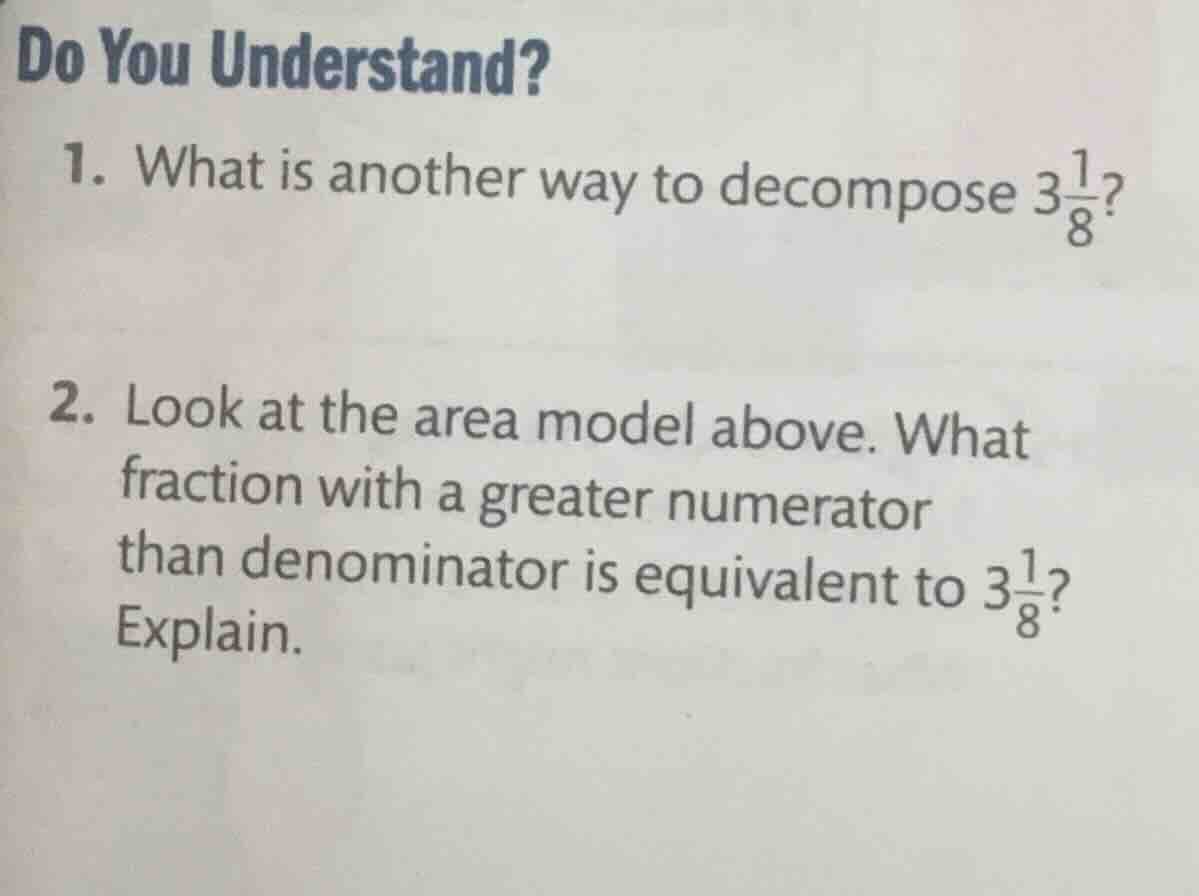
- what is another way to decompose $3\frac{1}{8}$?
- look at the area model above. what fraction with a greater numerator than denominator is equivalent to $3\frac{1}{8}$? explain.
Question 1
Step1: Recall mixed number decomposition
A mixed number \( a\frac{b}{c} \) can be decomposed by splitting the whole number part into smaller whole numbers and keeping the fractional part, or by expressing the whole number part as a sum of fractions with the same denominator as the fractional part. For \( 3\frac{1}{8} \), we can split the whole number 3 into, for example, \( 2 + 1 \), so \( 3\frac{1}{8}=2 + 1+\frac{1}{8}=2\frac{9}{8} \) (another way: \( 3\frac{1}{8}=1 + 1+ 1+\frac{1}{8} \), or \( 3\frac{1}{8}=2\frac{1}{8}+\frac{8}{8} \) since \( \frac{8}{8}=1 \), so \( 2\frac{1}{8}+1 = 3\frac{1}{8} \), but a common decomposition is to split the whole number and re - express part of it as a fraction. Let's use the method of converting part of the whole number to a fraction with denominator 8. We know that \( 3=\frac{24}{8} \), so \( 3\frac{1}{8}=\frac{23}{8}+\frac{1}{8} \)? No, wait, another way: \( 3\frac{1}{8}=2 + 1\frac{1}{8}=2+\frac{9}{8}=2\frac{9}{8} \), or \( 1+2\frac{1}{8} \), or \( 3\frac{1}{8}= \frac{24}{8}+\frac{1}{8}=\frac{25}{8} \) (but that's improper fraction). Wait, the question is about decomposition of mixed number. So we can write \( 3\frac{1}{8}=2 + 1\frac{1}{8} \), or \( 3\frac{1}{8}=1+1 + 1+\frac{1}{8} \), or \( 3\frac{1}{8}=2\frac{1}{8}+1 \) (since \( 2\frac{1}{8}+1=3\frac{1}{8} \)). Let's take a simple decomposition: split the whole number 3 into \( 2 + 1 \), so \( 3\frac{1}{8}=2 + 1\frac{1}{8}=2+\frac{9}{8}=2\frac{9}{8} \), or we can also write \( 3\frac{1}{8}=1+2\frac{1}{8} \), or \( 3\frac{1}{8}=3+\frac{1}{8} \) (but that's the original, so we need another way). Let's use the formula for decomposing a mixed number by expressing the whole number as a sum of fractions. Since \( 3=\frac{24}{8} \), we can write \( 3\frac{1}{8}=\frac{23}{8}+\frac{1}{8} \)? No, that's not right. Wait, the standard way to decompose a mixed number is to break the whole number part into smaller whole numbers and the fractional part. For example, \( 3\frac{1}{8}=2 + 1+\frac{1}{8}=2\frac{1}{8}+1 \), or \( 3\frac{1}{8}=1+1+1+\frac{1}{8} \), or \( 3\frac{1}{8}=2\frac{9}{8} \) (because \( 1\frac{1}{8}=\frac{9}{8} \) and \( 2+\frac{9}{8}=2\frac{9}{8} \)).
Step2: Provide a valid decomposition
One way is to write \( 3\frac{1}{8}=2 + 1\frac{1}{8} \), or \( 3\frac{1}{8}=1+2\frac{1}{8} \), or \( 3\frac{1}{8}=2\frac{1}{8}+\frac{8}{8} \) (since \( \frac{8}{8} = 1 \), so \( 2\frac{1}{8}+1=3\frac{1}{8} \)). A more straightforward decomposition is \( 3\frac{1}{8}=2 + 1\frac{1}{8} \) (we can also decompose the whole number 3 into \( 1+1 + 1 \), so \( 3\frac{1}{8}=1+1+1+\frac{1}{8} \)).
Step1: Recall the formula for converting mixed number to improper fraction
The formula to convert a mixed number \( a\frac{b}{c} \) to an improper fraction is \( \frac{a\times c + b}{c} \). For the mixed number \( 3\frac{1}{8} \), where \( a = 3 \), \( b = 1 \) and \( c=8 \).
Step2: Apply the formula
First, calculate \( a\times c=3\times8 = 24 \). Then add \( b \): \( 24 + 1=25 \). So the improper fraction is \( \frac{25}{8} \). We can check: \( \frac{25}{8}=3\frac{1}{8} \) because \( 25\div8 = 3 \) with a remainder of 1, so \( \frac{25}{8}=3\frac{1}{8} \). And in the fraction \( \frac{25}{8} \), the numerator \( 25 \) is greater than the denominator \( 8 \).

Snap & solve any problem in the app
Get step-by-step solutions on Sovi AI
Photo-based solutions with guided steps
Explore more problems and detailed explanations
One way is \( 2 + 1\frac{1}{8} \) (or \( 1+2\frac{1}{8} \), or \( 1 + 1+1+\frac{1}{8} \), or \( 2\frac{1}{8}+\frac{8}{8} \) etc.)