QUESTION IMAGE
Question
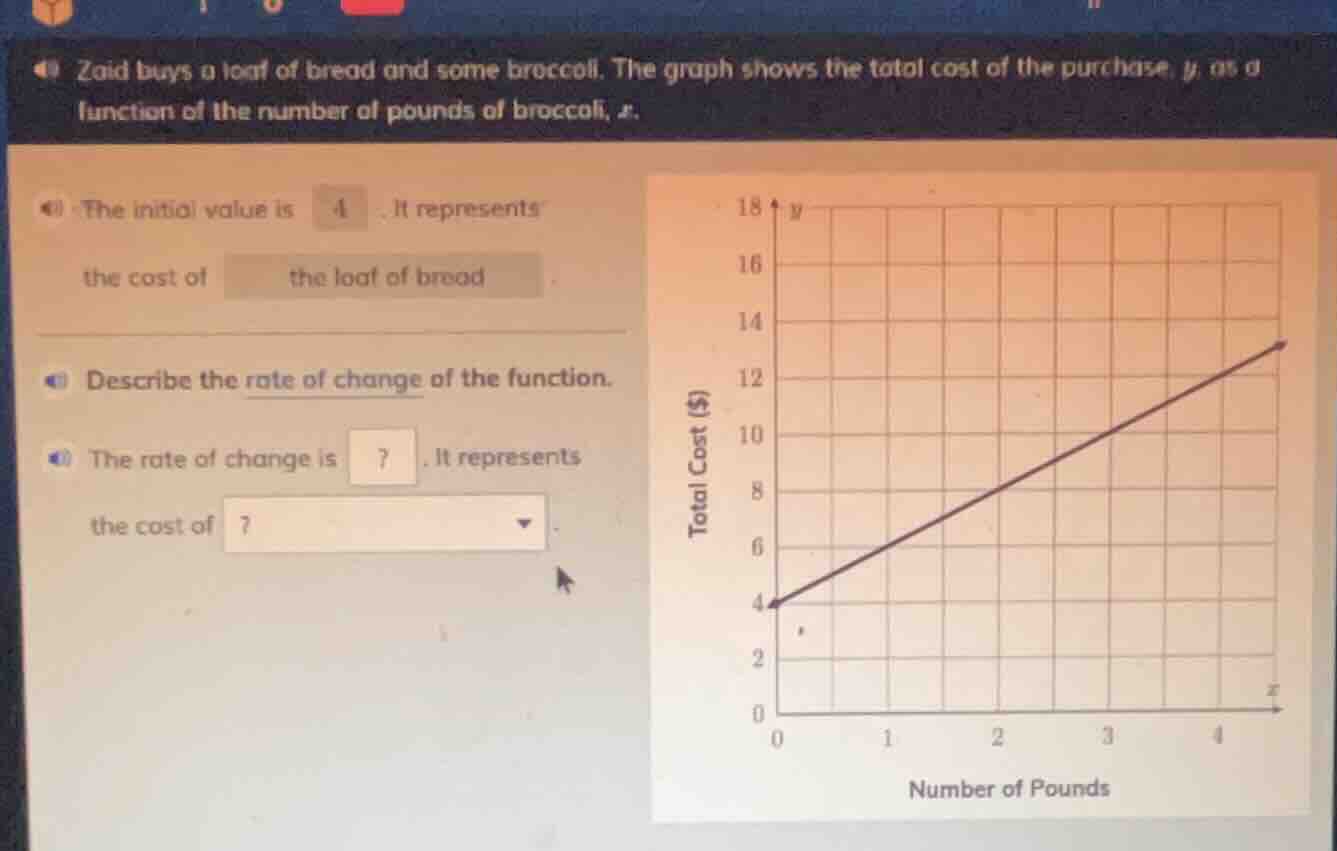
zaid buys a loaf of bread and some broccoli. the graph shows the total cost of the purchase, y, as a function of the number of pounds of broccoli, x. the initial value is 4. it represents the cost of the loaf of bread. describe the rate of change of the function. the rate of change is? it represents the cost of? (graph: x-axis is number of pounds, y-axis is total cost ($), with a line starting at (0,4) and going up to (4,14) approximately)
Step1: Recall rate of change formula
The rate of change (slope) of a linear function \( y = mx + b \) is calculated as \( m=\frac{y_2 - y_1}{x_2 - x_1} \), where \( (x_1,y_1) \) and \( (x_2,y_2) \) are two points on the line.
From the graph, we can take two points: when \( x_1 = 0 \), \( y_1 = 4 \); when \( x_2 = 4 \), \( y_2 = 12 \) (wait, no, looking at the graph, when \( x = 0 \), \( y = 4 \); when \( x = 4 \), \( y = 12 \)? Wait, no, the final point at \( x = 4 \) is \( y = 12 \)? Wait, no, the graph goes from (0,4) to, let's check the grid. Each grid square: x-axis is pounds, y-axis is dollars. Let's take (0,4) and (4,12)? Wait, no, when x=0, y=4; x=1, y=6? Wait, no, the first point is (0,4), then at x=1, y=6? Wait, no, the graph: from (0,4) to (4,12)? Wait, no, let's recalculate. Wait, the initial value (y-intercept) is 4 (when x=0, y=4). Let's take two points: (0, 4) and (4, 12). Then the slope (rate of change) is \( \frac{12 - 4}{4 - 0}=\frac{8}{4}=2 \). Wait, maybe I misread the graph. Wait, the y-axis: 4, 6, 8, 10, 12, 14. So when x=0, y=4; x=1, y=6? No, wait, the first segment: from (0,4) to (1,6)? No, the grid: each x is 1 pound, each y is 2 dollars? Wait, no, the y-axis has 4, 6, 8, 10, 12, 14. So the distance between 4 and 6 is 2, so each grid line is 2? No, the labels are 4, 6, 8, etc., so each unit is 2? Wait, no, the problem's graph: the y-axis is labeled 0,2,4,6,8,10,12,14,16,18. Wait, I see, the y-axis has ticks at 0,2,4,6,8,10,12,14,16,18. So (0,4) is at y=4, x=0. Then, let's take x=0, y=4; x=4, y=12. So the change in y is 12 - 4 = 8, change in x is 4 - 0 = 4. So rate of change is \( \frac{8}{4}=2 \). Wait, but the user's question has a box with 7? No, maybe I made a mistake. Wait, no, let's check again. Wait, the initial value is 4 (cost of bread). Now, rate of change: slope of the line. The line passes through (0,4) and (4,12)? Wait, no, when x=0, y=4; x=1, y=6? No, the graph: from (0,4) to (4,12). So slope is (12-4)/(4-0)=8/4=2. So the rate of change is 2, representing the cost per pound of broccoli. Wait, maybe the user's graph was misread. Wait, let's do it correctly. The linear function is y = mx + 4. When x=4, y=12 (from the graph, at x=4, y=12). So 12 = 4m + 4 → 4m = 8 → m=2. So the rate of change is 2, which is the cost per pound of broccoli.
Step1: Identify two points on the line
We have the point (0, 4) (when \( x = 0 \), \( y = 4 \)) and (4, 12) (when \( x = 4 \), \( y = 12 \)).
Step2: Calculate the rate of change (slope)
The formula for rate of change (slope) is \( m=\frac{y_2 - y_1}{x_2 - x_1} \). Substituting \( (x_1, y_1)=(0, 4) \) and \( (x_2, y_2)=(4, 12) \):
\[
m=\frac{12 - 4}{4 - 0}=\frac{8}{4}=2
\]
This rate of change represents the cost per pound of broccoli, as it's the change in total cost (y) per change in pounds of broccoli (x).

Snap & solve any problem in the app
Get step-by-step solutions on Sovi AI
Photo-based solutions with guided steps
Explore more problems and detailed explanations
The rate of change is \( 2 \). It represents the cost of one pound of broccoli.