QUESTION IMAGE
Question
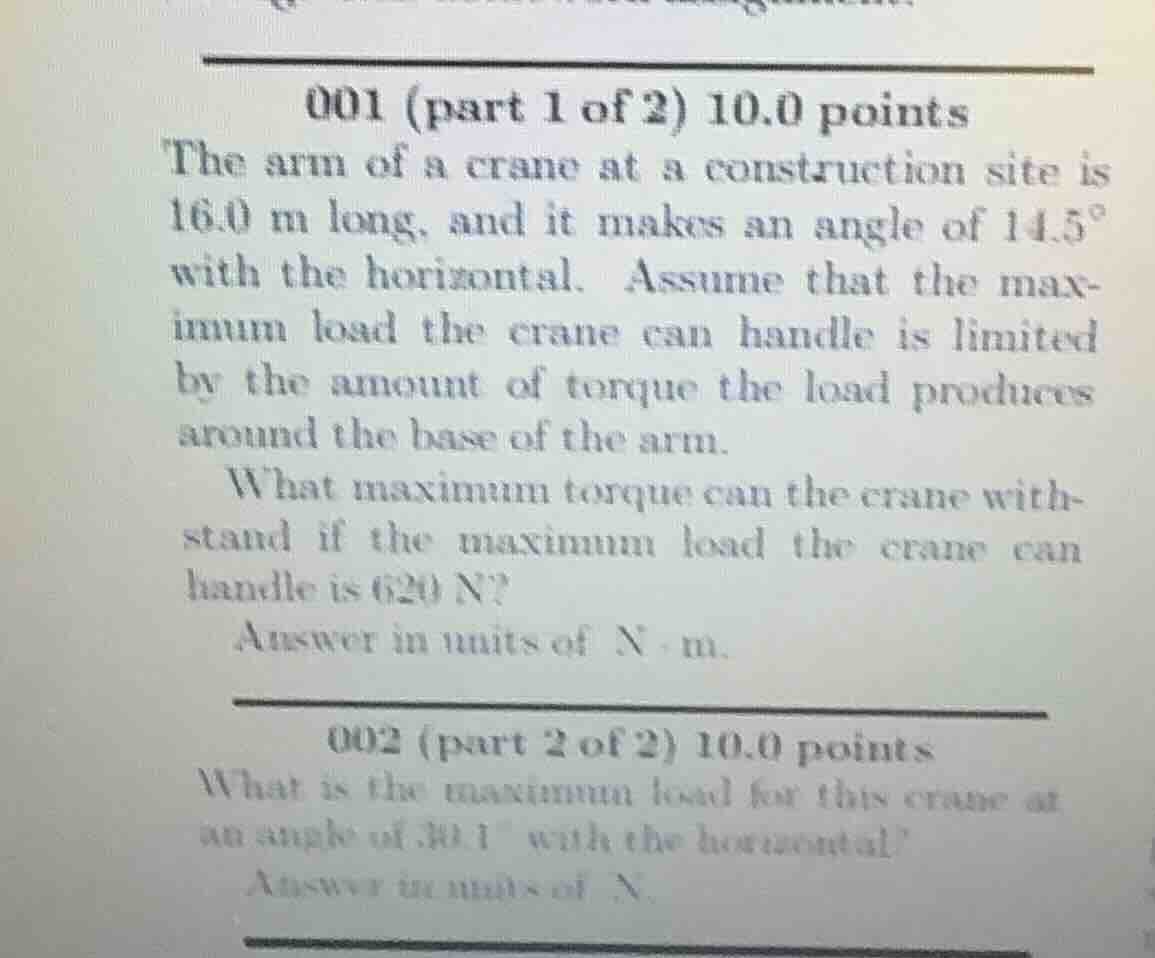
001 (part 1 of 2) 10.0 points
the arm of a crane at a construction site is 16.0 m long, and it makes an angle of 14.5° with the horizontal. assume that the maximum load the crane can handle is limited by the amount of torque the load produces around the base of the arm.
what maximum torque can the crane withstand if the maximum load the crane can handle is 620 n?
answer in units of n·m.
002 (part 2 of 2) 10.0 points
what is the maximum load for this crane at an angle of 30.1° with the horizontal?
answer in units of n.
Step1: Identify torque formula
Torque $\tau = rF\sin\theta$, where $r$ is arm length, $F$ is load, $\theta$ is angle between arm and horizontal (the perpendicular distance uses $\sin\theta$ for vertical component).
Step2: Calculate torque for part1
Substitute $r=16.0\ \text{m}$, $F=620\ \text{N}$, $\theta=14.5^\circ$
$\tau = 16.0 \times 620 \times \sin(14.5^\circ)$
First calculate $\sin(14.5^\circ) \approx 0.2504$
$\tau = 16.0 \times 620 \times 0.2504 \approx 2483.84$
Step3: Find max load for part2
First use max torque from part1. Rearrange $\tau = rF\sin\theta$ to $F = \frac{\tau}{r\sin\theta}$
Substitute $\tau \approx 2483.84\ \text{N·m}$, $r=16.0\ \text{m}$, $\theta=30.1^\circ$
$\sin(30.1^\circ) \approx 0.5015$
$F = \frac{2483.84}{16.0 \times 0.5015} \approx 310$

Snap & solve any problem in the app
Get step-by-step solutions on Sovi AI
Photo-based solutions with guided steps
Explore more problems and detailed explanations
Part 1: $\approx 2480\ \text{N·m}$ (or $2484\ \text{N·m}$ for more precision)
Part 2: $\approx 310\ \text{N}$