QUESTION IMAGE
Question
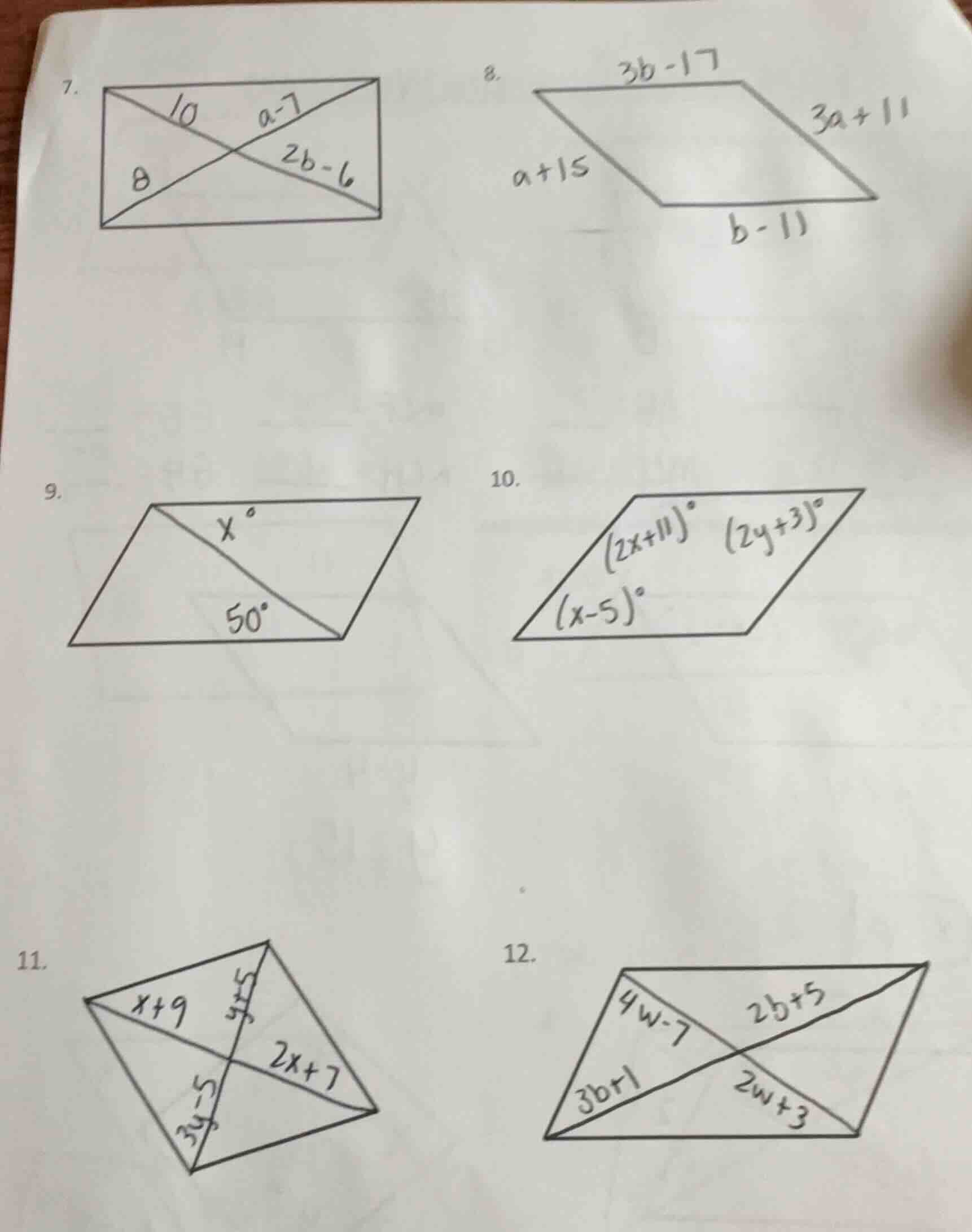
7.
8.
9.
10.
11.
12.
Problem 7 (Rectangle, Diagonals Bisect Each Other)
Step1: Recall rectangle diagonal property
In a rectangle, diagonals are equal and bisect each other. So, the segments of the diagonals are equal. Thus, \(a - 7=8\) and \(10 = 2b - 6\).
Step2: Solve for \(a\)
From \(a - 7=8\), add 7 to both sides: \(a=8 + 7=15\).
Step3: Solve for \(b\)
From \(10 = 2b - 6\), add 6 to both sides: \(10+6 = 2b\), so \(16 = 2b\). Divide by 2: \(b = 8\).
Step1: Recall parallelogram side property
In a parallelogram, opposite sides are equal. So, \(a + 15=3b - 17\) and \(3a + 11=b - 11\).
Step2: Solve the system of equations
From the second equation \(3a + 11=b - 11\), we can express \(b=3a + 22\). Substitute \(b = 3a + 22\) into the first equation:
\(a + 15=3(3a + 22)-17\)
\(a + 15=9a + 66 - 17\)
\(a + 15=9a + 49\)
Subtract \(a\) from both sides: \(15 = 8a + 49\)
Subtract 49: \(15-49 = 8a\)
\(-34 = 8a\) (Wait, this seems wrong. Maybe I mixed the sides. Let's re - check. Maybe \(a + 15=3a + 11\) and \(3b - 17=b - 11\). Ah, that's the mistake! In a parallelogram, opposite sides are equal. So, adjacent sides? No, opposite sides. So, \(a + 15\) and \(3a + 11\) are opposite? Wait, the parallelogram has sides \(a + 15\), \(3b - 17\), \(3a + 11\), \(b - 11\). So correct opposite sides: \(a + 15=3a + 11\) and \(3b - 17=b - 11\).
Step3: Solve for \(a\)
From \(a + 15=3a + 11\), subtract \(a\): \(15 = 2a + 11\), subtract 11: \(4 = 2a\), so \(a = 2\).
Step4: Solve for \(b\)
From \(3b - 17=b - 11\), subtract \(b\): \(2b - 17=-11\), add 17: \(2b=6\), so \(b = 3\).
Step1: Recall parallelogram angle and diagonal property
In a parallelogram, a diagonal divides it into two congruent triangles. Also, alternate interior angles are equal. So, \(x = 50\) (since the diagonal creates alternate interior angles which are equal in the parallelogram).

Snap & solve any problem in the app
Get step-by-step solutions on Sovi AI
Photo-based solutions with guided steps
Explore more problems and detailed explanations
\(a = 15\), \(b = 8\)