QUESTION IMAGE
Question
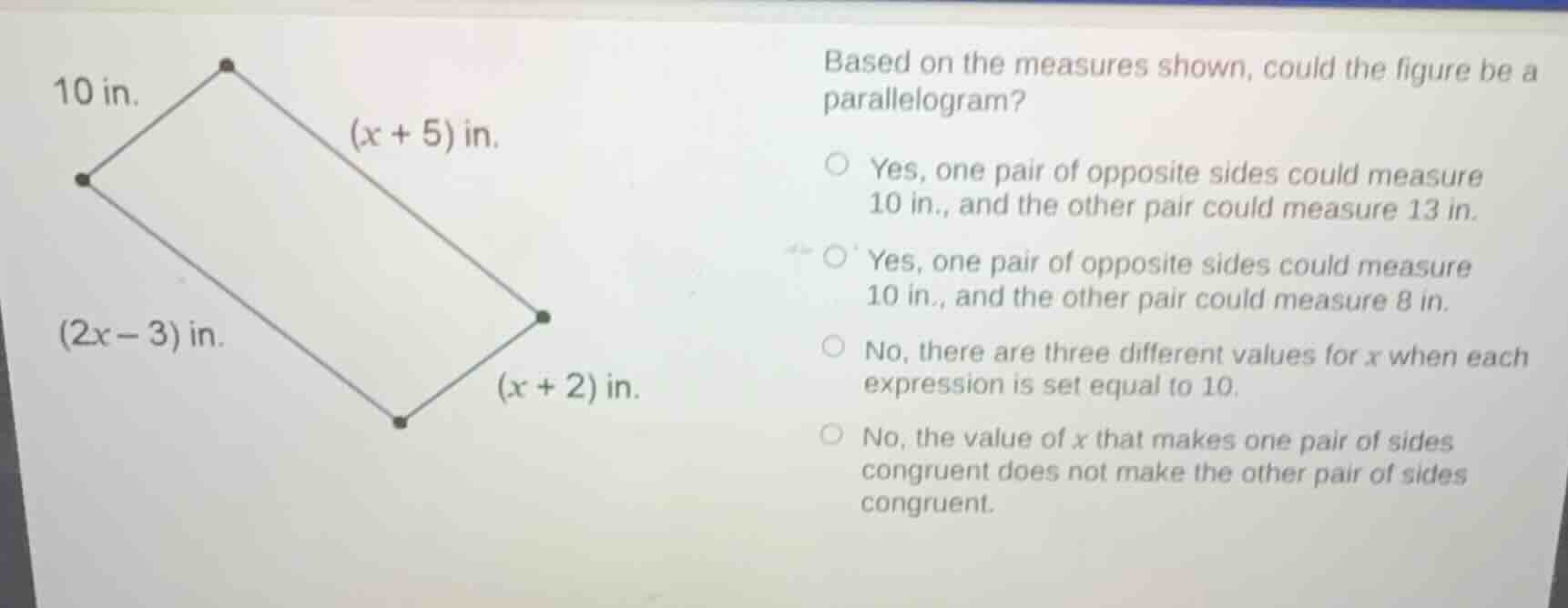
10 in.
$(x + 5)$ in.
$(2x - 3)$ in.
$(x + 2)$ in.
based on the measures shown, could the figure be a parallelogram?
- yes, one pair of opposite sides could measure 10 in., and the other pair could measure 13 in.
- yes, one pair of opposite sides could measure 10 in., and the other pair could measure 8 in.
- no, there are three different values for $x$ when each expression is set equal to 10.
- no, the value of $x$ that makes one pair of sides congruent does not make the other pair of sides congruent.
Step1: Recall parallelogram side property
In a parallelogram, opposite sides are congruent. So we need to check if we can find an \( x \) such that two pairs of opposite sides are equal. The sides are \( 10 \), \( x + 5 \), \( 2x - 3 \), \( x + 2 \). The opposite sides should be equal, so we can set up equations for possible pairs. Let's first check the pair \( x + 5 \) and \( 2x - 3 \) (opposite sides), and \( 10 \) and \( x + 2 \) (opposite sides).
Step2: Solve for \( x \) in first pair (\( x + 5 = 2x - 3 \))
Subtract \( x \) from both sides: \( 5 = x - 3 \). Then add 3 to both sides: \( x = 8 \).
Step3: Check second pair with \( x = 8 \) (\( 10 = x + 2 \))
Substitute \( x = 8 \): \( 10 = 8 + 2 \), which is \( 10 = 10 \), true. Now check the lengths: If \( x = 8 \), \( x + 5 = 13 \), \( 2x - 3 = 13 \), and \( x + 2 = 10 \). So one pair of opposite sides is 10 (10 and 10) and the other pair is 13 (13 and 13). Now check the other options. Option 2 says the other pair could be 8, but with \( x = 8 \), the other pair is 13, so option 2 is wrong. Option 3: there aren't three different \( x \) values. Option 4: the \( x \) that makes one pair congruent ( \( x = 8 \) for \( x + 5 = 2x - 3 \)) also makes the other pair congruent ( \( 10 = x + 2 \) when \( x = 8 \)). So the correct option is the first one.

Snap & solve any problem in the app
Get step-by-step solutions on Sovi AI
Photo-based solutions with guided steps
Explore more problems and detailed explanations
Yes, one pair of opposite sides could measure 10 in., and the other pair could measure 13 in.