QUESTION IMAGE
Question
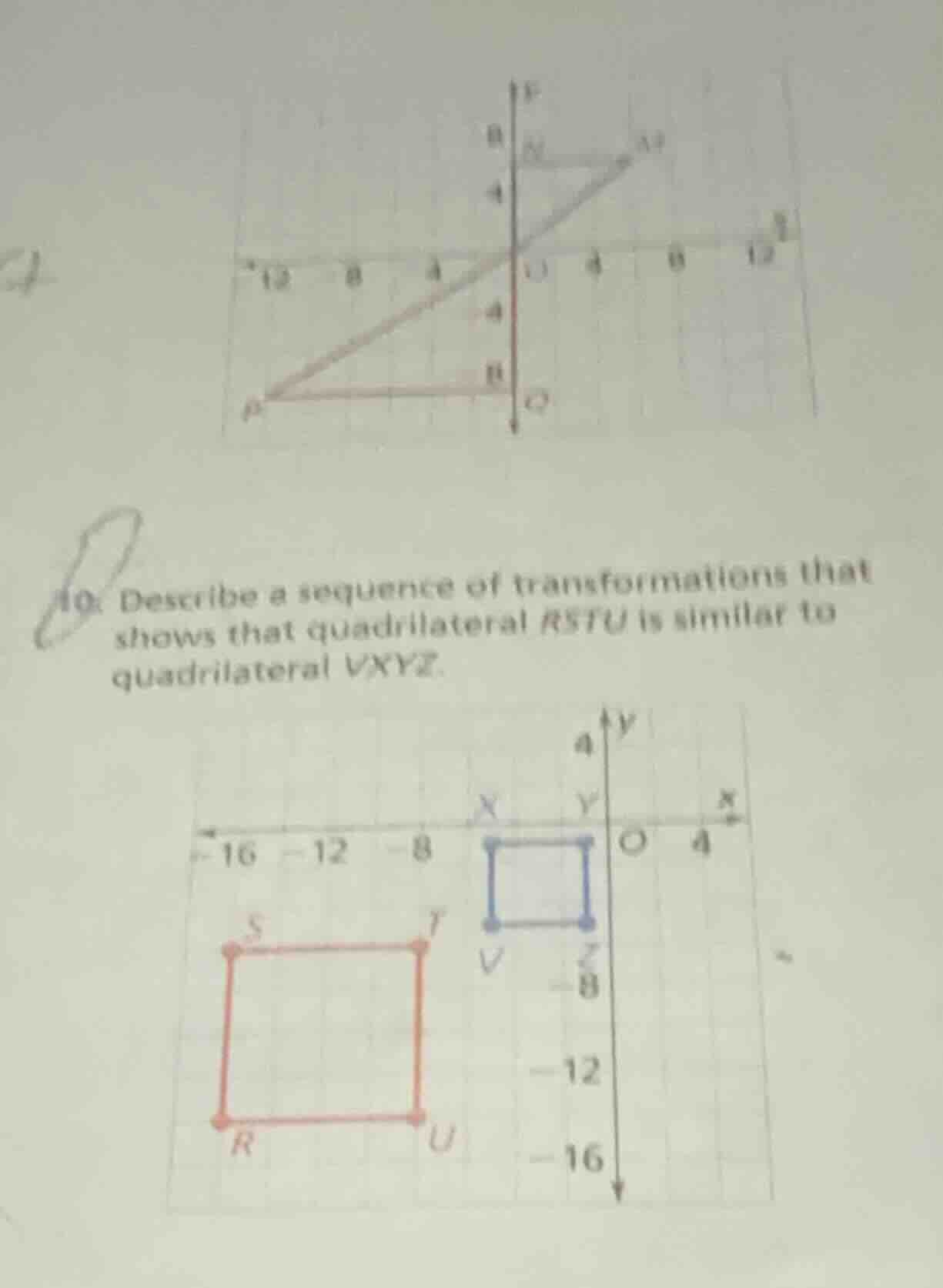
- describe a sequence of transformations that shows that quadrilateral rstu is similar to quadrilateral vxyz.
Step1: Analyze the size relationship
First, observe the side lengths of the two quadrilaterals. Let's assume the side length of quadrilateral \( VXYZ \) is \( s \), and the side length of quadrilateral \( RSTU \) is \( 3s \) (by counting the grid units, we can find the scale factor). So we can perform a dilation first. The scale factor \( k \) can be determined by comparing the corresponding side lengths. If we take the horizontal side of \( VXYZ \), from \( X(-4, -4) \) to \( Y(0, -4) \), the length is \( 4 \) units. The horizontal side of \( RSTU \), say from \( R(-12, -16) \) to \( U(-4, -16) \), the length is \( 8 \)? Wait, maybe I made a mistake. Wait, let's re - check. Let's take the coordinates: For \( VXYZ \), let's find the coordinates of the vertices. From the graph, \( V(-4, -8) \), \( X(-4, -4) \), \( Y(0, -4) \), \( Z(0, -8) \). So the length of \( VX \) (vertical side) is \( |-4 - (-8)|=4 \), and the length of \( XY \) (horizontal side) is \( |0 - (-4)| = 4 \). For \( RSTU \), let's assume \( R(-12, -16) \), \( S(-12, -8) \), \( T(-4, -8) \), \( U(-4, -16) \). Then the length of \( RS \) (vertical side) is \( |-8-(-16)| = 8 \), and the length of \( ST \) (horizontal side) is \( |-4 - (-12)|=8 \). Wait, no, maybe the scale factor is \( 2 \)? Wait, no, let's calculate the scale factor correctly. The length of \( VX \) is \( 4 \) (from \( y=-8 \) to \( y = - 4\)), and the length of \( RS \) is \( 8 \) (from \( y=-16 \) to \( y=-8 \))? Wait, maybe I misread the coordinates. Alternatively, let's use the grid. Let's assume the side length of \( VXYZ \) is \( 4 \) units (since from \( x=-4 \) to \( x = 0 \) is \( 4 \) units horizontally, and from \( y=-8 \) to \( y=-4 \) is \( 4 \) units vertically). The side length of \( RSTU \): from \( x=-12 \) to \( x=-4 \) is \( 8 \) units horizontally, and from \( y=-16 \) to \( y=-8 \) is \( 8 \) units vertically. So the scale factor \( k=\frac{8}{4}=2 \)? Wait, no, \( 8\div4 = 2 \)? Wait, \( 8\) is the length of \( RSTU\)'s side and \( 4\) is the length of \( VXYZ\)'s side, so the scale factor for dilation (enlargement) is \( 2 \)? Wait, no, if we want to go from \( VXYZ \) to \( RSTU \), we need to dilate \( VXYZ \) by a scale factor. Let's calculate the ratio of corresponding sides. The length of \( XY \) (in \( VXYZ \)): \( X(-4,-4) \), \( Y(0,-4) \), so length \( = 0 - (-4)=4 \). The length of \( ST \) (in \( RSTU \)): \( S(-12,-8) \), \( T(-4,-8) \), length \(=-4-(-12) = 8 \). So the ratio of \( ST\) to \( XY\) is \( \frac{8}{4}=2 \). So the scale factor \( k = 2 \). So first, we can dilate quadrilateral \( VXYZ \) with a scale factor of \( 2 \) centered at the origin. The rule for dilation centered at the origin is \( (x,y)\to(kx,ky) \). So for \( V(-4,-8) \), after dilation \( ( - 4\times2,-8\times2)=(-8,-16) \)? No, that's not matching. Wait, maybe the center of dilation is not the origin. Alternatively, maybe we should translate first. Wait, let's think about the transformation steps.
Step2: Dilation
First, we can perform a dilation on quadrilateral \( VXYZ \) to make its size match \( RSTU \). Let's find the scale factor. Let's take the vertical side of \( VXYZ \): from \( y=-8 \) to \( y=-4 \), length \( l_1 = 4 \). The vertical side of \( RSTU \): from \( y=-16 \) to \( y=-8 \), length \( l_2=8 \). So the scale factor \( k=\frac{l_2}{l_1}=\frac{8}{4} = 2 \). So we dilate \( VXYZ \) with a scale factor of \( 2 \) centered at the origin. The coordinates of \( V(-4,-8) \) after dilation: \( (-4\times2,-8\times2)=(-8,-16) \), \( X(-4,-4) \) after dilation: \( (-4\times2,…

Snap & solve any problem in the app
Get step-by-step solutions on Sovi AI
Photo-based solutions with guided steps
Explore more problems and detailed explanations
One possible sequence of transformations is: First, dilate quadrilateral \( VXYZ \) with a scale factor of \( 2 \) centered at the origin. Then, translate the resulting quadrilateral \( 4 \) units to the left (in the \( x \) - direction, \( y \) - coordinate remains unchanged). This sequence of a dilation (a similarity transformation) and a translation (a rigid transformation) shows that quadrilateral \( RSTU \) is similar to quadrilateral \( VXYZ \). (Note: Other valid sequences are also possible, such as dilating \( RSTU \) with a scale factor of \( \frac{1}{2} \) and translating, or combining with other rigid motions like rotation/reflection if needed, but in this case, since the figures are axis - aligned, dilation and translation suffice.)