QUESTION IMAGE
Question
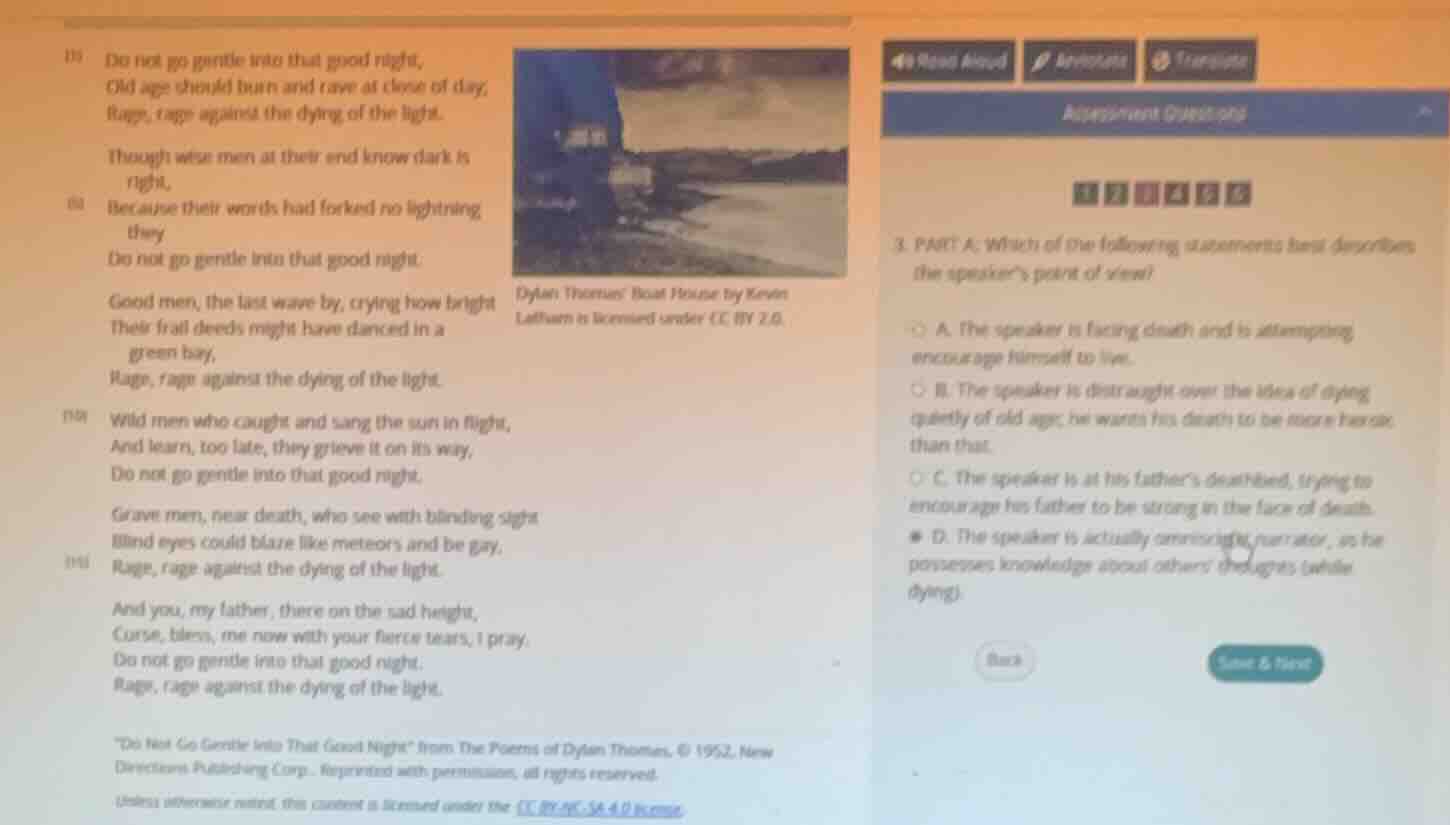
10 do not go gentle into that good night, old age should burn and rave at close of day; rage, rage against the dying of the light. though wise men at their end know dark is right, 10 because their words had forked no lightning they do not go gentle into that good night. good men, the last wave by, crying how bright their frail deeds might have danced in a green bay, rage, rage against the dying of the light. 10 wild men who caught and sang the sun in flight, and learn, too late, they grieved it on its way, do not go gentle into that good night. grave men, near death, who see with blinding sight blind eyes could blaze like meteors and be gay, 11 rage, rage against the dying of the light. and you, my father, there on the sad height, curse, bless, me now with your fierce tears, i pray. do not go gentle into that good night. rage, rage against the dying of the light. \do not go gentle into that good night\ from the poems of dylan thomas, © 1952, new directions publishing corp. reprinted with permission, all rights reserved. unless otherwise noted, this content is licensed under the cc by-nc-sa 4.0 license dylan thomas boat house by kevin latham is licensed under cc by 2.0. 3. part a: which of the following statements best describes the speaker’s point of view? a. the speaker is facing death and is attempting encourage himself to live. b. the speaker is distraught over the idea of dying quietly of old age; he wants his death to be more heroic than that. c. the speaker is at his father’s deathbed, trying to encourage his father to be strong in the face of death. d. the speaker is actually an omniscient narrator, so he possesses knowledge about others’ struggles while dying).
The poem directly addresses "you, my father" in the final stanza, where the speaker pleads with his father to resist death instead of accepting it gently. The preceding stanzas describe different types of men fighting against death, leading to the personal plea to his dying father, which matches option C. Options A and B are incorrect because the speaker is not speaking about his own death. Option D is wrong because the speaker is a personal voice addressing his father, not an omniscient narrator.

Snap & solve any problem in the app
Get step-by-step solutions on Sovi AI
Photo-based solutions with guided steps
Explore more problems and detailed explanations
C. The speaker is at his father's deathbed, trying to encourage his father to be strong in the face of death.