QUESTION IMAGE
Question
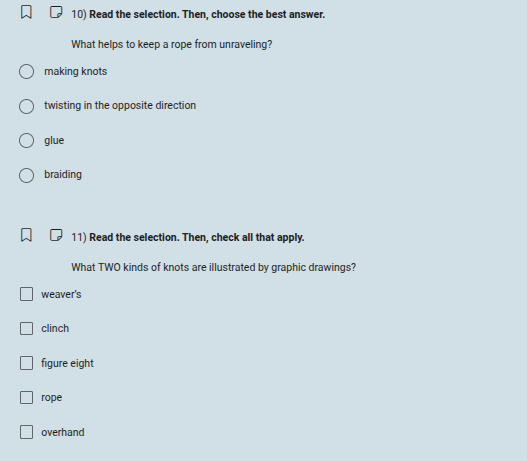
10 read the selection. then, choose the best answer.
what helps to keep a rope from unraveling?
making knots
twisting in the opposite direction
glue
braiding
- read the selection. then, check all that apply.
what two kinds of knots are illustrated by graphic drawings?
weavers
cinch
figure eight
rope
overhand
Question 10
To determine what keeps a rope from unraveling, we analyze each option:
- "Making knots": Knots are used to secure a rope and prevent it from unraveling, as they hold the rope's strands together.
- "Twisting in the opposite direction": This is more related to creating tension or adjusting a rope but not the primary way to prevent unraveling.
- "Glue": Not a typical or practical method for keeping a rope from unraveling, especially for functional ropes.
- "Braiding": Braiding is a way to structure a rope, but the act of braiding itself isn't the direct method to prevent unraveling; rather, the resulting braided structure (or using knots) does. So the best answer is making knots.
We need to identify which two knots are illustrated by graphic drawings (assuming common knot illustrations):
- "Weaver's": A specific knot, but not one of the most commonly illustrated basic knots.
- "Cinch": A type of knot, but again, not among the most basic illustrated ones.
- "Figure eight": A common knot illustrated, used for various purposes.
- "Rope": Not a type of knot.
- "Overhand": A very basic knot, commonly illustrated.
So the two knots likely illustrated are figure eight and overhand (or other combinations depending on the selection, but based on common knot illustrations, figure eight and overhand are common, or sometimes figure eight and cinch, but overhand and figure eight are more basic and commonly drawn).

Snap & solve any problem in the app
Get step-by-step solutions on Sovi AI
Photo-based solutions with guided steps
Explore more problems and detailed explanations
making knots