QUESTION IMAGE
Question
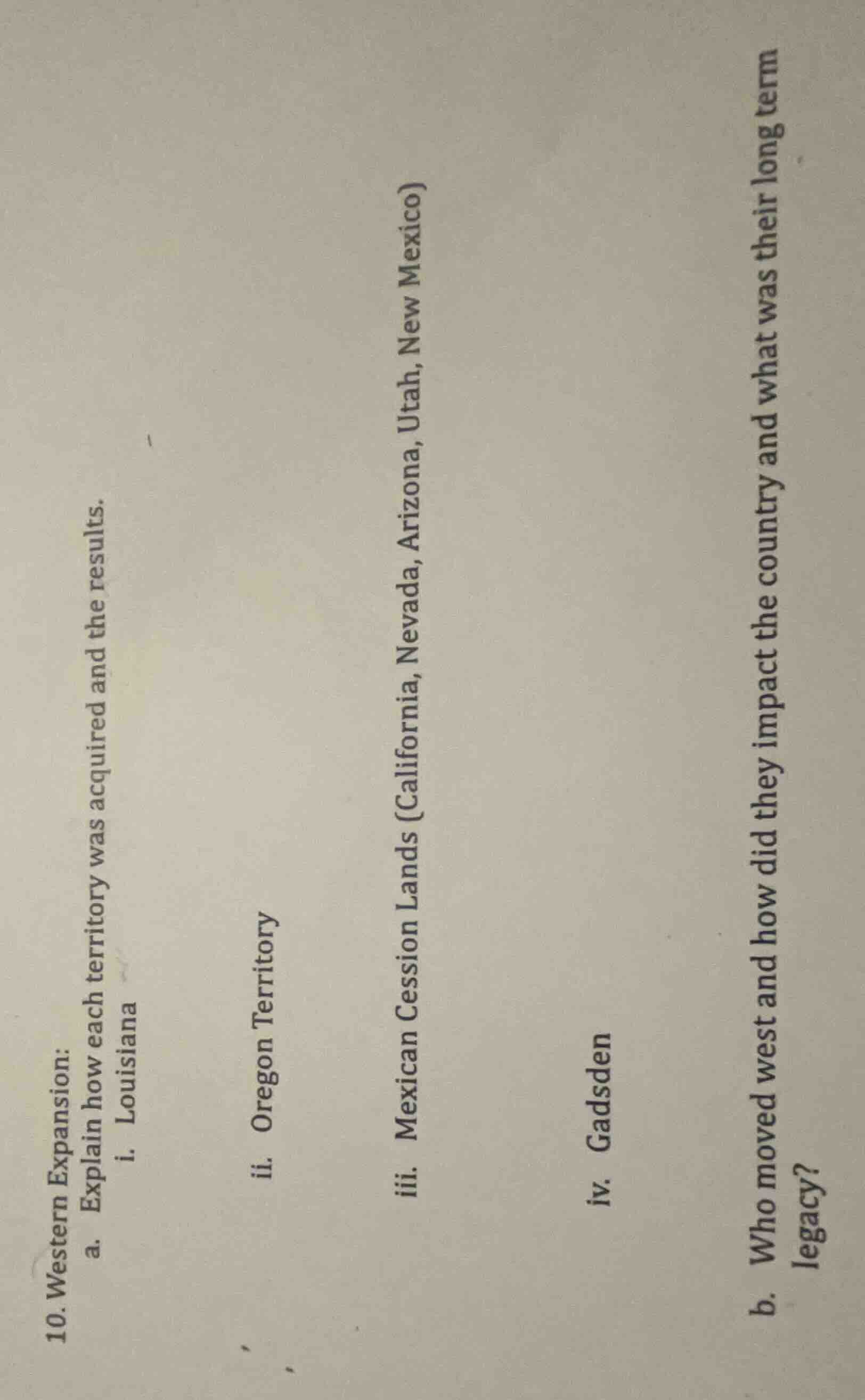
- western expansion:
a. explain how each territory was acquired and the results.
i. louisiana
ii. oregon territory
iii. mexican cession lands (california, nevada, arizona, utah, new mexico)
iv. gadsden
b. who moved west and how did they impact the country and what was their long term legacy?
Response
Part a: Explanation of each territory acquisition
i. Louisiana
- Acquisition: In 1803, the United States purchased the Louisiana Territory from France for $15 million. This was negotiated by President Thomas Jefferson.
- Results: It doubled the size of the United States, giving control over the Mississippi River and the port of New Orleans, opening up vast lands for settlement and trade, and securing access to the western frontier.
ii. Oregon Territory
- Acquisition: The Oregon Territory (including present - day Oregon, Washington, Idaho, and parts of Montana and Wyoming) was acquired through a treaty with Britain in 1846. The two countries had jointly occupied the region, and the treaty established the 49th parallel as the northern boundary of the US - held portion.
- Results: It gave the US a large Pacific - Northwest territory, which was rich in natural resources like timber and fur - bearing animals, and provided a new area for American settlement and expansion to the Pacific coast.
iii. Mexican Cession Lands
- Acquisition: After the Mexican - American War (1846 - 1848), the Treaty of Guadalupe Hidalgo was signed. Mexico ceded a large territory including present - day California, Nevada, Utah, Arizona, New Mexico, and parts of Colorado and Wyoming to the United States in exchange for $15 million and the assumption of $3.25 million in debts owed by Mexico to American citizens.
- Results: This acquisition added a huge amount of land to the US, including valuable gold - rich areas (like the California Gold Rush started in 1848), and expanded the nation's territory to the Pacific coast, facilitating westward expansion and the development of new states.
iv. Gadsden
- Acquisition: In 1853, the United States purchased a small strip of land in present - day southern Arizona and New Mexico from Mexico for $10 million. This was mainly to provide a suitable route for a southern transcontinental railroad.
- Results: It completed the continental - sized territory of the contiguous United States, providing the necessary land for the railroad construction, which was crucial for the economic development and integration of the western states.
Part b: Westward Movement, Impact, and Legacy
- Who Moved West: A diverse group of people moved west, including farmers seeking fertile land, miners in search of gold and other minerals, traders looking for new markets, and families hoping for a better life. Also, the government - sponsored settlers, as well as some immigrants from Europe and Asia (like Chinese immigrants who came to work on the railroads) were part of the westward movement.
- Impact on the Country:
- Economic: It led to the development of new industries such as mining, ranching, and agriculture in the west. The discovery of gold in California spurred a national and international economic boom. The expansion of railroads (facilitated by land acquisitions) connected the east and west, enabling the transport of goods and people, and promoting trade and economic growth across the nation.
- Political: It led to the creation of new states as the western territories were settled and petitioned for statehood, changing the balance of power in Congress. It also increased tensions over the issue of slavery in the new territories, which was a major factor leading up to the Civil War.
- Social: It led to the displacement and mistreatment of Native American tribes. As settlers moved west, they often conflicted with Native Americans over land, leading to forced…

Snap & solve any problem in the app
Get step-by-step solutions on Sovi AI
Photo-based solutions with guided steps
Explore more problems and detailed explanations
Part a: Explanation of each territory acquisition
i. Louisiana
- Acquisition: In 1803, the United States purchased the Louisiana Territory from France for $15 million. This was negotiated by President Thomas Jefferson.
- Results: It doubled the size of the United States, giving control over the Mississippi River and the port of New Orleans, opening up vast lands for settlement and trade, and securing access to the western frontier.
ii. Oregon Territory
- Acquisition: The Oregon Territory (including present - day Oregon, Washington, Idaho, and parts of Montana and Wyoming) was acquired through a treaty with Britain in 1846. The two countries had jointly occupied the region, and the treaty established the 49th parallel as the northern boundary of the US - held portion.
- Results: It gave the US a large Pacific - Northwest territory, which was rich in natural resources like timber and fur - bearing animals, and provided a new area for American settlement and expansion to the Pacific coast.
iii. Mexican Cession Lands
- Acquisition: After the Mexican - American War (1846 - 1848), the Treaty of Guadalupe Hidalgo was signed. Mexico ceded a large territory including present - day California, Nevada, Utah, Arizona, New Mexico, and parts of Colorado and Wyoming to the United States in exchange for $15 million and the assumption of $3.25 million in debts owed by Mexico to American citizens.
- Results: This acquisition added a huge amount of land to the US, including valuable gold - rich areas (like the California Gold Rush started in 1848), and expanded the nation's territory to the Pacific coast, facilitating westward expansion and the development of new states.
iv. Gadsden
- Acquisition: In 1853, the United States purchased a small strip of land in present - day southern Arizona and New Mexico from Mexico for $10 million. This was mainly to provide a suitable route for a southern transcontinental railroad.
- Results: It completed the continental - sized territory of the contiguous United States, providing the necessary land for the railroad construction, which was crucial for the economic development and integration of the western states.
Part b: Westward Movement, Impact, and Legacy
- Who Moved West: A diverse group of people moved west, including farmers seeking fertile land, miners in search of gold and other minerals, traders looking for new markets, and families hoping for a better life. Also, the government - sponsored settlers, as well as some immigrants from Europe and Asia (like Chinese immigrants who came to work on the railroads) were part of the westward movement.
- Impact on the Country:
- Economic: It led to the development of new industries such as mining, ranching, and agriculture in the west. The discovery of gold in California spurred a national and international economic boom. The expansion of railroads (facilitated by land acquisitions) connected the east and west, enabling the transport of goods and people, and promoting trade and economic growth across the nation.
- Political: It led to the creation of new states as the western territories were settled and petitioned for statehood, changing the balance of power in Congress. It also increased tensions over the issue of slavery in the new territories, which was a major factor leading up to the Civil War.
- Social: It led to the displacement and mistreatment of Native American tribes. As settlers moved west, they often conflicted with Native Americans over land, leading to forced removals, wars, and the destruction of Native American cultures. However, it also led to a more diverse American society as people from different regions and backgrounds came together in the west.
- Long - Term Legacy:
- It established the United States as a continental power with a vast territory from coast to coast. The idea of "Manifest Destiny" (the belief that the US was destined to expand across the continent) became a part of the national identity, though it also had negative connotations related to the subjugation of Native Americans and other groups.
- The westward expansion led to the development of a unique western culture, characterized by a spirit of independence, self - reliance, and entrepreneurship. It also left a legacy of environmental changes, as the natural landscapes were modified for agriculture, mining, and urban development. The issues of land ownership, resource management, and the rights of indigenous peoples that emerged during westward expansion still have relevance in modern - day discussions about land use and social justice.