QUESTION IMAGE
Question
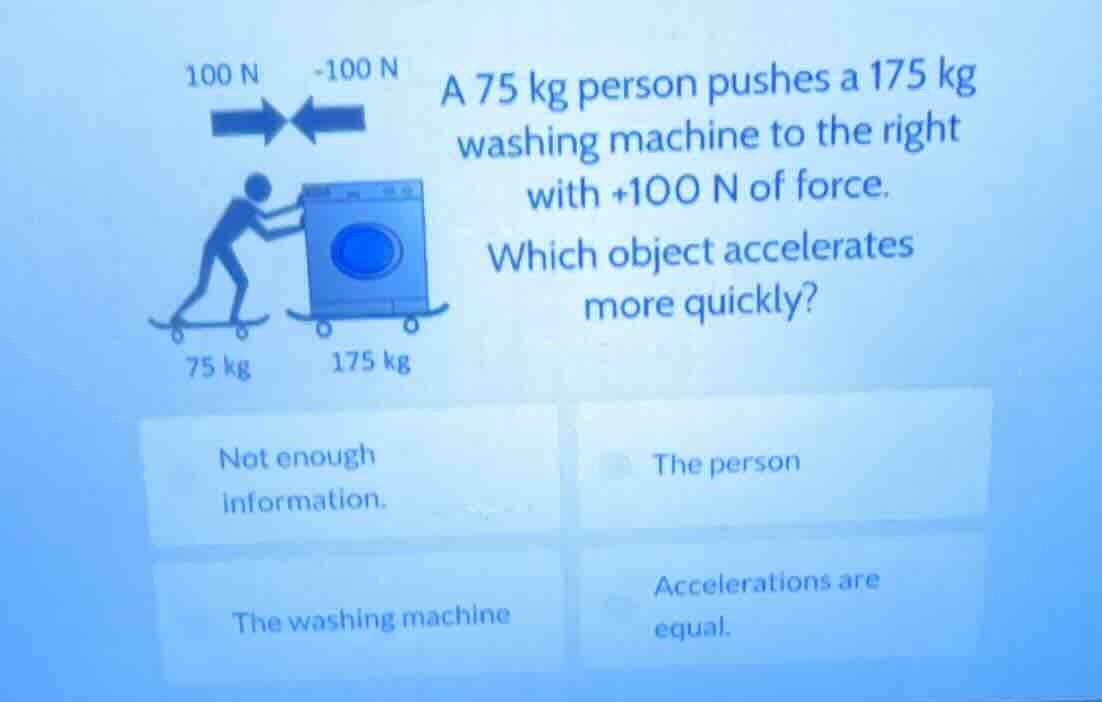
100 n -100 n a 75 kg person pushes a 175 kg washing machine to the right with +100 n of force. which object accelerates more quickly? 75 kg 175 kg not enough information. the person the washing machine accelerations are equal.
Step1: Recall Newton's Second Law
Newton's second law is \( F = ma \), which can be rearranged to \( a=\frac{F}{m} \), where \( F \) is force, \( m \) is mass, and \( a \) is acceleration.
Step2: Analyze Forces on Each Object
By Newton's third law, the force the person exerts on the washing machine (\( + 100\ N \)) is equal in magnitude and opposite in direction to the force the washing machine exerts on the person (\( - 100\ N \)). So both the person (mass \( m_1 = 75\ kg \)) and the washing machine (mass \( m_2=175\ kg \)) experience a net force of magnitude \( F = 100\ N \) (ignoring other forces for this analysis, as the problem focuses on these interaction forces).
Step3: Calculate Acceleration for the Person
Using \( a=\frac{F}{m} \), for the person: \( a_1=\frac{F}{m_1}=\frac{100\ N}{75\ kg}\approx1.33\ m/s^2 \).
Step4: Calculate Acceleration for the Washing Machine
For the washing machine: \( a_2=\frac{F}{m_2}=\frac{100\ N}{175\ kg}\approx0.57\ m/s^2 \).
Step5: Compare Accelerations
Since \( a_1 > a_2 \) (because when the numerator \( F \) is the same, a smaller denominator \( m \) gives a larger result), the person accelerates more quickly.

Snap & solve any problem in the app
Get step-by-step solutions on Sovi AI
Photo-based solutions with guided steps
Explore more problems and detailed explanations
The person