QUESTION IMAGE
Question
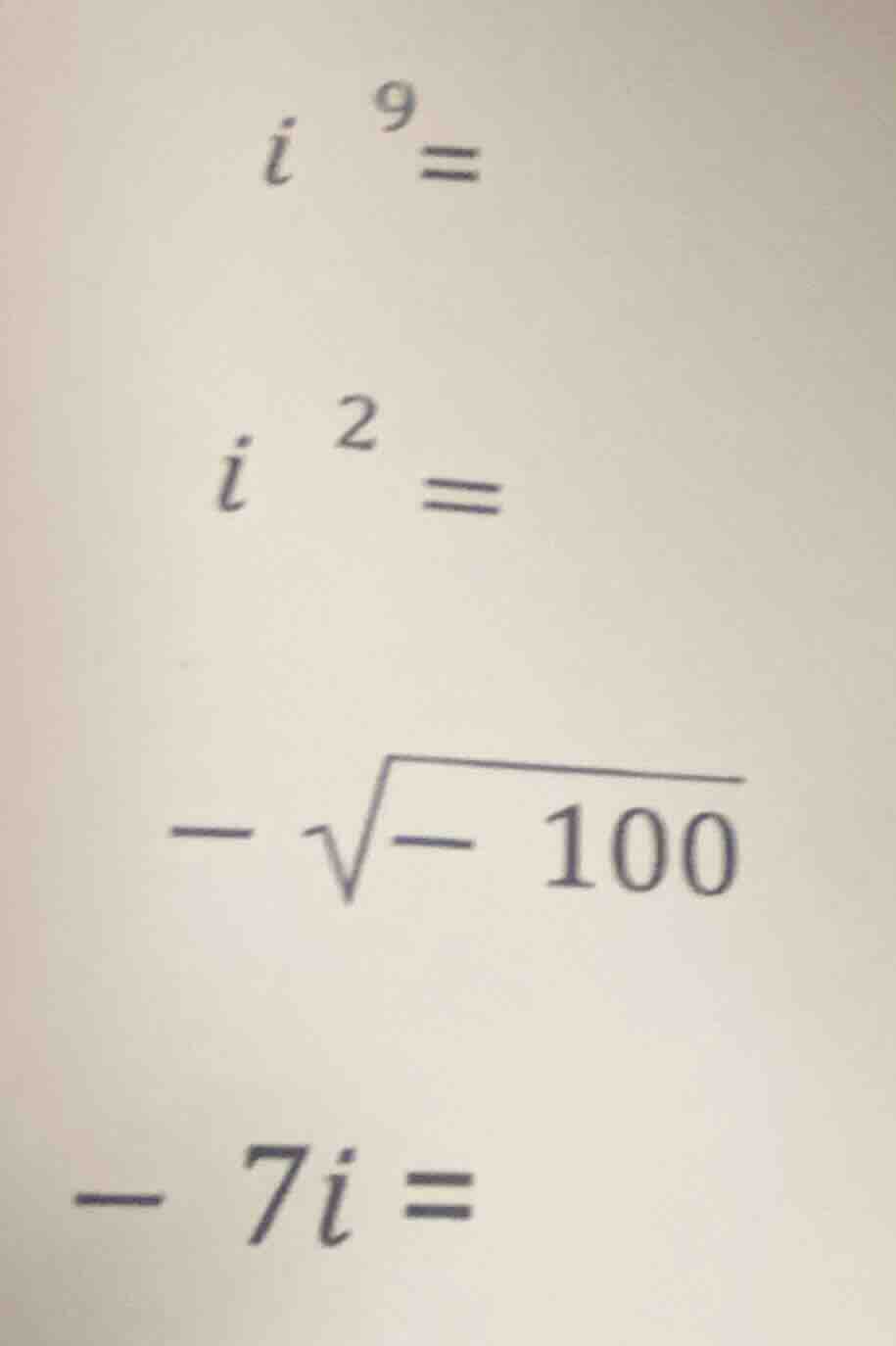
i^9=
i^2=
-√-100
-7i=
For \(i^9\):
Step1: Recall \(i\) properties
We know \(i^1 = i\), \(i^2=-1\), \(i^3 = i^2\cdot i=-i\), \(i^4=(i^2)^2 = (-1)^2 = 1\), and the powers of \(i\) repeat every 4. So we can express \(i^9\) as \(i^{4\times2 + 1}\).
Step2: Simplify using exponent rules
Using the property \(a^{m + n}=a^m\cdot a^n\) and \(a^{mn}=(a^m)^n\), we have \(i^{4\times2+1}=(i^4)^2\cdot i^1\). Since \(i^4 = 1\), then \((1)^2\cdot i=i\).
For \(i^2\):
Step1: Recall definition of \(i\)
By definition, the imaginary unit \(i=\sqrt{-1}\), so \(i^2 = (\sqrt{-1})^2\).
Step2: Simplify the square
Squaring \(\sqrt{-1}\) gives \(-1\), so \(i^2=-1\).
For \(-\sqrt{-100}\):
Step1: Factor out \(-1\) inside the square root
We can write \(\sqrt{-100}=\sqrt{100\times(-1)}\).
Step2: Use property of square roots
Using \(\sqrt{ab}=\sqrt{a}\cdot\sqrt{b}\) (for \(a\geq0,b\geq0\), here we extend to complex numbers), we have \(\sqrt{100\times(-1)}=\sqrt{100}\cdot\sqrt{-1}\). Since \(\sqrt{100} = 10\) and \(\sqrt{-1}=i\), this becomes \(10i\). Then \(-\sqrt{-100}=- 10i\).
For \(-7i\):
This is already in the standard form of a complex number (it's a purely imaginary number), so \(-7i\) is just \(-7i\) (if we were to write it in \(a + bi\) form, \(a = 0\) and \(b=-7\)).

Snap & solve any problem in the app
Get step-by-step solutions on Sovi AI
Photo-based solutions with guided steps
Explore more problems and detailed explanations
s:
\(i^9=\boldsymbol{i}\)
\(i^2=\boldsymbol{-1}\)
\(-\sqrt{-100}=\boldsymbol{-10i}\)
\(-7i=\boldsymbol{-7i}\)