QUESTION IMAGE
Question
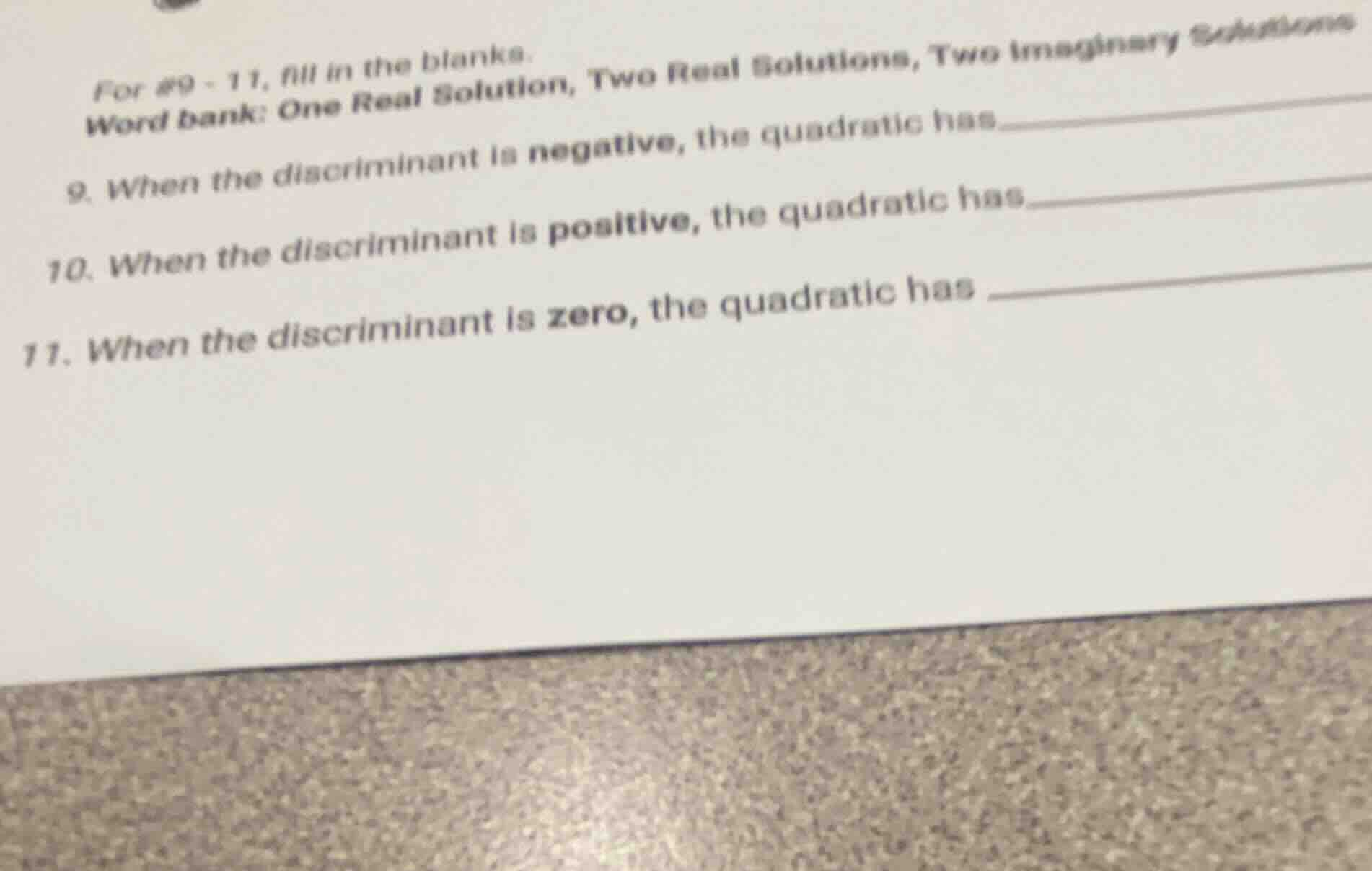
for #9 - 11, fill in the blanks. word bank: one real solution, two real solutions, two imaginary solutions 9. when the discriminant is negative, the quadratic has __ 10. when the discriminant is positive, the quadratic has 11. when the discriminant is zero, the quadratic has __
Question 9
The discriminant of a quadratic equation \(ax^2 + bx + c = 0\) is \(D = b^2 - 4ac\). When \(D<0\), the square root of a negative number is imaginary, so there are two imaginary (complex) solutions.
When the discriminant \(D = b^2 - 4ac>0\), the square root of a positive number is real, and we get two distinct real solutions from the quadratic formula \(x=\frac{-b\pm\sqrt{D}}{2a}\).
When the discriminant \(D = b^2 - 4ac = 0\), the quadratic formula becomes \(x=\frac{-b\pm0}{2a}=-\frac{b}{2a}\), which is a single real solution (with multiplicity two).

Snap & solve any problem in the app
Get step-by-step solutions on Sovi AI
Photo-based solutions with guided steps
Explore more problems and detailed explanations
Two Imaginary Solutions