QUESTION IMAGE
Question
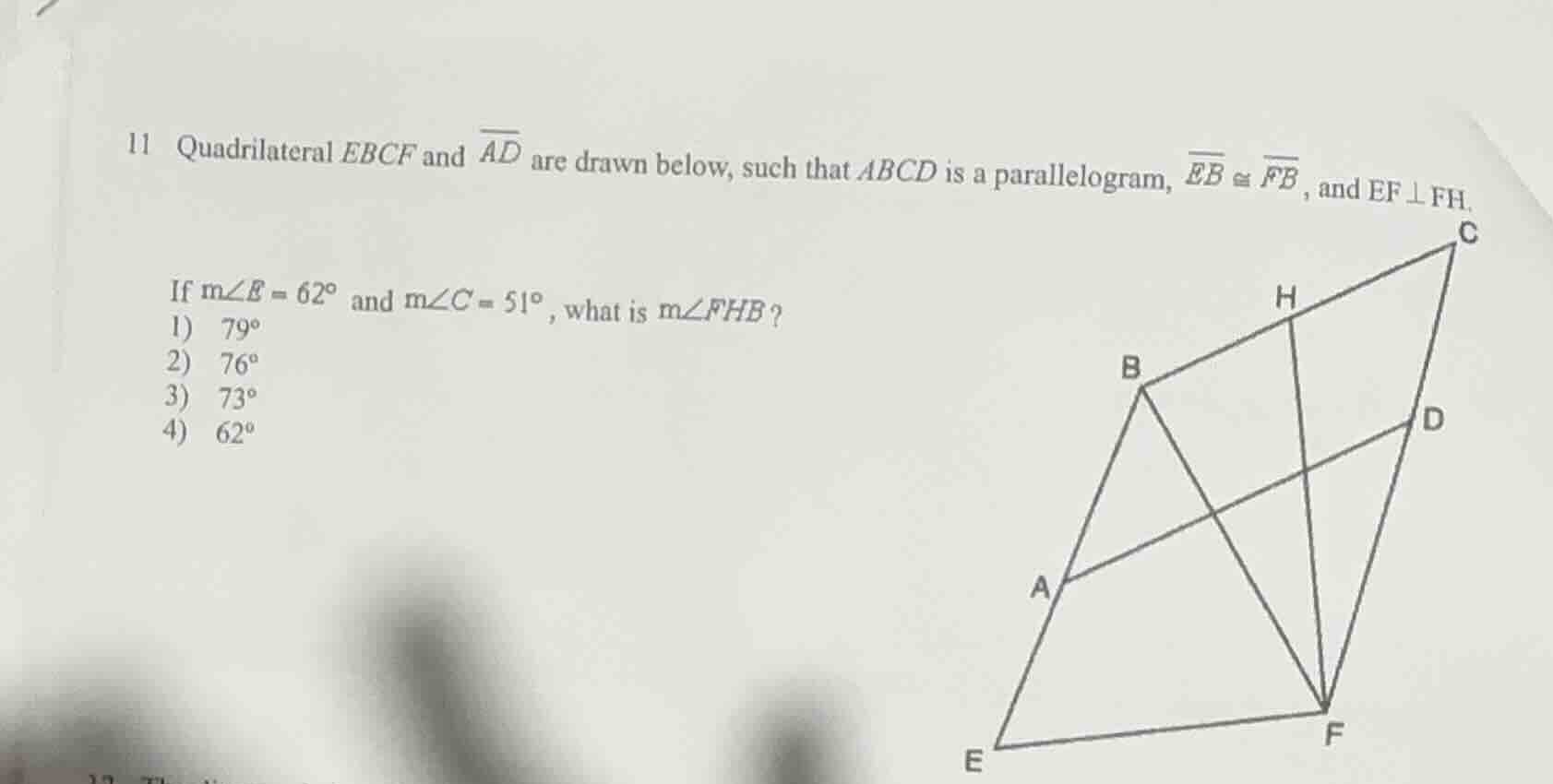
11 quadrilateral ebcf and \\(\overline{ad}\\) are drawn below, such that abcd is a parallelogram, \\(\overline{eb} \cong \overline{fb}\\), and \\(ef \perp fh\\).
if \\(m\angle e = 62^\circ\\) and \\(m\angle c = 51^\circ\\), what is \\(m\angle fhb\\)?
- \\(79^\circ\\)
- \\(76^\circ\\)
- \\(73^\circ\\)
- \\(62^\circ\\)
Step1: Find $\angle EFB$ in $\triangle EBF$
Since $\overline{EB} \cong \overline{FB}$, $\triangle EBF$ is isosceles with $\angle E = \angle EFB = 62^\circ$.
Step2: Calculate $\angle EBF$
Sum of angles in a triangle is $180^\circ$.
$\angle EBF = 180^\circ - 62^\circ - 62^\circ = 56^\circ$
Step3: Find $\angle EBC$ (parallelogram property)
In parallelogram $ABCD$, $\angle ABC = 180^\circ - \angle C = 180^\circ - 51^\circ = 129^\circ$
Step4: Calculate $\angle FBC$
$\angle FBC = \angle ABC - \angle EBF = 129^\circ - 56^\circ = 73^\circ$
Step5: Find $\angle EFH$
Since $EF \perp FH$, $\angle EFH = 90^\circ$. $\angle BFH = \angle EFH - \angle EFB = 90^\circ - 62^\circ = 28^\circ$
Step6: Calculate $\angle FHB$ (triangle angle sum)
In $\triangle FHB$, $\angle FHB = 180^\circ - \angle FBC - \angle BFH = 180^\circ - 73^\circ - 28^\circ = 79^\circ$

Snap & solve any problem in the app
Get step-by-step solutions on Sovi AI
Photo-based solutions with guided steps
Explore more problems and detailed explanations
- $79^\circ$