QUESTION IMAGE
Question
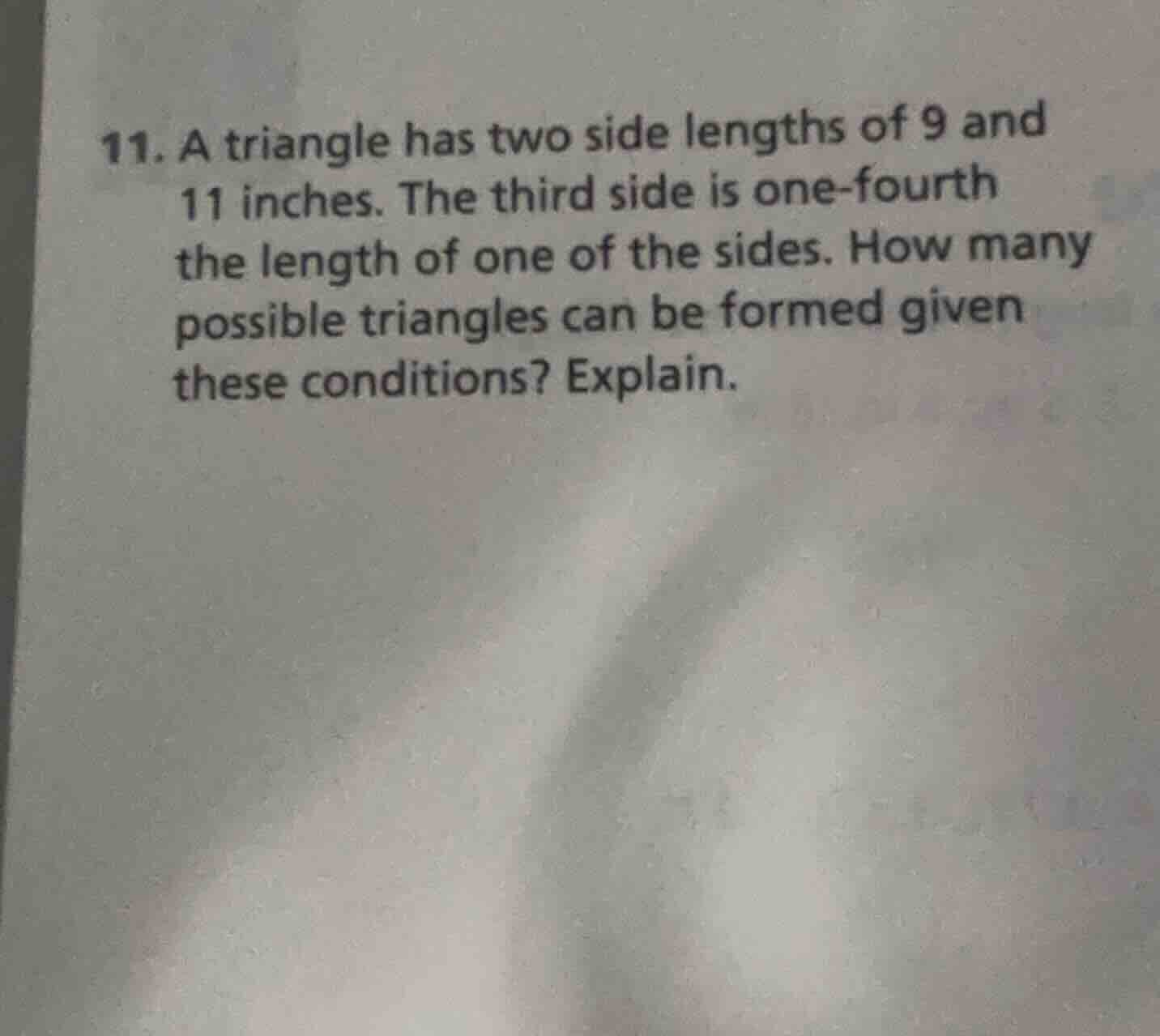
- a triangle has two side lengths of 9 and 11 inches. the third side is one-fourth the length of one of the sides. how many possible triangles can be formed given these conditions? explain.
Step1: List possible third sides
The third side could be $\frac{1}{4} \times 9 = \frac{9}{4} = 2.25$ inches, or $\frac{1}{4} \times 11 = \frac{11}{4} = 2.75$ inches.
Step2: Test first third side (2.25 in)
Use triangle inequality: sum of any two sides > third side.
Check $9 + 2.25 > 11$: $11.25 > 11$ (true)
Check $9 + 11 > 2.25$: $20 > 2.25$ (true)
Check $11 + 2.25 > 9$: $13.25 > 9$ (true)
Step3: Test second third side (2.75 in)
Use triangle inequality:
Check $9 + 2.75 > 11$: $11.75 > 11$ (true)
Check $9 + 11 > 2.75$: $20 > 2.75$ (true)
Check $11 + 2.75 > 9$: $13.75 > 9$ (true)

Snap & solve any problem in the app
Get step-by-step solutions on Sovi AI
Photo-based solutions with guided steps
Explore more problems and detailed explanations
2 possible triangles can be formed. Both potential third side lengths ($\frac{9}{4}$ inches and $\frac{11}{4}$ inches) satisfy the triangle inequality theorem, meaning valid triangles can be constructed with each of these third sides paired with the given 9 and 11-inch sides.