QUESTION IMAGE
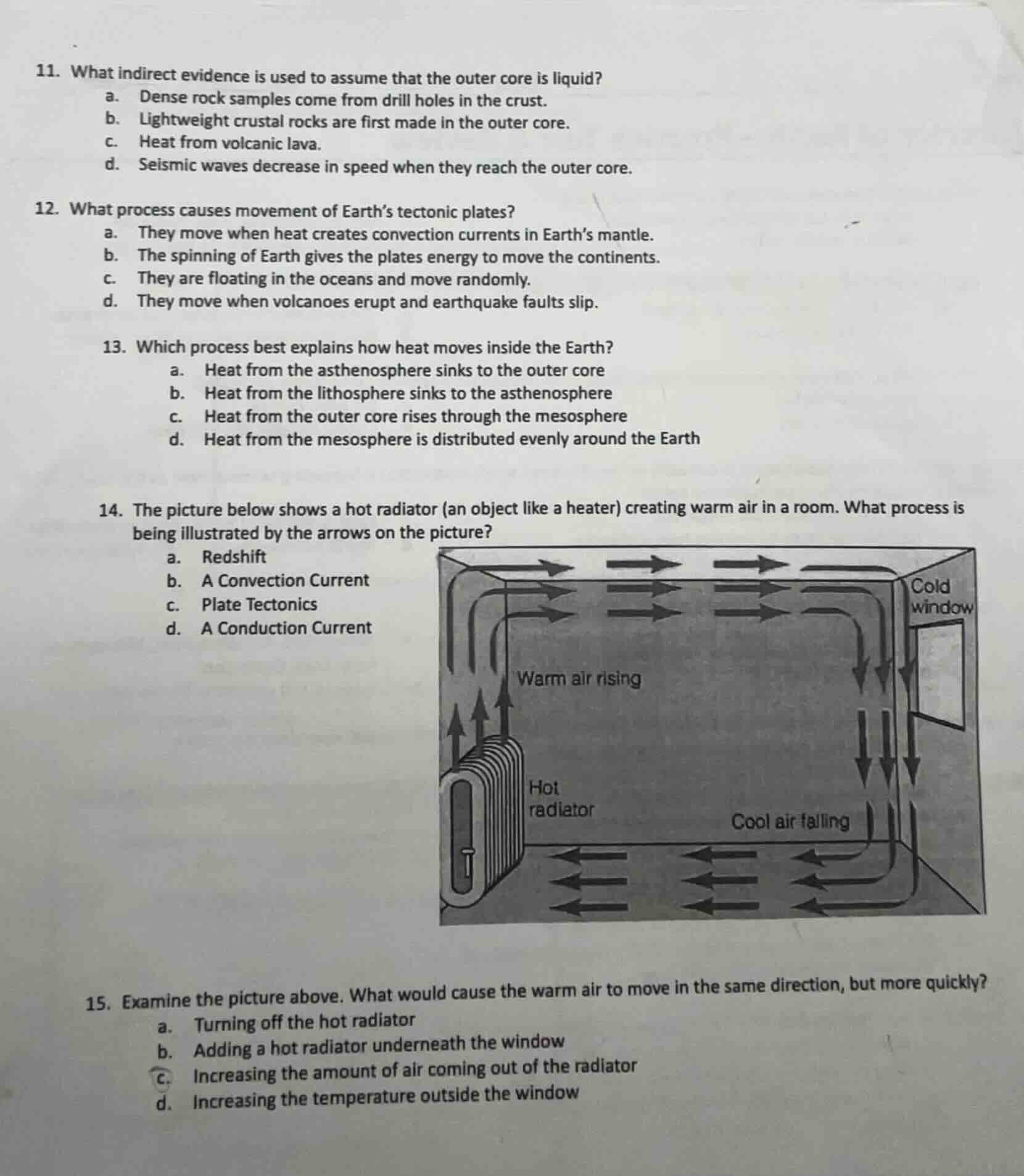
Question
- what indirect evidence is used to assume that the outer core is liquid?
a. dense rock samples come from drill holes in the crust.
b. lightweight crustal rocks are first made in the outer core.
c. heat from volcanic lava.
d. seismic waves decrease in speed when they reach the outer core.
- what process causes movement of earth’s tectonic plates?
a. they move when heat creates convection currents in earth’s mantle.
b. the spinning of earth gives the plates energy to move the continents.
c. they are floating in the oceans and move randomly.
d. they move when volcanoes erupt and earthquake faults slip.
- which process best explains how heat moves inside the earth?
a. heat from the asthenosphere sinks to the outer core
b. heat from the lithosphere sinks to the asthenosphere
c. heat from the outer core rises through the mesosphere
d. heat from the mesosphere is distributed evenly around the earth
- the picture below shows a hot radiator (an object like a heater) creating warm air in a room. what process is being illustrated by the arrows on the picture?
a. redshift
b. a convection current
c. plate tectonics
d. a conduction current
- examine the picture above. what would cause the warm air to move in the same direction, but more quickly?
a. turning off the hot radiator
b. adding a hot radiator underneath the window
c. increasing the amount of air coming out of the radiator
d. increasing the temperature outside the window
Question 11
To determine the indirect evidence for the outer core being liquid, we analyze each option:
- Option a: Rock samples from the crust don't relate to the outer core's state.
- Option b: Crustal rocks aren't formed in the outer core.
- Option c: Volcanic lava heat doesn't indicate outer core's state.
- Option d: Seismic waves (S - waves can't travel through liquid) slow down in the outer core, suggesting it's liquid.
For tectonic plate movement:
- Option a: Heat in the mantle creates convection currents that drive plate movement. This is correct.
- Option b: Earth's spinning doesn't directly move plates.
- Option c: Plates aren't floating in oceans randomly.
- Option d: Volcanoes and earthquakes are results, not causes of plate movement.
For heat movement inside Earth:
- Option a: Heat from the asthenosphere (part of the mantle) sinking to the outer core is incorrect; heat from the outer core rises.
- Option b: Heat from the lithosphere (rigid outer layer) sinking to the asthenosphere is incorrect; heat from the core/mantle rises.
- Option c: Heat from the outer core rises through the mesosphere (part of the mantle) – this is part of the convection process.
- Option d: Heat isn't distributed evenly; it moves via convection.

Snap & solve any problem in the app
Get step-by-step solutions on Sovi AI
Photo-based solutions with guided steps
Explore more problems and detailed explanations
d. Seismic waves decrease in speed when they reach the outer core.