QUESTION IMAGE
Question
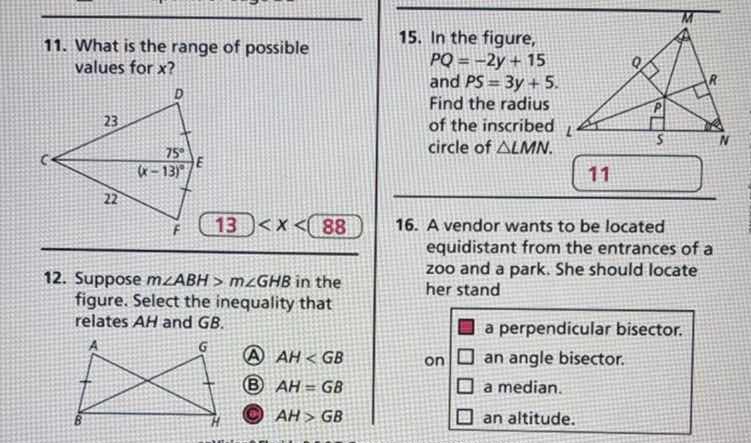
- what is the range of possible values for x?
- suppose ( mangle abh > mangle ghb ) in the figure. select the inequality that relates ( ah ) and ( gb ).
- in the figure,( pq = -2y + 15 ) and ( ps = 3y + 5 ). find the radius of the inscribed circle of ( \triangle lmn ).
- a vendor wants to be located equidistant from the entrances of a zoo and a park. she should locate her stand on
(square) a perpendicular bisector.
(square) an angle bisector.
(square) a median.
(square) an altitude.
Question 11
Step1: Apply the Hinge Theorem
The Hinge Theorem states that if two sides of one triangle are congruent to two sides of another triangle, but the included angle of the first triangle is larger than the included angle of the second triangle, then the third side of the first triangle is longer than the third side of the second triangle. In $\triangle CDE$ and $\triangle CFE$, $CE$ is common, $CD = 23$, $CF = 22$, and $\angle DCE = 75^\circ$, $\angle FCE=(x - 13)^\circ$. Wait, actually, since $CD > CF$, for the angles opposite, but here we have two triangles with a common side $CE$, and two sides: $CD = 23$, $CF = 22$, and the included angles at $C$: $\angle DCE$ and $\angle FCE$. Wait, maybe I got it reversed. Let's correct. The Hinge Theorem: if two sides of $\triangle 1$ are equal to two sides of $\triangle 2$, and the included angle of $\triangle 1$ is greater than included angle of $\triangle 2$, then the third side of $\triangle 1$ is greater than third side of $\triangle 2$. Here, in $\triangle CDE$ and $\triangle CFE$, $CE$ is common, $CD = 23$, $CF = 22$, so $CD > CF$. So the angle opposite to $CD$ (which is $DE$) and angle opposite to $CF$ (which is $FE$). Wait, maybe the angles at $C$: $\angle DCE$ and $\angle FCE$. Wait, the problem is to find the range of $x$ such that the triangle inequality or the Hinge Theorem applies. Wait, the given answer is $13 < x < 88$. Let's see: the angle at $C$ for $\triangle CFE$ is $(x - 13)^\circ$, and for $\triangle CDE$ is $75^\circ$. Wait, maybe the two triangles share side $CE$, $CD = 23$, $CF = 22$, so to apply the Hinge Theorem, we need the included angles. Wait, maybe the angle at $C$ for $\triangle CFE$ must be less than $75^\circ$ (since $CF < CD$), so $(x - 13) < 75$, so $x < 88$. Also, the angle must be positive, so $(x - 13) > 0$, so $x > 13$. Hence, $13 < x < 88$.
Step2: Verify the inequalities
- Lower bound: The angle $(x - 13)^\circ$ must be greater than $0^\circ$ (since it's an angle in a triangle), so $x - 13 > 0 \implies x > 13$.
- Upper bound: The angle $(x - 13)^\circ$ must be less than $75^\circ$ (by Hinge Theorem, since $CF = 22 < CD = 23$, the included angle for the smaller side must be smaller), so $x - 13 < 75 \implies x < 88$.
The Hinge Theorem (also known as the SAS Inequality Theorem) states that if two sides of one triangle are congruent to two sides of another triangle, but the included angle of the first triangle is larger than the included angle of the second triangle, then the third side of the first triangle is longer than the third side of the second triangle. In the figure, triangles $ABH$ and $GHB$: $BH$ is common, $AB = GH$ (assuming from the figure, since the triangles are drawn with $AB$ and $GH$ as equal sides), and $\angle ABH > \angle GHB$. So by the Hinge Theorem, the side opposite $\angle ABH$ (which is $AH$) is longer than the side opposite $\angle GHB$ (which is $GB$). Hence, $AH > GB$.
Step2: Identify the correct inequality
From the Hinge Theorem, since $\angle ABH > \angle GHB$, and $AB = GH$, $BH$ common, then $AH > GB$. So the correct option is C (assuming the options are A: $AH < GB$, B: $AH = GB$, C: $AH > GB$).
In a triangle, the radius of the inscribed circle (inradius) is related to the area and the semi - perimeter, but in this case, $PQ$, $PS$, and $PR$ are the lengths of the tangents from a point to a circle, and in a triangle, the inradius is the distance from the in - center to each side, and the tangents from a common point to a circle are equal. Here, $PQ$ and $PS$ are both tangents from point $P$ to the incircle (since $PQ \perp LM$ and $PS \perp LN$, so they are radii? Wait, no, $PQ$, $PS$, $PR$ are the lengths of the tangents from $P$ to the incircle? Wait, no, $P$ is the in - center? Wait, the in - center is the intersection of angle bisectors, and the distance from the in - center to each side is the inradius. But here, $PQ=-2y + 15$ and $PS = 3y+5$. Since $PQ$ and $PS$ are both distances from the in - center $P$ to the sides $LM$ and $LN$ respectively, they should be equal (because the inradius is the same for all sides). So set $PQ = PS$:
$-2y+15=3y + 5$
Step1: Solve for y
$-2y-3y=5 - 15$
$-5y=-10$
$y = 2$
Step2: Find the inradius
Substitute $y = 2$ into either $PQ$ or $PS$. Let's use $PS=3y + 5$. Then $PS=3(2)+5=6 + 5 = 11$. So the radius of the inscribed circle is $11$.

Snap & solve any problem in the app
Get step-by-step solutions on Sovi AI
Photo-based solutions with guided steps
Explore more problems and detailed explanations
$13 < x < 88$