QUESTION IMAGE
Question
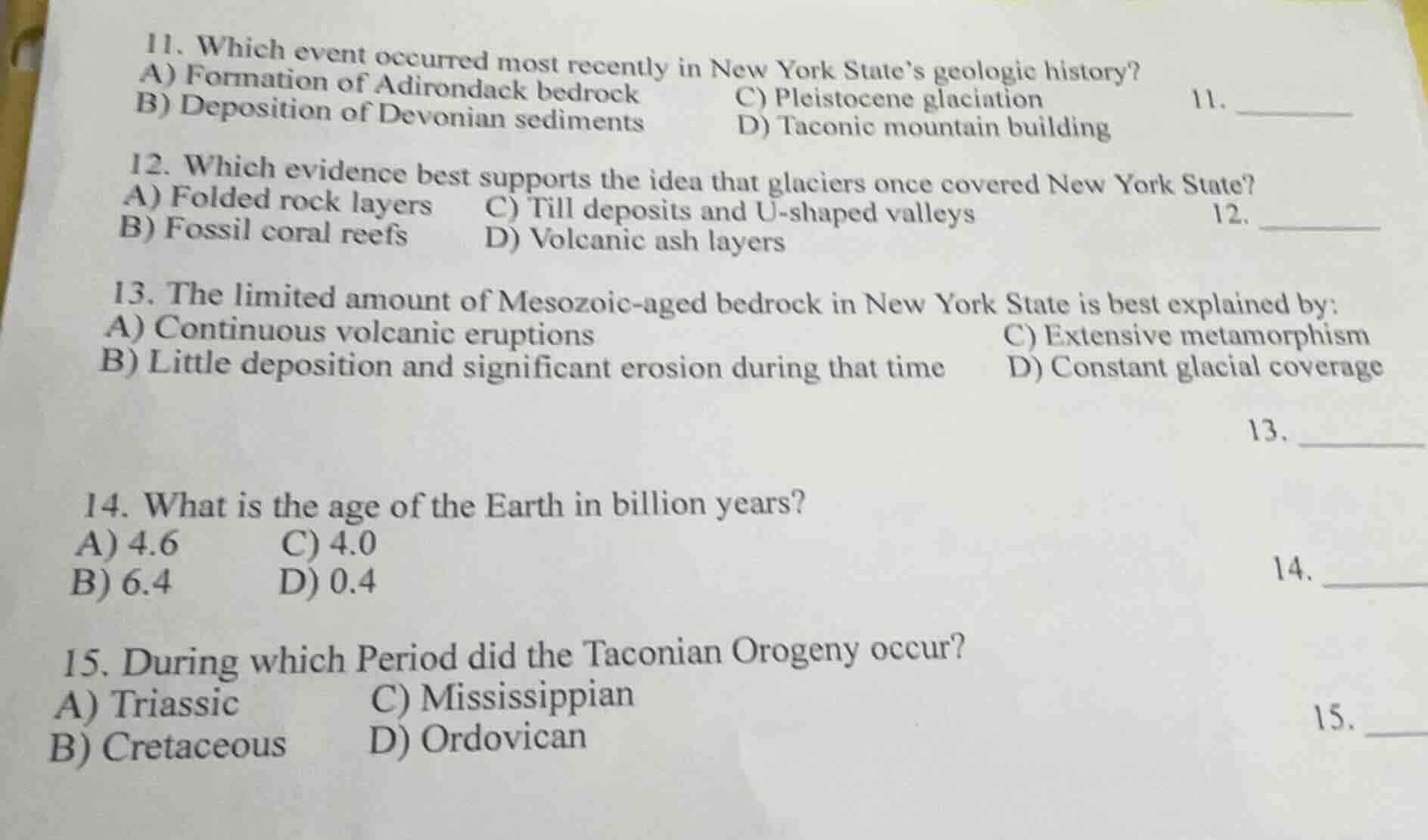
- which event occurred most recently in new york state’s geologic history?
a) formation of adirondack bedrock c) pleistocene glaciation
b) deposition of devonian sediments d) taconic mountain building 11. ______
- which evidence best supports the idea that glaciers once covered new york state?
a) folded rock layers c) till deposits and u - shaped valleys
b) fossil coral reefs d) volcanic ash layers 12. ______
- the limited amount of mesozoic - aged bedrock in new york state is best explained by:
a) continuous volcanic eruptions c) extensive metamorphism
b) little deposition and significant erosion during that time d) constant glacial coverage
- ______
- what is the age of the earth in billion years?
a) 4.6 c) 4.0
b) 6.4 d) 0.4 14. ______
- during which period did the taconian orogeny occur?
a) triassic c) mississippian
b) cretaceous d) ordovician 15. ______
Brief Explanations
- Pleistocene glaciation is the most recent geologic event among the options, occurring within the last 2.6 million to 11,700 years, while the other events are hundreds of millions of years older.
- Till deposits (unsorted sediment left by glaciers) and U-shaped valleys (carved by glacial erosion) are direct, diagnostic geologic features of past glacial coverage.
- Limited Mesozoic bedrock in New York State is due to minimal sediment deposition in the region during the Mesozoic, combined with significant erosion removing what little sediment was deposited.
- Radiometric dating of the oldest Earth rocks and meteorites confirms the Earth is approximately 4.6 billion years old.
- The Taconian Orogeny, a mountain-building event affecting New York State, occurred during the Ordovician Period.

Snap & solve any problem in the app
Get step-by-step solutions on Sovi AI
Photo-based solutions with guided steps
Explore more problems and detailed explanations
- C) Pleistocene glaciation
- C) Till deposits and U-shaped valleys
- B) Little deposition and significant erosion during that time
- A) 4.6
- D) Ordovican