QUESTION IMAGE
Question
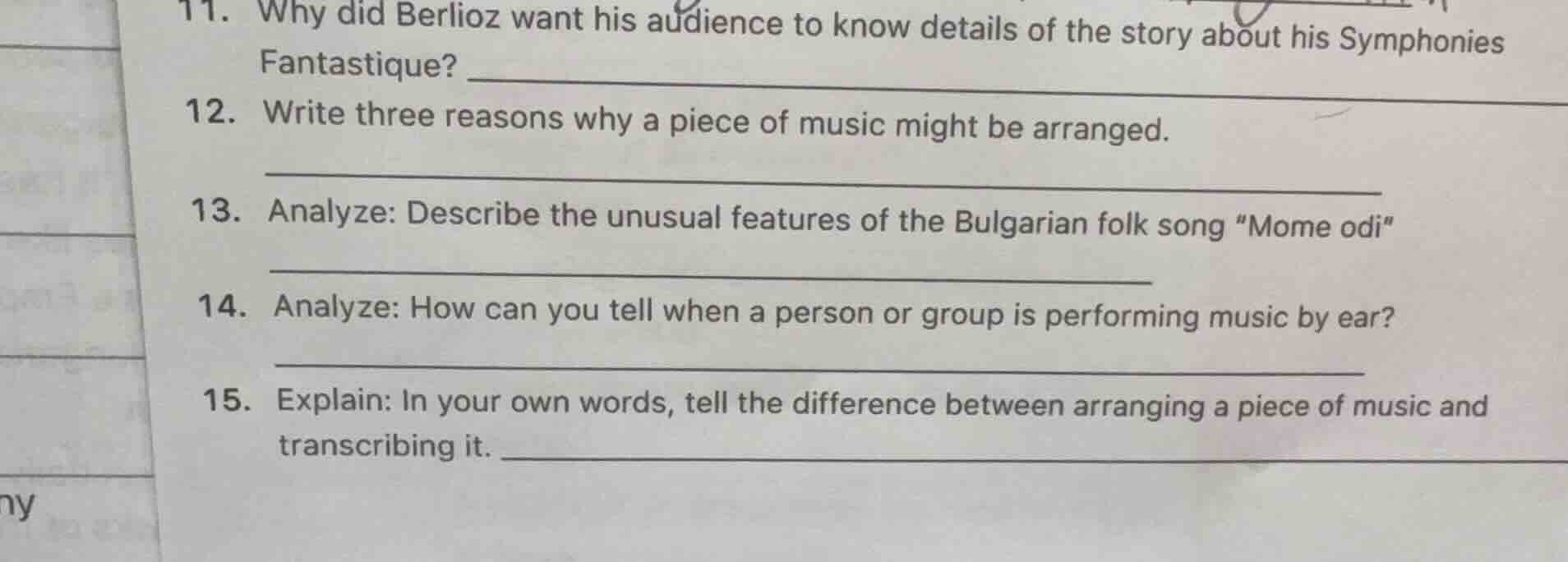
- why did berlioz want his audience to know details of the story about his symphonies fantastique?12. write three reasons why a piece of music might be arranged.13. analyze: describe the unusual features of the bulgarian folk song \mome odi\14. analyze: how can you tell when a person or group is performing music by ear?15. explain: in your own words, tell the difference between arranging a piece of music and transcribing it.
Brief Explanations
- Berlioz's Symphonie Fantastique is a program symphony; the narrative is core to understanding its emotional and structural intent—he wanted the audience to grasp the autobiographical, dramatic arc that ties the symphony's movements together, as the music directly reflects the story's events and moods.
- 1. To adapt the piece for a different ensemble (e.g., a piano work for orchestra). 2. To update the style for a modern audience (e.g., a classical piece reworked as jazz). 3. To make it accessible for beginner performers by simplifying complex parts.
- "Mome odi" features asymmetric, additive time signatures (like 5/8 or 7/8) common in Bulgarian folk music, intricate polyphonic vocal harmonies, and a driving, rhythmic pulse that emphasizes off-beats, unlike the regular meters of most Western folk or classical music.
- Performers playing by ear will deviate from a strict written score: they may improvise variations, adjust tempos or dynamics spontaneously, make small rhythmic changes, or lack a physical sheet music reference while performing.
- Arranging involves reworking an existing piece (changing instrumentation, style, or structure) while keeping the core melody/intent intact. Transcribing is writing down a piece of music (from a recording or live performance) that was previously unwritten, creating a score that matches the original performance as closely as possible.

Snap & solve any problem in the app
Get step-by-step solutions on Sovi AI
Photo-based solutions with guided steps
Explore more problems and detailed explanations
- To help the audience understand the symphony's dramatic, autobiographical narrative that shapes its musical structure and emotional tone.
12.
- To adapt for a different performance ensemble
- To update the piece to a modern musical style
- To simplify the work for less experienced performers
- It uses irregular, additive time signatures, complex vocal polyphony, and emphasizes off-beat rhythmic pulses.
- Performers will improvise variations, adjust tempos/dynamics spontaneously, and typically lack written sheet music during the performance.
- Arranging reworks an existing piece's instrumentation/style; transcribing creates a written score from an unwritten recorded/live performance.