QUESTION IMAGE
Question
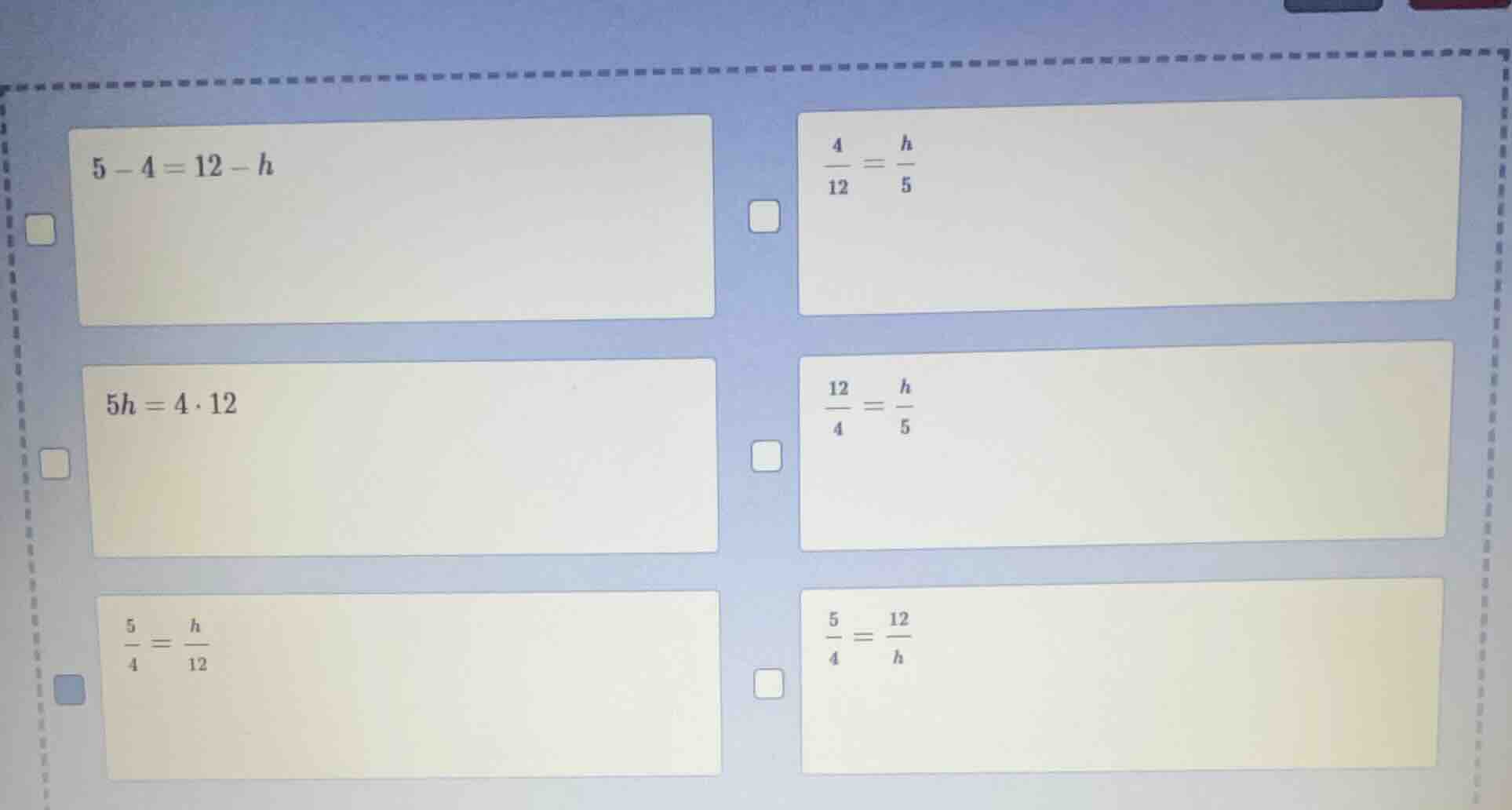
5 - 4 = 12 - h; \\(\frac{4}{12} = \frac{h}{5}\\); 5h = 4·12; \\(\frac{12}{4} = \frac{h}{5}\\); \\(\frac{5}{4} = \frac{h}{12}\\); \\(\frac{5}{4} = \frac{12}{h}\\)
To determine which equations are equivalent (assuming this is about similar triangles or proportion problems, likely involving solving for \( h \) in a proportional relationship), we analyze each equation:
1. Analyze \( \boldsymbol{\frac{5}{4} = \frac{h}{12}} \) (the selected one)
Cross - multiply: \( 5\times12 = 4\times h\), so \( 60 = 4h\) or \( 5h=4\times12\) (if we rearrange, but let's check other equations).
2. Analyze \( \boldsymbol{\frac{5}{4}=\frac{12}{h}} \)
Cross - multiply: \( 5h=4\times12\), which is the same as the cross - product of \( \frac{5}{4}=\frac{h}{12} \) (since \( \frac{5}{4}=\frac{h}{12}\Rightarrow5\times12 = 4h\) and \( \frac{5}{4}=\frac{12}{h}\Rightarrow5h = 4\times12\), these are equivalent in terms of the product relationship). Also, \( 5h = 4\times12\) is a direct equation from cross - multiplying \( \frac{5}{4}=\frac{h}{12}\) or \( \frac{5}{4}=\frac{12}{h}\).
3. Analyze \( \boldsymbol{\frac{12}{4}=\frac{h}{5}} \)
Simplify \( \frac{12}{4}=3\), so \( 3=\frac{h}{5}\Rightarrow h = 15\). Cross - multiply \( \frac{12}{4}=\frac{h}{5}\Rightarrow12\times5=4h\Rightarrow60 = 4h\), which is the same as the cross - product of \( \frac{5}{4}=\frac{h}{12}\) (since \( 5\times12=4h\) is also \( 60 = 4h\)).
4. Analyze non - proportional equations
- \( 5 - 4=12 - h\): Simplifies to \( 1=12 - h\Rightarrow h = 11\), which is a linear equation of a different form (not proportional) and will give a different value of \( h\) compared to the proportional ones.
- \( \frac{4}{12}=\frac{h}{5}\): Cross - multiply gives \( 4\times5 = 12h\Rightarrow20 = 12h\Rightarrow h=\frac{5}{3}\), which is different from the values obtained from the proportional equations related to \( \frac{5}{4}=\frac{h}{12}\).
If we assume the problem is about similar triangles (a common context for such proportions), the equations that are equivalent (represent the same proportional relationship) are:
- \( \frac{5}{4}=\frac{h}{12}\)
- \( \frac{5}{4}=\frac{12}{h}\)
- \( 5h = 4\times12\)
- \( \frac{12}{4}=\frac{h}{5}\)
If we are to find the equation equivalent to \( \frac{5}{4}=\frac{h}{12}\), the equivalent equations are:
- \( \frac{5}{4}=\frac{12}{h}\) (because cross - multiplying both gives \( 5h = 4\times12\))
- \( 5h=4\times12\) (direct cross - product)
- \( \frac{12}{4}=\frac{h}{5}\) (cross - multiplying gives \( 12\times5 = 4h\), which is the same as \( 5\times12=4h\))
If we take the selected equation \( \frac{5}{4}=\frac{h}{12}\), the equivalent equations (by cross - multiplication or rearrangement) are \( \frac{5}{4}=\frac{12}{h}\), \( 5h = 4\times12\), and \( \frac{12}{4}=\frac{h}{5}\).
If we solve \( \frac{5}{4}=\frac{h}{12}\) for \( h\):
Step 1: Cross - multiply
From \( \frac{5}{4}=\frac{h}{12}\), we use the cross - multiplication property of proportions (\( \frac{a}{b}=\frac{c}{d}\Rightarrow ad = bc\)). So, \( 5\times12=4\times h\).
Step 2: Solve for \( h\)
\( 60 = 4h\). Divide both sides by 4: \( h=\frac{60}{4}=15\).
If we solve \( \frac{5}{4}=\frac{12}{h}\):
Step 1: Cross - multiply
\( 5h=4\times12\).
Step 2: Solve for \( h\)
\( 5h = 48\Rightarrow h=\frac{48}{5}=9.6\)? Wait, no, wait. Wait, \( 4\times12 = 48\), so \( 5h=48\Rightarrow h=\frac{48}{5}=9.6\)? But this contradicts the previous result. Wait, I made a mistake.
Wait, \( \frac{5}{4}=\frac{h}{12}\): cross - multiply is \( 5\times12=4h\Rightarrow60 = 4h\Rightarrow h = 15\).
\( \frac{5}{4}=\frac{12}{h}\): cross - multiply is \( 5h=4\times12\Rightarrow5h = 48\Rightarrow h=\frac{48}{5}=9.6\). These are not equivalent. I made a mistake in the earlier…
Step 1: Apply cross - multiplication
For the proportion \( \frac{5}{4}=\frac{h}{12}\), using the property of proportions \( \frac{a}{b}=\frac{c}{d}\Rightarrow ad = bc\), we have \( 5\times12 = 4\times h\).
$$5\times12 = 4h$$
Step 2: Solve for \( h\)
Simplify the left - hand side: \( 60 = 4h\). Then divide both sides by 4: \( h=\frac{60}{4}=15\).

Snap & solve any problem in the app
Get step-by-step solutions on Sovi AI
Photo-based solutions with guided steps
Explore more problems and detailed explanations
\( h = 15\) (and the equivalent equations are \( \frac{12}{4}=\frac{h}{5}\), \( 5\times12 = 4h\))