QUESTION IMAGE
Question
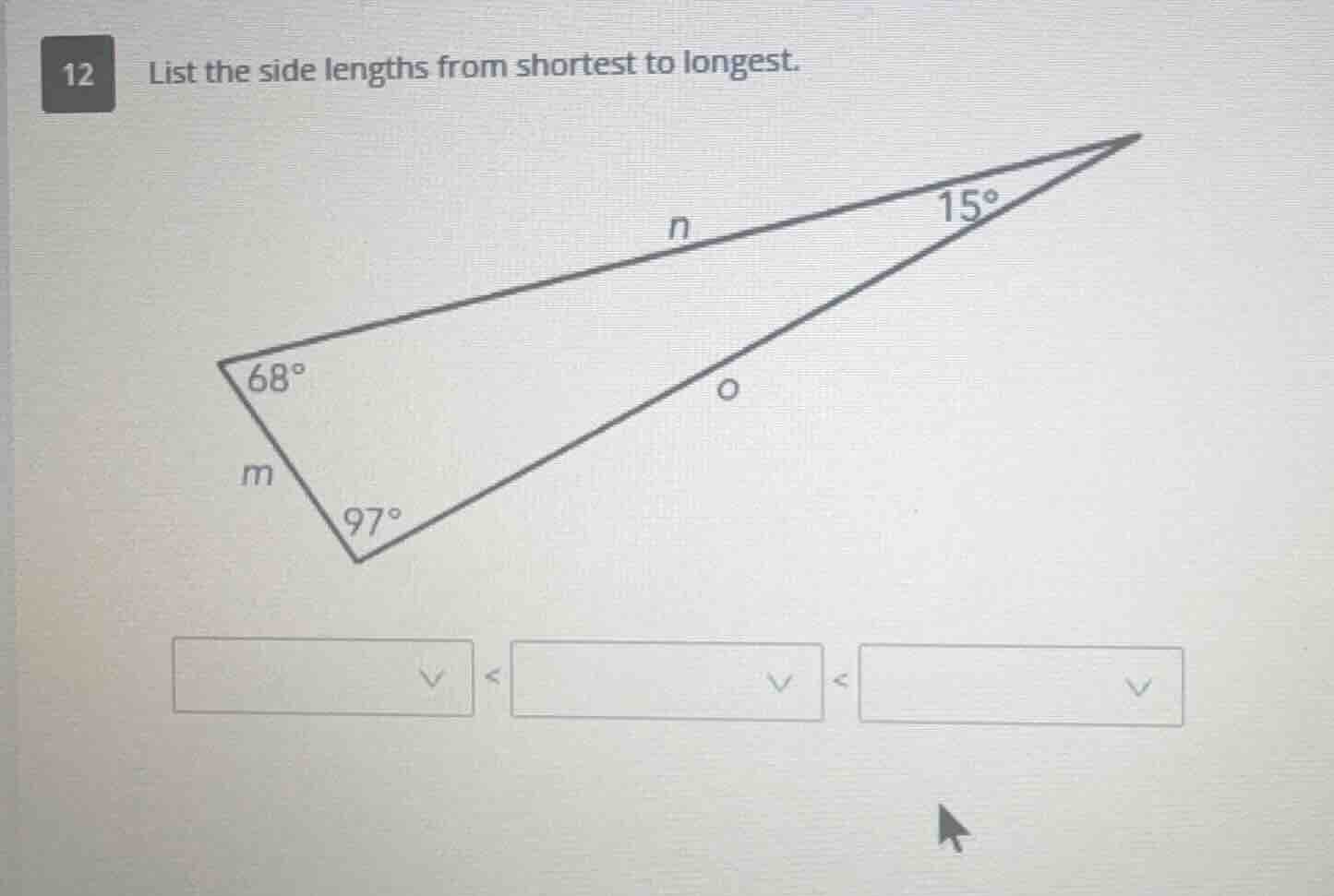
12 list the side lengths from shortest to longest.
Step1: Find the third angle
The sum of angles in a triangle is \(180^\circ\). So the third angle (opposite side \(m\)) is \(180 - 68 - 97 - 15\)? Wait, no, wait. Wait, the triangle has angles \(15^\circ\), \(68^\circ\), and let's calculate the third angle. Wait, \(180 - 15 - 68 = 97^\circ\). Wait, the angles are \(15^\circ\), \(68^\circ\), \(97^\circ\). So the sides opposite these angles: side \(n\) is opposite \(68^\circ\)? Wait, no, let's label the triangle. Let's say the angles are: angle \(A = 15^\circ\), angle \(B = 68^\circ\), angle \(C = 97^\circ\). Then side opposite angle \(A\) (15°) is \(m\)? Wait, no, looking at the diagram: the side labeled \(m\) is between \(68^\circ\) and \(97^\circ\), so the angle opposite \(m\) is \(15^\circ\). The side labeled \(n\) is between \(15^\circ\) and \(97^\circ\), so the angle opposite \(n\) is \(68^\circ\). The side labeled \(o\) is between \(15^\circ\) and \(68^\circ\), so the angle opposite \(o\) is \(97^\circ\).
Step2: Relate angles to side lengths
In a triangle, the larger the angle, the longer the side opposite it. So we order the angles from smallest to largest: \(15^\circ < 68^\circ < 97^\circ\). Therefore, the sides opposite these angles (which are \(m\), \(n\), \(o\) respectively) will be in the same order. Wait, angle \(15^\circ\) is opposite side \(m\)? Wait, no, let's correct: angle \(15^\circ\) is at the top, so the side opposite angle \(15^\circ\) is \(m\) (the side between \(68^\circ\) and \(97^\circ\)). Angle \(68^\circ\) is at the left, so the side opposite angle \(68^\circ\) is \(n\) (the side from the left angle to the top angle). Angle \(97^\circ\) is at the bottom, so the side opposite angle \(97^\circ\) is \(o\) (the side from the top angle to the bottom angle). Wait, no, maybe I mixed up. Let's re-express:
- Angle \(15^\circ\): opposite side \(m\) (since \(m\) is between the other two angles)
- Angle \(68^\circ\): opposite side \(o\)? Wait, no, the diagram: the side labeled \(n\) is the longest side? Wait, no, let's use the angle-side relationship: in a triangle, longer side is opposite larger angle.
So angles: \(15^\circ\) (smallest), \(68^\circ\), \(97^\circ\) (largest). So the sides opposite these angles:
- Opposite \(15^\circ\): side \(m\) (wait, no, maybe the labels are: the side with length \(m\) is opposite \(15^\circ\), side \(n\) opposite \(68^\circ\), side \(o\) opposite \(97^\circ\). Wait, no, let's check the diagram again. The triangle has three sides: \(m\), \(n\), \(o\). The angles are \(15^\circ\) (top), \(68^\circ\) (left), \(97^\circ\) (bottom). So:
- Side \(m\) is between left angle (\(68^\circ\)) and bottom angle (\(97^\circ\)), so it's opposite the top angle (\(15^\circ\)).
- Side \(n\) is between top angle (\(15^\circ\)) and bottom angle (\(97^\circ\)), so it's opposite the left angle (\(68^\circ\)).
- Side \(o\) is between top angle (\(15^\circ\)) and left angle (\(68^\circ\)), so it's opposite the bottom angle (\(97^\circ\)).
Therefore, side opposite \(15^\circ\) is \(m\), opposite \(68^\circ\) is \(n\), opposite \(97^\circ\) is \(o\).
Since \(15^\circ < 68^\circ < 97^\circ\), the sides opposite them ( \(m\), \(n\), \(o\)) will be in the order \(m < n < o\)? Wait, no: wait, the larger the angle, the longer the side opposite. So angle \(15^\circ\) (smallest) → side \(m\) (shortest), angle \(68^\circ\) → side \(n\) (longer than \(m\)), angle \(97^\circ\) (largest) → side \(o\) (longest). Wait, no, that can't be. Wait, no: if angle is larger, side opposite is longer. So angle \(15^\circ\) (small) → side opposite (m) is short. Angle \(…

Snap & solve any problem in the app
Get step-by-step solutions on Sovi AI
Photo-based solutions with guided steps
Explore more problems and detailed explanations
\(m < n < o\)