QUESTION IMAGE
Question
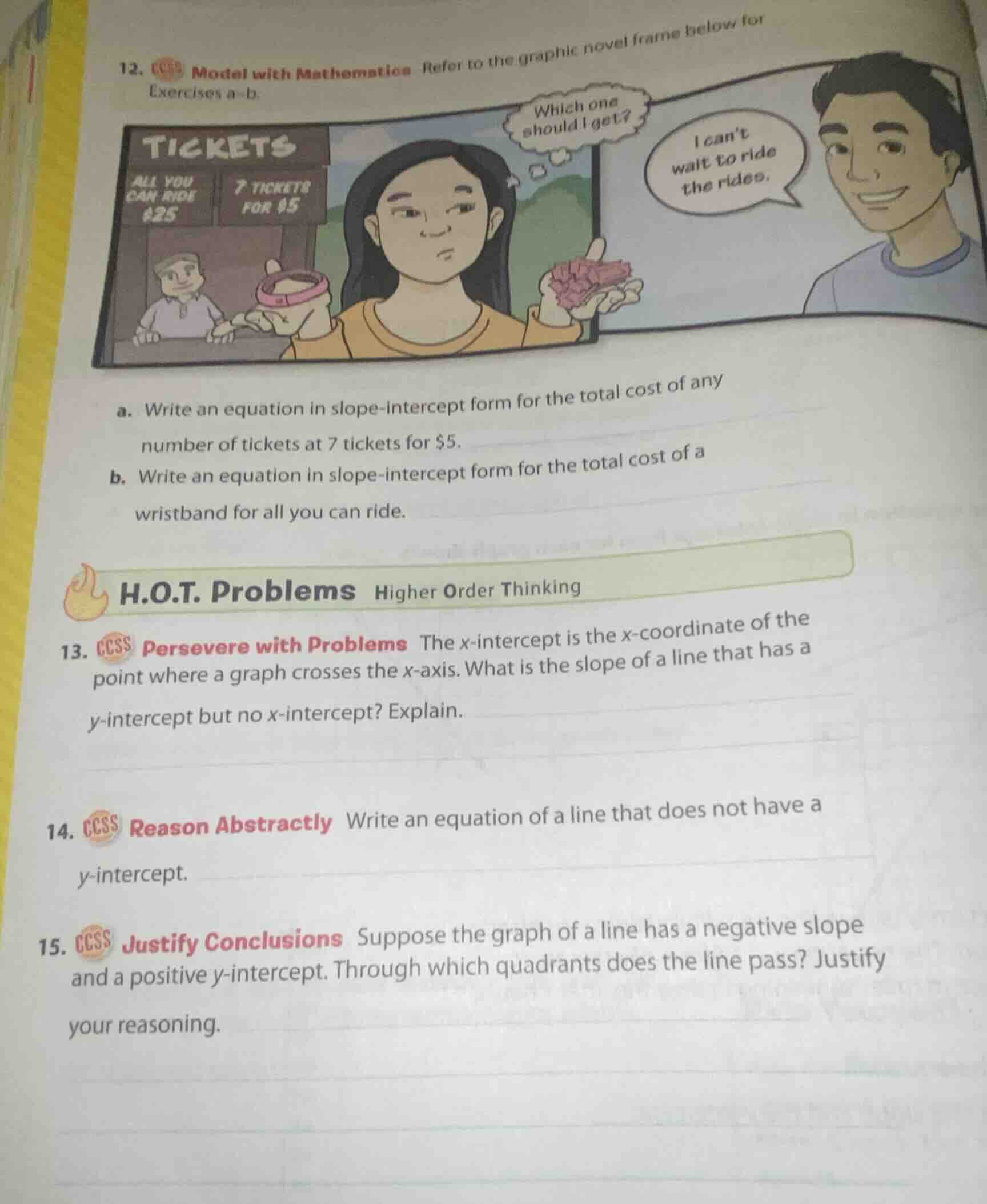
- model with mathematics refer to the graphic novel frame below for exercises a - b.
a. write an equation in slope - intercept form for the total cost of any number of tickets at 7 tickets for $5.
b. write an equation in slope - intercept form for the total cost of a wristband for all you can ride.
h.o.t. problems higher order thinking
- persevere with problems the x - intercept is the x - coordinate of the point where a graph crosses the x - axis. what is the slope of a line that has a y - intercept but no x - intercept? explain.
- reason abstractly write an equation of a line that does not have a y - intercept.
- justify conclusions suppose the graph of a line has a negative slope and a positive y - intercept. through which quadrants does the line pass? justify your reasoning.
Part a (12a)
Step1: Define variables and slope
Let \( x \) be the number of tickets, \( y \) be the total cost. The cost for 7 tickets is $5, so the cost per ticket (slope \( m \)) is \( \frac{5}{7} \). The y - intercept \( b \) is 0 (no fixed cost other than per - ticket cost).
The slope - intercept form is \( y=mx + b \).
Step2: Write the equation
Substitute \( m=\frac{5}{7} \) and \( b = 0 \) into the slope - intercept form. So the equation is \( y=\frac{5}{7}x \).
Part b (12b)
Step1: Define variables and slope
Let \( x \) be the number of rides (or any variable representing usage), \( y \) be the total cost. The wristband costs a fixed $25, so the slope \( m = 0 \) (no cost per ride) and the y - intercept \( b=25 \).
The slope - intercept form is \( y = mx + b \).
Step2: Write the equation
Substitute \( m = 0 \) and \( b=25 \) into the slope - intercept form. So the equation is \( y=25 \) (or \( y = 0x+25 \)).
Problem 13
Step1: Analyze the line's characteristics
A line with a y - intercept but no x - intercept is a horizontal line? No, wait. A line with a y - intercept (crosses the y - axis) but no x - intercept (never crosses the x - axis) is a horizontal line? No, a vertical line has an undefined slope and no y - intercept (except when \( x = 0 \), but a vertical line \( x=a,a
eq0 \) has no y - intercept). Wait, a line with a y - intercept but no x - intercept: a horizontal line \( y = k,k
eq0 \). The slope of a horizontal line is 0. Because for a horizontal line, the change in \( y \) (rise) is 0, and slope \( m=\frac{\text{rise}}{\text{run}}=\frac{0}{\text{run}} = 0 \) (where run is the change in \( x \)).
Step2: Explain
A line with a y - intercept (\( b
eq0 \)) and no x - intercept means it never crosses the x - axis. Such a line is horizontal (parallel to the x - axis). The slope of a horizontal line is 0, since the difference in \( y \) - values (rise) between any two points on the line is 0, and slope is \( \frac{\text{rise}}{\text{run}} \), so \( m = 0 \).
Problem 14

Snap & solve any problem in the app
Get step-by-step solutions on Sovi AI
Photo-based solutions with guided steps
Explore more problems and detailed explanations
s:
12a: \( \boldsymbol{y=\frac{5}{7}x} \)
12b: \( \boldsymbol{y = 25} \) (or \( \boldsymbol{y=0x + 25} \))
13: The slope is 0. A line with a y - intercept but no x - intercept is horizontal (\( y = k,k
eq0 \)), and horizontal lines have a slope of 0.
14: An example is \( \boldsymbol{x = 3} \) (or any \( \boldsymbol{x=c,c
eq0} \))
15: The line passes through Quadrants II, I, and IV. The positive y - intercept (\( b>0 \)) means it crosses the y - axis above the origin. The negative slope means it decreases as \( x \) increases. It crosses the x - axis at a positive \( x \) - value (\( x=-\frac{b}{m}>0 \) since \( m<0,b>0 \)). For \( x<0 \), \( y>0 \) (Quadrant II); for \( 0