QUESTION IMAGE
Question
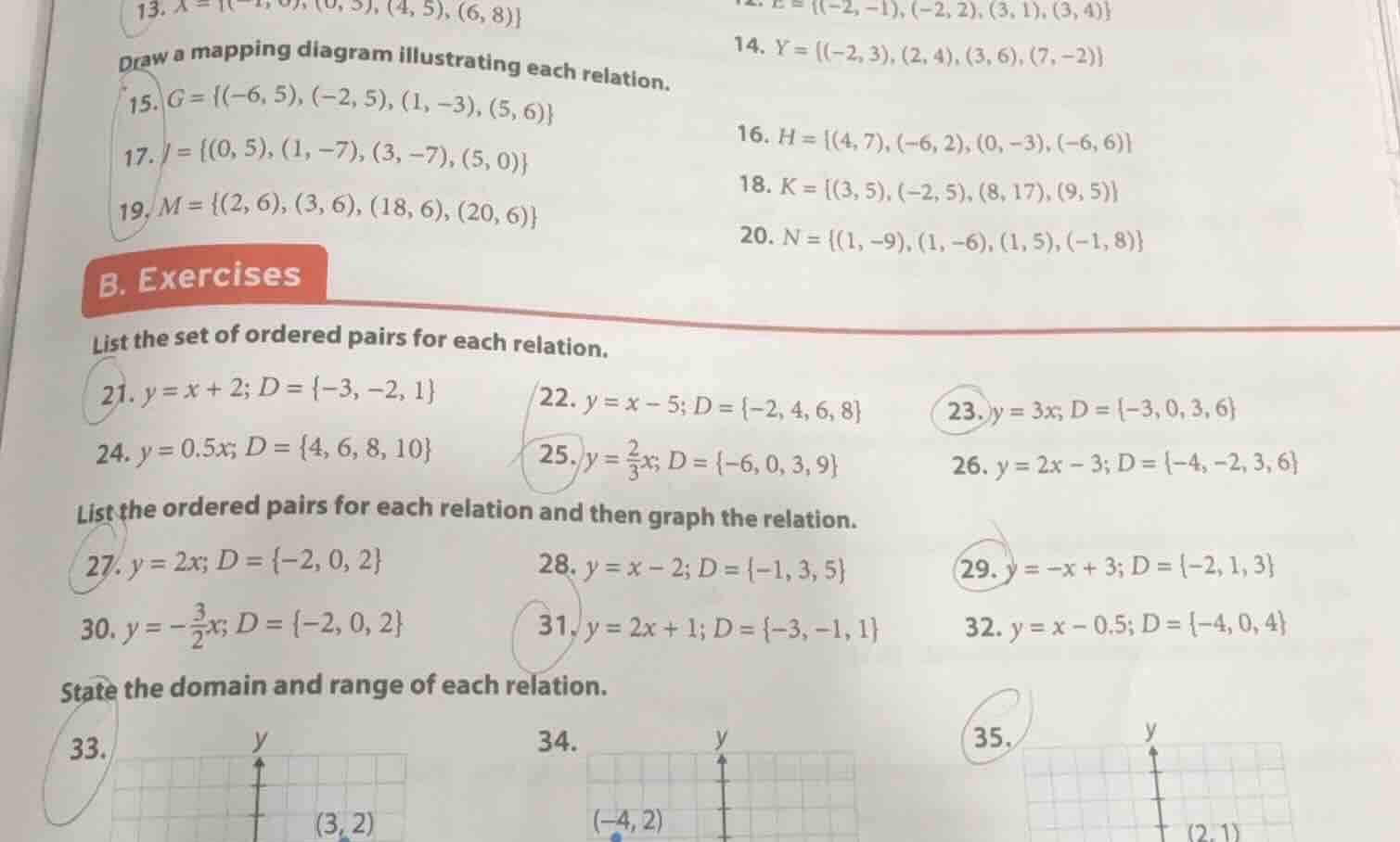
- x = {(-1, 0), (0, 5), (4, 5), (6, 8)}
draw a mapping diagram illustrating each relation.
- g = {(-6, 5), (-2, 5), (1, -3), (5, 6)}
- i = {(0, 5), (1, -7), (3, -7), (5, 0)}
- m = {(2, 6), (3, 6), (18, 6), (20, 6)}
- e = {(-2, -1), (-2, 2), (3, 1), (3, 4)}
- y = {(-2, 3), (2, 4), (3, 6), (7, -2)}
- h = {(4, 7), (-6, 2), (0, -3), (-6, 6)}
- k = {(3, 5), (-2, 5), (8, 17), (9, 5)}
- n = {(1, -9), (1, -6), (1, 5), (-1, 8)}
b. exercises
list the set of ordered pairs for each relation.
- ( y = x + 2 ); ( d = {-3, -2, 1} )
- ( y = x - 5 ); ( d = {-2, 4, 6, 8} )
- ( y = 3x ); ( d = {-3, 0, 3, 6} )
- ( y = 0.5x ); ( d = {4, 6, 8, 10} )
- ( y = \frac{2}{3}x ); ( d = {-6, 0, 3, 9} )
- ( y = 2x - 3 ); ( d = {-4, -2, 3, 6} )
list the ordered pairs for each relation and then graph the relation.
- ( y = 2x ); ( d = {-2, 0, 2} )
- ( y = x - 2 ); ( d = {-1, 3, 5} )
- ( y = -x + 3 ); ( d = {-2, 1, 3} )
- ( y = -\frac{3}{2}x ); ( d = {-2, 0, 2} )
- ( y = 2x + 1 ); ( d = {-3, -1, 1} )
- ( y = x - 0.5 ); ( d = {-4, 0, 4} )
state the domain and range of each relation.
33.
34.
35.
(3, 2)
(-4, 2)
(2, 1)
Let's solve problem 23: \( y = 3x \); \( D = \{-3, 0, 3, 6\} \)
Step 1: Substitute \( x = -3 \) into \( y = 3x \)
To find the corresponding \( y \)-value when \( x = -3 \), we use the equation \( y = 3x \). Substituting \( x = -3 \) gives:
\( y = 3(-3) = -9 \)
So the ordered pair is \( (-3, -9) \).
Step 2: Substitute \( x = 0 \) into \( y = 3x \)
Substituting \( x = 0 \) into the equation:
\( y = 3(0) = 0 \)
The ordered pair is \( (0, 0) \).
Step 3: Substitute \( x = 3 \) into \( y = 3x \)
For \( x = 3 \):
\( y = 3(3) = 9 \)
The ordered pair is \( (3, 9) \).
Step 4: Substitute \( x = 6 \) into \( y = 3x \)
Substituting \( x = 6 \):
\( y = 3(6) = 18 \)
The ordered pair is \( (6, 18) \).

Snap & solve any problem in the app
Get step-by-step solutions on Sovi AI
Photo-based solutions with guided steps
Explore more problems and detailed explanations
The set of ordered pairs for the relation \( y = 3x \) with domain \( D = \{-3, 0, 3, 6\} \) is \( \{(-3, -9), (0, 0), (3, 9), (6, 18)\} \).