QUESTION IMAGE
Question
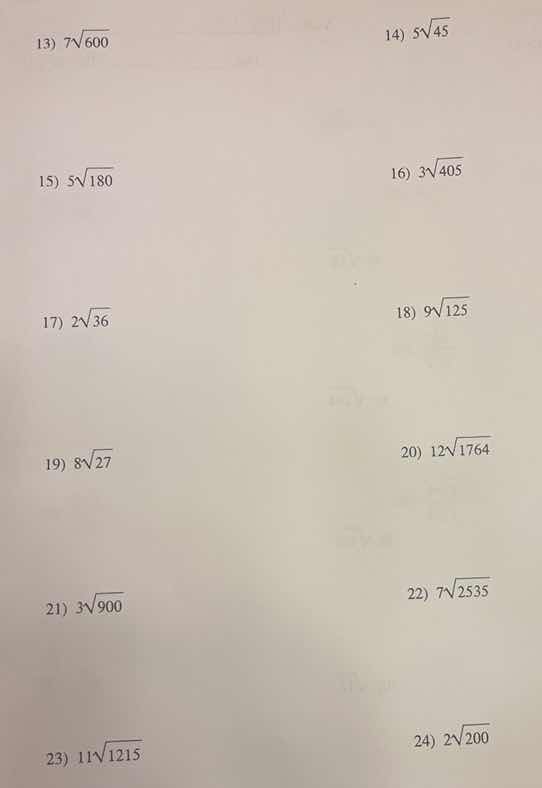
- $7sqrt{600}$
- $5sqrt{45}$
- $5sqrt{180}$
- $3sqrt{405}$
- $2sqrt{36}$
- $9sqrt{125}$
- $8sqrt{27}$
- $12sqrt{1764}$
- $3sqrt{900}$
- $7sqrt{2535}$
- $11sqrt{1215}$
- $2sqrt{200}$
Let's solve each problem step by step. We'll use the property \(\sqrt{ab}=\sqrt{a}\cdot\sqrt{b}\) (where \(a,b\geq0\)) to simplify the square roots.
Problem 13: \(7\sqrt{600}\)
Step 1: Factor 600
We can factor 600 as \(600 = 100\times6\), where 100 is a perfect square.
Step 2: Apply the square root property
\(\sqrt{600}=\sqrt{100\times6}=\sqrt{100}\cdot\sqrt{6}=10\sqrt{6}\)
Step 3: Multiply by 7
\(7\sqrt{600}=7\times10\sqrt{6}=70\sqrt{6}\)
Problem 14: \(5\sqrt{45}\)
Step 1: Factor 45
Factor 45 as \(45 = 9\times5\), and 9 is a perfect square.
Step 2: Apply the square root property
\(\sqrt{45}=\sqrt{9\times5}=\sqrt{9}\cdot\sqrt{5}=3\sqrt{5}\)
Step 3: Multiply by 5
\(5\sqrt{45}=5\times3\sqrt{5}=15\sqrt{5}\)
Problem 15: \(5\sqrt{180}\)
Step 1: Factor 180
Factor 180 as \(180 = 36\times5\), and 36 is a perfect square.
Step 2: Apply the square root property
\(\sqrt{180}=\sqrt{36\times5}=\sqrt{36}\cdot\sqrt{5}=6\sqrt{5}\)
Step 3: Multiply by 5
\(5\sqrt{180}=5\times6\sqrt{5}=30\sqrt{5}\)
Problem 16: \(3\sqrt{405}\)
Step 1: Factor 405
Factor 405 as \(405 = 81\times5\), and 81 is a perfect square.
Step 2: Apply the square root property
\(\sqrt{405}=\sqrt{81\times5}=\sqrt{81}\cdot\sqrt{5}=9\sqrt{5}\)
Step 3: Multiply by 3
\(3\sqrt{405}=3\times9\sqrt{5}=27\sqrt{5}\)
Problem 17: \(2\sqrt{36}\)
Step 1: Simplify \(\sqrt{36}\)
Since \(6^2 = 36\), \(\sqrt{36}=6\)
Step 2: Multiply by 2
\(2\sqrt{36}=2\times6 = 12\)
Problem 18: \(9\sqrt{125}\)
Step 1: Factor 125
Factor 125 as \(125 = 25\times5\), and 25 is a perfect square.
Step 2: Apply the square root property
\(\sqrt{125}=\sqrt{25\times5}=\sqrt{25}\cdot\sqrt{5}=5\sqrt{5}\)
Step 3: Multiply by 9
\(9\sqrt{125}=9\times5\sqrt{5}=45\sqrt{5}\)
Problem 19: \(8\sqrt{27}\)
Step 1: Factor 27
Factor 27 as \(27 = 9\times3\), and 9 is a perfect square.
Step 2: Apply the square root property
\(\sqrt{27}=\sqrt{9\times3}=\sqrt{9}\cdot\sqrt{3}=3\sqrt{3}\)
Step 3: Multiply by 8
\(8\sqrt{27}=8\times3\sqrt{3}=24\sqrt{3}\)
Problem 20: \(12\sqrt{1764}\)
Step 1: Simplify \(\sqrt{1764}\)
We know that \(42^2=1764\), so \(\sqrt{1764}=42\)
Step 2: Multiply by 12
\(12\sqrt{1764}=12\times42 = 504\)
Problem 21: \(3\sqrt{900}\)
Step 1: Simplify \(\sqrt{900}\)
Since \(30^2 = 900\), \(\sqrt{900}=30\)
Step 2: Multiply by 3
\(3\sqrt{900}=3\times30 = 90\)
Problem 22: \(7\sqrt{2535}\)
Step 1: Factor 2535
First, we factor 2535. Let's check if it's divisible by 5: \(2535\div5 = 507\). Then \(507\div3=169\), and \(169 = 13^2\). So \(2535=5\times3\times13^2 = 15\times169\)
Step 2: Apply the square root property
\(\sqrt{2535}=\sqrt{169\times15}=\sqrt{169}\cdot\sqrt{15}=13\sqrt{15}\)
Step 3: Multiply by 7
\(7\sqrt{2535}=7\times13\sqrt{15}=91\sqrt{15}\)
Problem 23: \(11\sqrt{1215}\)
Step 1: Factor 1215
Factor 1215: \(1215\div5 = 243\), \(243=81\times3\), so \(1215 = 5\times81\times3=405\times3 = 81\times15\) (since \(81\times15=1215\))
Step 2: Apply the square root property
\(\sqrt{1215}=\sqrt{81\times15}=\sqrt{81}\cdot\sqrt{15}=9\sqrt{15}\)
Step 3: Multiply by 11
\(11\sqrt{1215}=11\times9\sqrt{15}=99\sqrt{15}\)
Problem 24: \(2\sqrt{200}\)
Step 1: Factor 200
Factor 200 as \(200 = 100\times2\), and 100 is a perfect square.
Step 2: Apply the square root property
\(\sqrt{200}=\sqrt{100\times2}=\sqrt{100}\cdot\sqrt{2}=10\sqrt{2}\)
Step 3: Multiply by 2
\(2\sqrt{200}=2\times10\sqrt{2}=20\sqrt{2}\)
Final Answers:
- \(\boldsymbol{70\sqrt{6}}\)
- \(\boldsymbol{15\sqrt{5}}\)
- \(\boldsy…

Snap & solve any problem in the app
Get step-by-step solutions on Sovi AI
Photo-based solutions with guided steps
Explore more problems and detailed explanations
Let's solve each problem step by step. We'll use the property \(\sqrt{ab}=\sqrt{a}\cdot\sqrt{b}\) (where \(a,b\geq0\)) to simplify the square roots.
Problem 13: \(7\sqrt{600}\)
Step 1: Factor 600
We can factor 600 as \(600 = 100\times6\), where 100 is a perfect square.
Step 2: Apply the square root property
\(\sqrt{600}=\sqrt{100\times6}=\sqrt{100}\cdot\sqrt{6}=10\sqrt{6}\)
Step 3: Multiply by 7
\(7\sqrt{600}=7\times10\sqrt{6}=70\sqrt{6}\)
Problem 14: \(5\sqrt{45}\)
Step 1: Factor 45
Factor 45 as \(45 = 9\times5\), and 9 is a perfect square.
Step 2: Apply the square root property
\(\sqrt{45}=\sqrt{9\times5}=\sqrt{9}\cdot\sqrt{5}=3\sqrt{5}\)
Step 3: Multiply by 5
\(5\sqrt{45}=5\times3\sqrt{5}=15\sqrt{5}\)
Problem 15: \(5\sqrt{180}\)
Step 1: Factor 180
Factor 180 as \(180 = 36\times5\), and 36 is a perfect square.
Step 2: Apply the square root property
\(\sqrt{180}=\sqrt{36\times5}=\sqrt{36}\cdot\sqrt{5}=6\sqrt{5}\)
Step 3: Multiply by 5
\(5\sqrt{180}=5\times6\sqrt{5}=30\sqrt{5}\)
Problem 16: \(3\sqrt{405}\)
Step 1: Factor 405
Factor 405 as \(405 = 81\times5\), and 81 is a perfect square.
Step 2: Apply the square root property
\(\sqrt{405}=\sqrt{81\times5}=\sqrt{81}\cdot\sqrt{5}=9\sqrt{5}\)
Step 3: Multiply by 3
\(3\sqrt{405}=3\times9\sqrt{5}=27\sqrt{5}\)
Problem 17: \(2\sqrt{36}\)
Step 1: Simplify \(\sqrt{36}\)
Since \(6^2 = 36\), \(\sqrt{36}=6\)
Step 2: Multiply by 2
\(2\sqrt{36}=2\times6 = 12\)
Problem 18: \(9\sqrt{125}\)
Step 1: Factor 125
Factor 125 as \(125 = 25\times5\), and 25 is a perfect square.
Step 2: Apply the square root property
\(\sqrt{125}=\sqrt{25\times5}=\sqrt{25}\cdot\sqrt{5}=5\sqrt{5}\)
Step 3: Multiply by 9
\(9\sqrt{125}=9\times5\sqrt{5}=45\sqrt{5}\)
Problem 19: \(8\sqrt{27}\)
Step 1: Factor 27
Factor 27 as \(27 = 9\times3\), and 9 is a perfect square.
Step 2: Apply the square root property
\(\sqrt{27}=\sqrt{9\times3}=\sqrt{9}\cdot\sqrt{3}=3\sqrt{3}\)
Step 3: Multiply by 8
\(8\sqrt{27}=8\times3\sqrt{3}=24\sqrt{3}\)
Problem 20: \(12\sqrt{1764}\)
Step 1: Simplify \(\sqrt{1764}\)
We know that \(42^2=1764\), so \(\sqrt{1764}=42\)
Step 2: Multiply by 12
\(12\sqrt{1764}=12\times42 = 504\)
Problem 21: \(3\sqrt{900}\)
Step 1: Simplify \(\sqrt{900}\)
Since \(30^2 = 900\), \(\sqrt{900}=30\)
Step 2: Multiply by 3
\(3\sqrt{900}=3\times30 = 90\)
Problem 22: \(7\sqrt{2535}\)
Step 1: Factor 2535
First, we factor 2535. Let's check if it's divisible by 5: \(2535\div5 = 507\). Then \(507\div3=169\), and \(169 = 13^2\). So \(2535=5\times3\times13^2 = 15\times169\)
Step 2: Apply the square root property
\(\sqrt{2535}=\sqrt{169\times15}=\sqrt{169}\cdot\sqrt{15}=13\sqrt{15}\)
Step 3: Multiply by 7
\(7\sqrt{2535}=7\times13\sqrt{15}=91\sqrt{15}\)
Problem 23: \(11\sqrt{1215}\)
Step 1: Factor 1215
Factor 1215: \(1215\div5 = 243\), \(243=81\times3\), so \(1215 = 5\times81\times3=405\times3 = 81\times15\) (since \(81\times15=1215\))
Step 2: Apply the square root property
\(\sqrt{1215}=\sqrt{81\times15}=\sqrt{81}\cdot\sqrt{15}=9\sqrt{15}\)
Step 3: Multiply by 11
\(11\sqrt{1215}=11\times9\sqrt{15}=99\sqrt{15}\)
Problem 24: \(2\sqrt{200}\)
Step 1: Factor 200
Factor 200 as \(200 = 100\times2\), and 100 is a perfect square.
Step 2: Apply the square root property
\(\sqrt{200}=\sqrt{100\times2}=\sqrt{100}\cdot\sqrt{2}=10\sqrt{2}\)
Step 3: Multiply by 2
\(2\sqrt{200}=2\times10\sqrt{2}=20\sqrt{2}\)
Final Answers:
- \(\boldsymbol{70\sqrt{6}}\)
- \(\boldsymbol{15\sqrt{5}}\)
- \(\boldsymbol{30\sqrt{5}}\)
- \(\boldsymbol{27\sqrt{5}}\)
- \(\boldsymbol{12}\)
- \(\boldsymbol{45\sqrt{5}}\)
- \(\boldsymbol{24\sqrt{3}}\)
- \(\boldsymbol{504}\)
- \(\boldsymbol{90}\)
- \(\boldsymbol{91\sqrt{15}}\)
- \(\boldsymbol{99\sqrt{15}}\)
- \(\boldsymbol{20\sqrt{2}}\)