QUESTION IMAGE
Question
- find $\angle ade$.
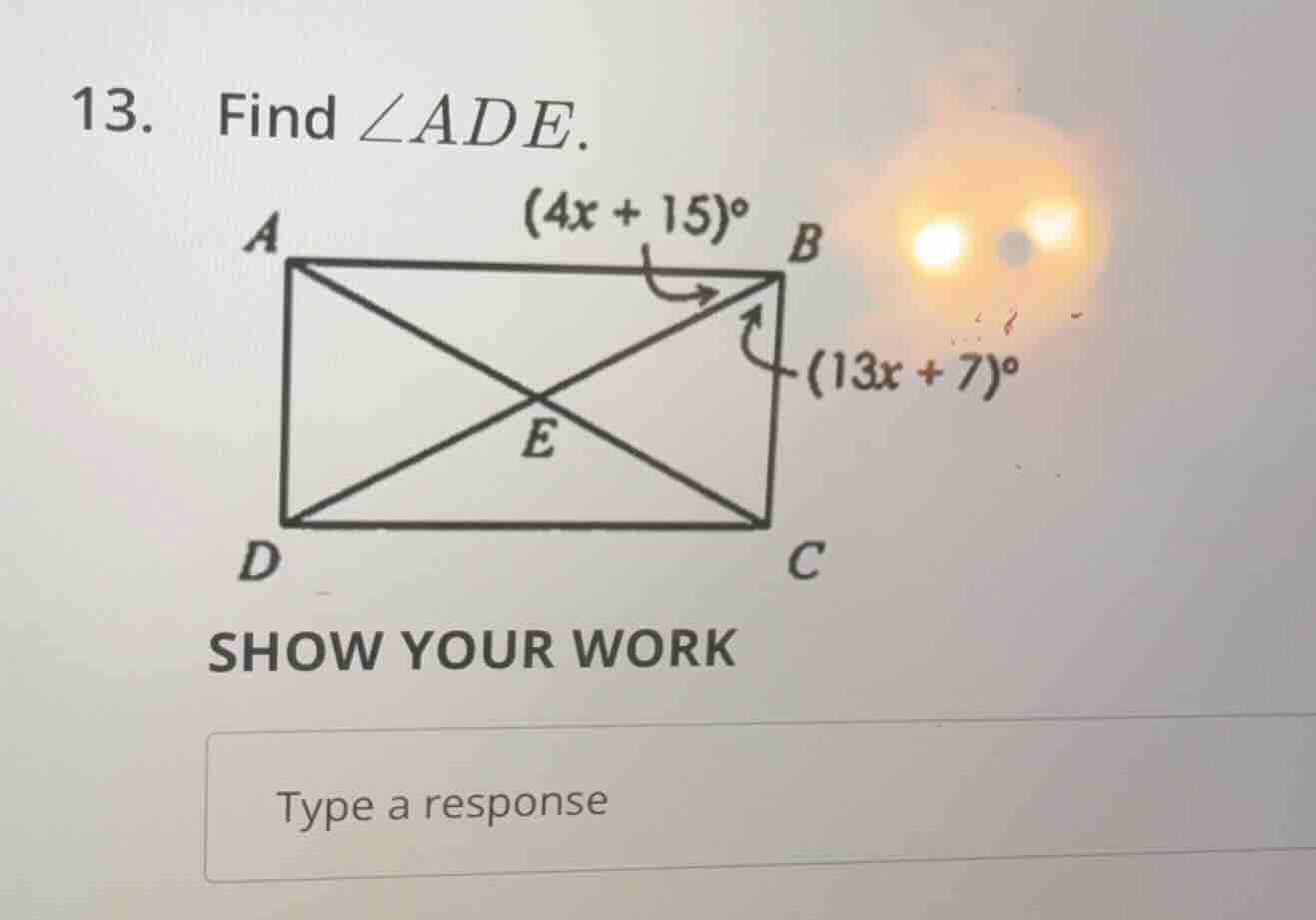
rectangle with vertices a, b, c, d; diagonals intersect at e. angle at b: $(4x + 15)^\circ$ (between ab and be), angle at b: $(13x + 7)^\circ$ (between bc and be). show your work
type a response
Step1: Use rectangle angle property
In rectangle \(ABCD\), \(\angle ABC = 90^\circ\), so \((4x+15)^\circ + (13x+7)^\circ = 90^\circ\)
Step2: Simplify to solve for \(x\)
Combine like terms:
\(4x + 13x + 15 + 7 = 90\)
\(17x + 22 = 90\)
Subtract 22 from both sides:
\(17x = 90 - 22 = 68\)
Solve for \(x\):
\(x = \frac{68}{17} = 4\)
Step3: Find \(\angle ABD\)
Substitute \(x=4\) into \(4x+15\):
\(\angle ABD = 4(4) + 15 = 16 + 15 = 31^\circ\)
Step4: Use rectangle diagonal property
In rectangle \(ABCD\), diagonals are equal and bisect each other, so \(AE = DE\), meaning \(\angle ADE = \angle DAE\). Also, \(AB \parallel DC\), so \(\angle ABD = \angle ADB = \angle ADE = 31^\circ\)

Snap & solve any problem in the app
Get step-by-step solutions on Sovi AI
Photo-based solutions with guided steps
Explore more problems and detailed explanations
\(31^\circ\)