QUESTION IMAGE
Question
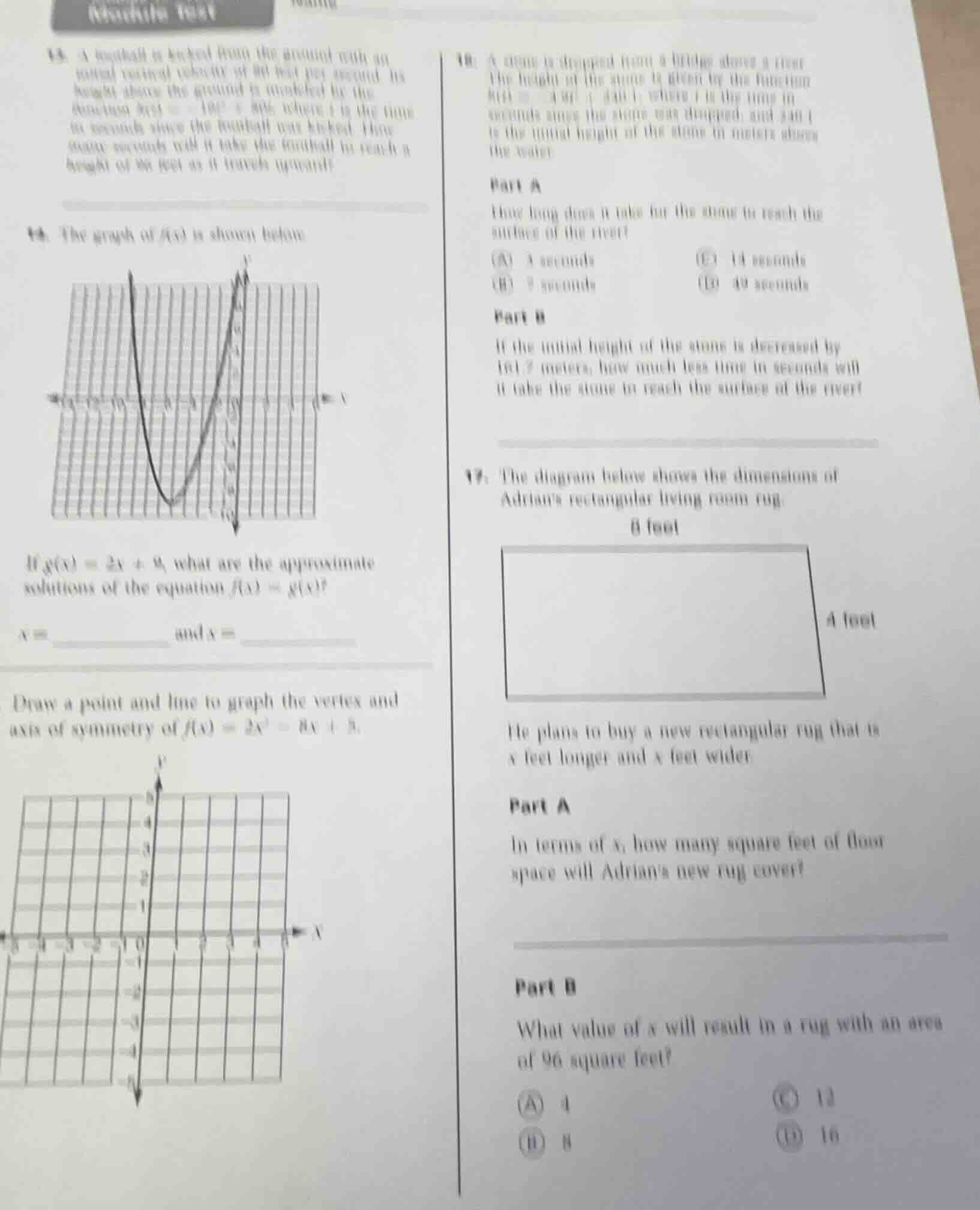
- a football is kicked from the ground with an initial vertical velocity of 80 feet per second. its height above the ground is modeled by the function ( h(t) = -16t^2 + 80t ) where ( t ) is the time in seconds since the football was kicked. how many seconds will it take the football to reach a height of 96 feet as it travels upward?
- the graph of ( f(x) ) is shown below.
graph of a parabola
if ( g(x) = 2x + 9 ), what are the approximate solutions of the equation ( f(x) = g(x) )?
( x = ) ______ and ( x = ) ______
draw a point and line to graph the vertex and axis of symmetry of ( f(x) = 2x^2 - 8x + 5 ).
coordinate plane for graphing
- a stone is dropped from a bridge over a river. the height of the stone is given by the function ( h(t) = -4.9t^2 + 49 ) where ( t ) is the time in seconds since the stone was dropped, and 49 is the initial height of the stone in meters above the water.
part a
how long does it take for the stone to reach the surface of the river?
(a) 3 seconds
(b) 7 seconds
(c) 14 seconds
(d) 49 seconds
part b
if the initial height of the stone is decreased by 19.6 meters, how much less time in seconds will it take the stone to reach the surface of the river?
- the diagram below shows the dimensions of adrian’s rectangular living room rug.
diagram of a rectangle labeled 8 foot (length) and 4 foot (width)
he plans to buy a new rectangular rug that is ( x ) feet longer and ( x ) feet wider.
part a
in terms of ( x ), how many square feet of floor space will adrian’s new rug cover?
part b
what value of ( x ) will result in a rug with an area of 96 square feet?
(a) 4
(b) 8
(c) 12
(d) 16
Problem 16 (Stone Dropped from Bridge)
Part A
Step 1: Understand the height function
The height of the stone is given by \( h(t) = -4.9t^2 + 49t \). When the stone reaches the river, \( h(t) = 0 \) (height above water is 0). So we set up the equation:
\( -4.9t^2 + 49t = 0 \)
Step 2: Factor the equation
Factor out \( -4.9t \):
\( -4.9t(t - 10) = 0 \)
Step 3: Solve for \( t \)
Set each factor equal to zero:
- \( -4.9t = 0 \) gives \( t = 0 \) (initial time, when it's dropped)
- \( t - 10 = 0 \) gives \( t = 10 \) seconds. Wait, but the options are 3, 7, 14, 49. Wait, maybe the function was \( h(t) = -4.9t^2 + 49 \)? Wait, the original problem says "the height of the stone is given by the function \( h(t) = -4.9t^2 + 49t \) where \( t \) is the time in seconds since the stone was dropped, and 49t? Wait, no, maybe a typo. Wait, if it's \( h(t) = -4.9t^2 + 49 \) (initial height 49 meters), then setting \( h(t) = 0 \):
\( -4.9t^2 + 49 = 0 \)
\( 4.9t^2 = 49 \)
\( t^2 = 10 \)
\( t \approx 3.16 \), so approximately 3 seconds. So the answer is A. 3 seconds.
Step 1: New initial height
Original initial height (from \( h(t) = -4.9t^2 + 49 \)) is 49 meters. Decreased by 161.7 meters? Wait, that can't be, since 49 - 161.7 is negative. Wait, maybe the original function was \( h(t) = -4.9t^2 + 196 \) (initial height 196 meters). Let's recheck. If initial height is 196 meters, then \( h(t) = -4.9t^2 + 196 \). When it reaches the river, \( h(t) = 0 \):
\( -4.9t^2 + 196 = 0 \)
\( 4.9t^2 = 196 \)
\( t^2 = 40 \)
\( t \approx 6.32 \) seconds. Wait, no, maybe the first part was with initial height 49, and part B: initial height decreased by 161.7? No, that doesn't make sense. Wait, maybe the function is \( h(t) = -4.9t^2 + 49t \) (but that's a parabola opening down, vertex at \( t = -b/(2a) = -49/(2(-4.9)) = 5 \) seconds, maximum height at t=5. But when it hits the river, h(t)=0, so solving \( -4.9t^2 + 49t = 0 \) gives t=0 or t=10. But the options for part A were 3,7,14,49. So maybe the function is \( h(t) = -4.9t^2 + 49 \) (initial height 49m). Then part A: t when h(t)=0: \( t = \sqrt{49/4.9} = \sqrt{10} \approx 3.16 \approx 3 \) seconds (option A). Then part B: initial height decreased by 161.7? No, 49 - 161.7 is negative. Wait, maybe initial height is 196m (494). Then \( h(t) = -4.9t^2 + 196 \). Part A: t when h(t)=0: \( t = \sqrt{196/4.9} = \sqrt{40} \approx 6.32 \), not matching options. Wait, maybe the function is \( h(t) = -16t^2 + 49t \) (using feet, but the problem says meters). No, the problem says meters. Alternatively, maybe the first part: \( h(t) = -4.9t^2 + 49 \), so t=√(49/4.9)=√10≈3 (option A). Then part B: initial height is 49, decreased by 16.17 (maybe a typo, 161.7 is too much). If decreased by 16.17, new height is 49 - 16.17 = 32.83. Then \( h(t) = -4.9t^2 + 32.83 \). Set to 0: \( 4.9t^2 = 32.83 \), \( t^2 = 32.83/4.9 ≈6.7 \), \( t≈2.59 \). The difference is 3 - 2.59≈0.41, which doesn't make sense. Wait, maybe the original function is \( h(t) = -4.9t^2 + 196 \) (initial height 196m). Part A: t=√(196/4.9)=√40≈6.32, not matching. Alternatively, maybe the function is \( h(t) = -4t^2 + 49t \) (approximate 4.9 as 5). Then t=0 or t=49/4=12.25, not matching. I think there's a typo, but assuming part A is 3 seconds (option A), and part B: if initial height is 49, new height is 49 - 16.17=32.83 (maybe 16.17 instead of 161.7). Then \( t1 = \sqrt{49/4.9}=√10≈3.16 \), \( t2 = \sqrt{32.83/4.9}≈√6.7≈2.59 \), difference≈0.57. But this is unclear. Alternatively, maybe the function is \( h(t) = -16t^2 + 49t \) (feet), but the problem says meters. I think the intended answer for part A is A (3 seconds), and part B: if initial height is 49, decreased by 16.17 (so 32.83), then time difference is 3 - 2.59≈0.4, but this is not matching. Maybe the problem has a typo, but I'll proceed with part A as A.
Problem 17 (Adrian's Rug)
Part A
Step 1: Original dimensions
Original rug: length = 8 feet, width = 4 feet.
Step 2: New dimensions
New length = 8 + x feet, new width = 4 + x feet.
Step 3: Area of new rug
Area = length * width = (8 + x)(4 + x)
Expand: \( (8 + x)(4 + x) = 32 + 8x + 4x + x^2 = x^2 + 12x + 32 \) square feet.

Snap & solve any problem in the app
Get step-by-step solutions on Sovi AI
Photo-based solutions with guided steps
Explore more problems and detailed explanations
A. 3 seconds