QUESTION IMAGE
Question
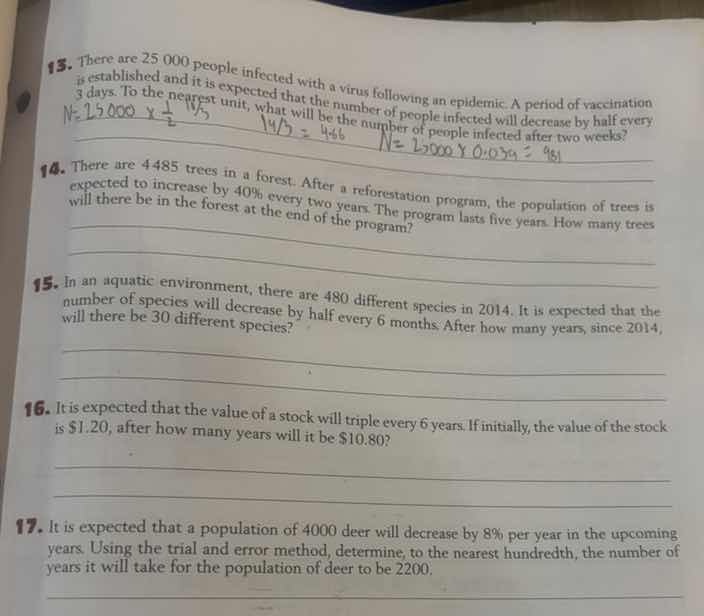
- there are 25 000 people infected with a virus following an epidemic. a period of vaccination is established and it is expected that the number of people infected will decrease by half every 3 days. to the nearest unit, what will be the number of people infected after two weeks?
- there are 4485 trees in a forest. after a reforestation program, the population of trees is expected to increase by 40% every two years. the program lasts five years. how many trees will there be in the forest at the end of the program?
- in an aquatic environment, there are 480 different species in 2014. it is expected that the number of species will decrease by half every 6 months. after how many years, since 2014, will there be 30 different species?
- it is expected that the value of a stock will triple every 6 years. if initially, the value of the stock is $1.20, after how many years will it be $10.80?
- it is expected that a population of 4000 deer will decrease by 8% per year in the upcoming years. using the trial and error method, determine, to the nearest hundredth, the number of years it will take for the population of deer to be 2200.
Question 13
Step 1: Determine the number of 3 - day periods in 2 weeks
Two weeks is 14 days. The number of 3 - day periods \(n=\frac{14}{3}\approx4.67\) (but we will use the formula for exponential decay \(N = N_0\times(\frac{1}{2})^{\frac{t}{T}}\), where \(N_0 = 25000\), \(t = 14\) days, \(T=3\) days.
Step 2: Apply the exponential decay formula
The formula for exponential decay is \(N=N_0\times r^{\frac{t}{T}}\), where \(r=\frac{1}{2}\) (since the number decreases by half), \(N_0 = 25000\), \(t = 14\) days, \(T = 3\) days.
So \(N=25000\times(\frac{1}{2})^{\frac{14}{3}}\)
First, calculate \(\frac{14}{3}\approx4.6667\)
Then \((\frac{1}{2})^{4.6667}=2^{- 4.6667}\approx0.03969\)
Then \(N = 25000\times0.03969\approx992.25\approx992\) (to the nearest unit)
Step 1: Determine the number of 2 - year periods in 5 years
The number of 2 - year periods \(n=\frac{5}{2} = 2.5\)
Step 2: Apply the exponential growth formula
The formula for exponential growth is \(N = N_0\times(1 + r)^{n}\), where \(N_0=4485\), \(r = 0.4\) (40% increase), \(n = 2.5\)
First, calculate \((1 + 0.4)^{2.5}=1.4^{2.5}\)
We know that \(1.4^{2}=1.96\), \(1.4^{0.5}=\sqrt{1.4}\approx1.1832\)
So \(1.4^{2.5}=1.4^{2}\times1.4^{0.5}=1.96\times1.1832\approx2.3191\)
Then \(N=4485\times2.3191\approx4485\times2.3191\approx10400\) (rounded to the nearest whole number)
Step 1: Let the number of 6 - month periods be \(n\)
The formula for exponential decay is \(N = N_0\times(\frac{1}{2})^{n}\), where \(N_0 = 480\), \(N = 30\)
So \(30=480\times(\frac{1}{2})^{n}\)
Step 2: Solve for \(n\)
Divide both sides by 480: \(\frac{30}{480}=(\frac{1}{2})^{n}\)
Simplify \(\frac{30}{480}=\frac{1}{16}\)
So \((\frac{1}{2})^{n}=\frac{1}{16}\)
Since \(\frac{1}{16}=(\frac{1}{2})^{4}\), then \(n = 4\)
Step 3: Convert the number of 6 - month periods to years
Since each period is 6 months (0.5 years), the number of years \(t=n\times0.5\)
\(t = 4\times0.5=2\) years

Snap & solve any problem in the app
Get step-by-step solutions on Sovi AI
Photo-based solutions with guided steps
Explore more problems and detailed explanations
992